


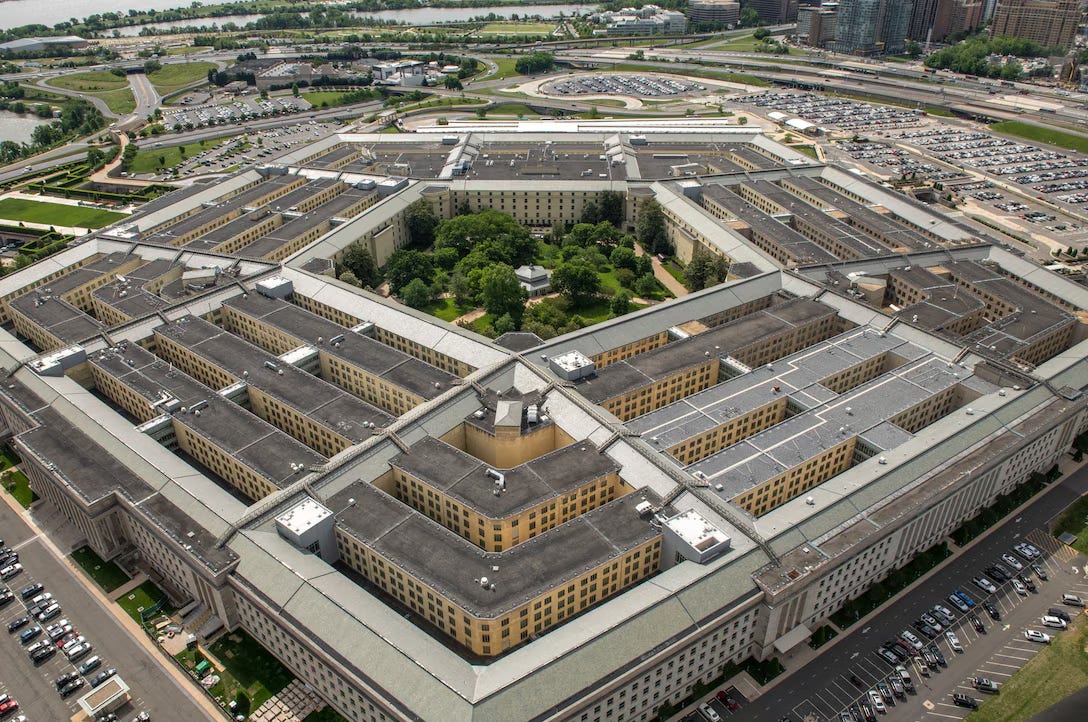
Walking through the halls of the Pentagon can be both awe-inspiring and unsettling. Not just for its scale—a five-story structure with five concentric rings stretching nearly 18 miles—but for its formality. On the outermost “E-Ring,” where the highest civilian and military leaders reside, the walls are lined with oil portraits of secretaries past, flags from allies, military campaign streamers, preserved uniforms, and glass-encased artifacts from earlier wars. The offices of the military services feel less like workplaces than curated museums of discipline and sacrifice.
The building’s weight is more than ceremonial. It reflects the military’s unbroken presence in American life—at every inflection point, in every crisis, shaping how power is exercised and remembered. Its aura comes not from myth but from history: wars won and lost, trust earned and broken, decisions that defined eras. That institutional memory imposes a kind of gravitational pull—on policy, behavior, and leadership.
The danger for any new secretary is to mistake that aura for a mirror. The office bestows authority—but only to those who understand its weight. The successful ones—Dick Cheney, Robert Gates, James Mattis— faced criticism and pursued contested policies, but they respected the institution’s scale, worked within its rhythms, and gained credibility through restraint. Each arrived fluent in military affairs and the workings of government itself.
Pete Hegseth brought none of that. He is an ideologue with no institutional feel, no support from within, and none of the experience that once served as a minimum qualification. The result is no longer theoretical. This is a train wreck happening in real time.
In his first six months as secretary of defense, Hegseth has not led the Pentagon so much as destabilized it. The building, which thrives on clarity of command and procedural discipline, has instead become defined by purges, factional infighting, and erratic crisis management. This turmoil has radiated outward from his personal staff to the operational gears of the department itself.
That dysfunction was on display again this past week. Justin Fulcher, a senior adviser with ties to Elon Musk’s Department of Government Efficiency (DOGE), resigned on Saturday after a short but emblematic tenure. Elevated despite limited defense credentials, Fulcher quickly became a lightning rod: clashing with DOGE-aligned colleagues, accusing Pentagon security of tracking his movements, and proposing surveillance tools to identify internal leakers. Weeks before his resignation, his desk was quietly removed from the secretary’s suite—a move officially labeled “temporary.”
This episode wasn’t an outlier. At least five other senior officials, including Hegseth’s initial chief of staff, have been sidelined since February under vague accusations of disloyalty or insubordination. The result is a vacuum: leadership posts unfilled, coordination stalled, and decision-making fractured. Hegseth has yet to name a permanent chief of staff. Multiple directorates remain vacant or under acting leadership. Rival factions—movement conservatives and DOGE technocrats—are said to be waging bureaucratic trench warfare through surveillance, attempted firings, and anonymous leaks.
This front-office dysfunction has bled into strategic and operational decisions with global consequences. It surfaced most vividly in March, during the now-infamous “SignalGate” debacle, when Hegseth and top aides debated potential airstrikes in Yemen over an unsecured group chat—and accidentally included a journalist. When the breach came to light, Hegseth dismissed concerns and lashed out at the press, signaling that procedural norms no longer applied.
In June, following Operation Midnight Hammer—the U.S. airstrike campaign on Iran’s nuclear infrastructure—Hegseth used the Pentagon’s first public briefing as a personal platform. He delivered a 30-minute tirade against the press for reporting a preliminary Defense Intelligence Agency assessment that the strikes had delayed but not dismantled Iran’s program. Rather than address the intelligence, he accused internal leakers of “muddying the waters” and the press of hating the military. Standing beside him, Joint Chiefs Chairman Gen. Dan Caine offered a restrained, professional account of the operation, deferring questions of damage estimates to the intelligence community.
The dysfunction has not remained confined to the Secretary’s front office. It has echoed outward, distorting strategic and operational choices that demand institutional discipline. Most visibly, the confusion has disrupted decisions on U.S. arms transfers to Ukraine and strained the AUKUS defense pact with Australia. In July, a scheduled shipment of long-range artillery to Kyiv—publicly deemed critical by Ukrainian officials—was abruptly delayed without interagency coordination or allied notification. Press reports traced the disruption to disarray inside Hegseth’s senior staff. The shipment resumed only after direct intervention by President Donald Trump, underscoring the extent to which the Pentagon’s internal chain of command had broken. Around the same time, the Pentagon initiated a unilateral review of the AUKUS agreement without consulting the State Department, National Security Council, or Australian counterparts—prompting Canberra to pause joint planning and voice private concerns over U.S. reliability.
The defining feature of Hegseth’s leadership these past months has been performative crisis management built on distrust and grievance. What once would have been viewed as a one-off managerial collapse now increasingly resembles a governing model.
Hegseth has been lucky, so far. The crises on his watch, though dramatic on camera, have been structurally forgiving. The June bombing of Iranian nuclear facilities occurred only after Israel had cleared the airspace and neutralized key defenses. The short-lived air strikes on Houthi targets this past spring required no forward deployment, no joint command, no real-time adaptation. Both operations relied on overwhelming U.S. advantage and fixed targets. They succeeded not because of Hegseth’s leadership, but despite it.
The next challenge might emerge in Kaliningrad, Moldova, or the Taiwan Strait—scenarios where decisions compress to minutes, where interagency coordination must be seamless, trust of allies is certain, and where early missteps cannot be offset by airpower alone. These are environments where spectacle offers no advantage, and where the Pentagon cannot function as a stage for loyalty tests and factional surveillance.
Hegseth’s unraveling tenure is not an aberration. Across the national security apparatus, the same erosion of competence and institutional continuity is underway. The federal response to the Texas floods offered a domestic preview: FEMA stumbled, DHS leadership faltered, and preventable deaths followed—not from lack of resources, but from failed command.
So far, the costs are absorbed elsewhere. Ukrainians adjust. Iranian scientists recalibrate. Allies grow wary. But no adversary has yet imposed a test that demands simultaneous decisions under pressure, with consequences that cannot be deflected. When that moment comes, the loss of discipline, trust, and institutional leadership will not be theoretical. It will define the crisis.
Trump might see chaos as a feature—useful for deflecting blame, disrupting scrutiny, and keeping rivals off balance. But chaos is not a strategy. It is a liability masquerading as control. And eventually, it gets tested.
Brian O’Neill, a retired senior executive from the CIA and National Counterterrorism Center, is an instructor on strategic intelligence at Georgia Tech. His Safehouse Briefing Substack looks at what’s ahead in global security, geopolitics, and national strategy.

A train wreck in real time. I could not have said it better!
The writing is very good. Pete Hesgeth is deranged.