

By Stacey Abrams and Genny Castillo
As America draws closer to its 250th anniversary, democracy has never been more necessary or more at risk. For communities of color in the South and across the nation, the distance between democracy and delivery has rarely been as wide. As we celebrate a major milestone in our nation’s history, the South stands as a harbinger of what’s to come for other regions across the nation if we don’t act now. Yet, if we pay attention, the South can be a shining example of how to fight to save our democracy.
Authoritarianism is about taking power, hoarding power and refusing accountability for the consequences. After decades of hard-won progress, the South again is bearing witness to leaders determined to undermine our nation’s foundational ideals. But what happens in the South never stays in the South.
Most American families face the rising cost of gas and groceries as they spend more and more of their income on daily essentials. Healthcare has been stripped from millions, and affordable housing is a mirage for millions. In our system of government, though, redress ideally comes from electing officials who understand the complexity of the problems and are committed to providing relief. However, in the South, help is not at hand. Instead, Republican legislators and governors are eagerly at work to permanently silence the voices of Black and brown voters, those disproportionately harmed by the economic challenges caused by tariffs, benefit cuts, and income inequality.
For decades, the states that fall below the Mason-Dixon Line have struggled with poverty, poor healthcare outcomes, low educational attainment, and more. This is a direct result of systemic underinvestment in the diverse communities across the region, a soft authoritarianism that has been practiced since the dawn of the republic. Black and brown Southerners have been in practice as well — harnessing community innovation to defeat oppression. From the civil rights movement to the fight for environmental justice to today’s demands for social progress, the communities left behind by the Trump administration and the Republican regime know the way forward. It begins with recognizing what we’ve faced and understanding how we’ve defeated attacks on democracy before.
For centuries, the South has been a testing ground for conservatives pushing people of color to the outer bounds of democratic engagement — using policy as a vehicle to limit opportunity for millions of Americans. During the Jim Crow era, local and state political leaders engaged in veiled suppression through “race neutrality” and, under the guise of “states’ rights” and other euphemisms, implemented poll taxes, literacy tests, and more to deny Black people the fullness of their American citizenship.
In recent years, Southern states were among the first to pass legislation designed to ban diversity, equity, and inclusion (DEI) and prohibit our children from learning the full history of America. Voting rights and DEI are central pillars of a pluralism that has sustained America’s complex web of race, ethnicity, religion and other differences. The right understands this, and with the ammunition wielded by the Trump administration, they have attacked these key pathways to opportunity, including the signing of an executive order banning DEI in the federal government and removing Smithsonian Institution museum exhibits that don’t adhere to the administration’s myopic view of American history.
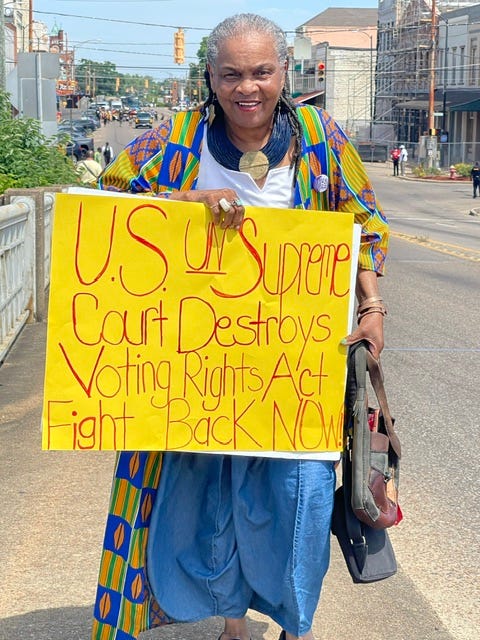
In the aftermath of the Supreme Court’s decision to decimate the Voting Rights Act in Louisiana v. Callais and then in the redux of Allen v. Milligan, we see state legislators across the South again working furiously to impose discriminatory maps that dilute the voices of millions of voters to thwart the political participation of Black and Brown voters.
But all is not lost. Throughout history, movements anchored in the South have led to major changes in our nation that benefited all Americans. The Montgomery Bus Boycott started as a local action but galvanized the nation, ultimately leading to the passage of landmark legislation such as the Civil Rights Act of 1964 and the Voting Rights Act of 1965.
The environmental justice movement was born in Warren County, North Carolina, when residents of the county came together to protest the spraying of toxic oil on rural county roads. That six-week protest is the foundation of a decades-long movement to ensure that marginalized communities across the country are not subjected to hazardous waste and pollution.
The gunning down of Ahmad Arbery in Glynn County, Georgia, helped drive the racial justice reckoning that swept the country in 2020.
Now we are witnessing a new generation of activism responding to the injustices of today.
Impacted communities across the South are refusing to stand idly by while their rights are stolen from them. This groundswell of energy is rooted in the legacy of Southern-based movements that started in the South but led to nationwide change.
A broad coalition of organizations from states including Alabama, Mississippi, and Tennessee have come together to educate and mobilize communities on the impacts of partisan gerrymandering on Black and Brown voters.
Communities in South Carolina and Georgia are speaking out against the proliferation of data centers in underinvested communities. These centers are driving up utility bills for residents and draining thousands of gallons of water daily. The individuals speaking out are demanding that tech companies provide greater transparency by ensuring local residents benefit from the use of resources.
College students in Texas and other Southern states are standing together in solidarity to speak out against attacks on DEI and academic freedom that have led to student groups being defunded and courses being audited, censored and canceled.
Organizations like the Southern Economic Advancement Project (SEAP) are building momentum with Southern leaders and grassroots organizations fighting to advance progressive policies in their communities that build a strong social safety net, create economic opportunity, and bring historically overlooked constituents into policy conversations. Through the 10 Steps Campaign — a nationwide civic education and mobilization effort to help Americans recognize authoritarian tactics and take concrete action to resist them and rebuild democratic power — SEAP is also deeply embedded in the national coalition confronting authoritarianism.
These actions are rooted in the South but are part of a nationwide movement to protect our nation’s democracy from the authoritarian actions of the Trump administration and its conservative acolytes. By honoring the founding principles of equality and liberty, diverse communities across the South and beyond are pushing our leaders to live up to America’s highest ideals.
As we look ahead to the next 250 years of America’s story, we must look to the South for lessons on how people come together despite their differences to fight against those who wish to limit the fullness of our democracy to a select few.
The South’s history shows us what it means to work to expand democracy for all, and fight for a nation that truly embodies the values of liberty and justice for all.
Stacey Abrams and Genny Castillo is executive director of the Southern Economic Advancement Project.
How do African Communities in The South not despair? How do they look at America and our politics and have hope that things will get better?
It is good to learn of those people and organizations fighting back in positive ways to continue and expand the democracy we used to take for granted.