


Few observers expected Defense Secretary Pete Hegseth’s congressional testimony this week to reveal much. By now, the pattern is familiar. Trump officials do not arrive on Capitol Hill to illuminate policy or answer questions. They go to Capitol Hill to insult and deflect.
Hegseth did not disappoint. He borrowed from the Pam Bondi school of counterattack and the Kristi Noem school of deflection: deny the premise, accuse Democrats of staging “gotcha” questions, and treat demands for basic facts as if they were incoming enemy fire. The result was less testimony than performance, aimed not at Congress so much as at the one viewer whose approval still matters most.
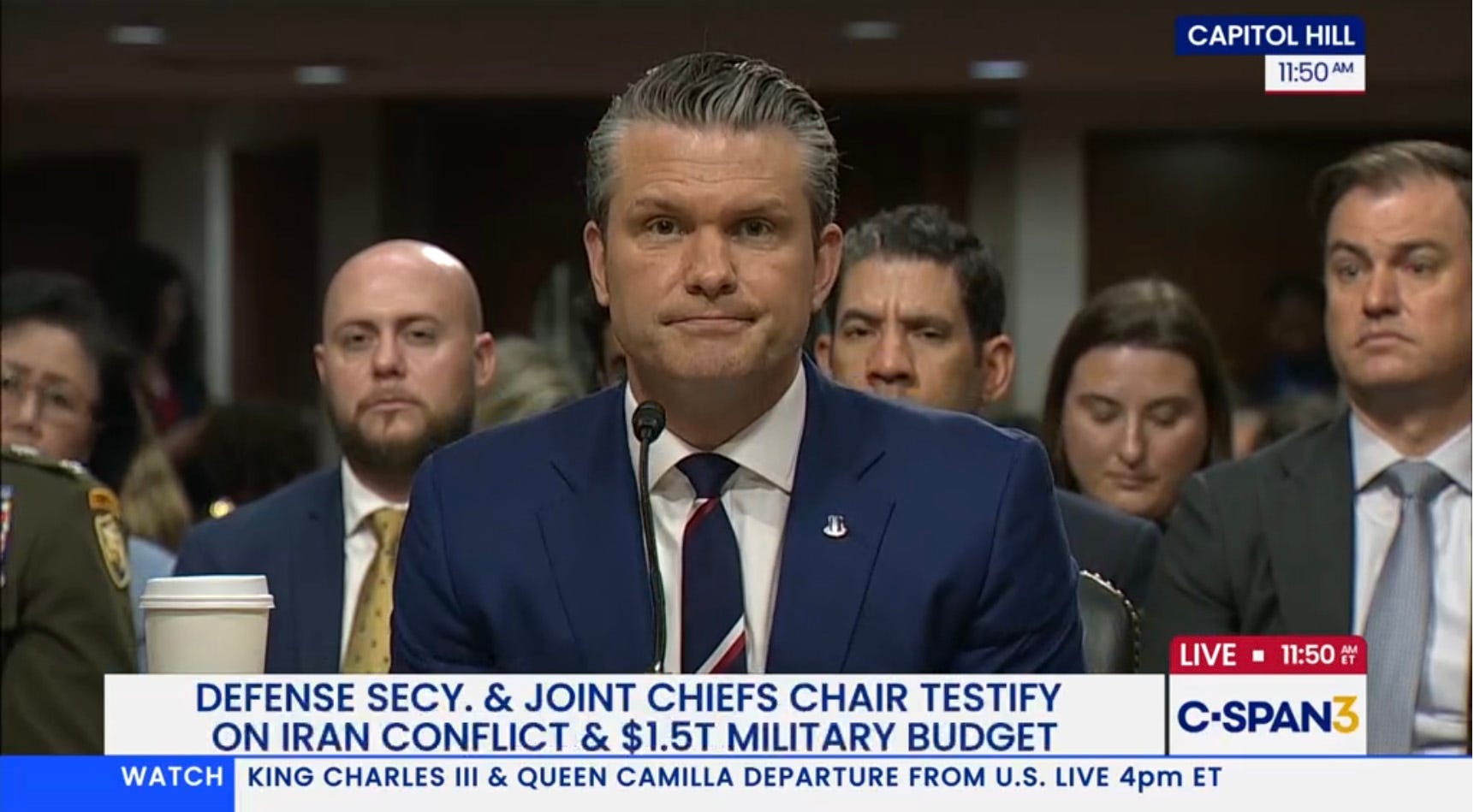
There were headline moments. The Pentagon’s acting comptroller placed the cost of the Iran war at roughly $25 billion, before accounting for the wider economic and readiness consequences that rarely fit neatly into first estimates.
For his part, Hegseth relied on a familiar Trump-era maneuver: When pressed for answers, change the clock.
He argued that criticism of the war after only a few weeks was unfair: Vietnam lasted years. Judgment should wait.
He also claimed that the War Powers clock had paused because of the ceasefire with Iran, meaning the administration did not yet need to seek congressional authorization to continue the conflict.
That is where the testimony became more than deflection. It revealed the administration’s new argument: give the war more time.
When the Trump administration struck Iran’s nuclear facilities last June, the message was direct: decisive action, immediate results, no ambiguity. Iran’s nuclear program, the president said, had been “completely and totally obliterated.” The model was clear. Modern war, done right, would be fast, controlled, and conclusive. Hegseth’s testimony this week marked a retreat from that standard.
A conflict sold as immediate and decisive is now being defended as unfinished and unresolved.
But the problem is not only the shifting standard. It is also the history Hegseth—and Trump—used to defend it.
Vietnam is not the right analogy — not because it lasted 18 years, but because it belongs to a different category. The same is true of Korea and World War II. In those cases, the United States entered conflicts already underway and framed its involvement around defending an invaded country or resisting expansionist aggression.
That is not the structure here. The United States initiated this conflict directly against Iran while emphasizing speed, precision, and control. The expectation was not prolonged engagement. It was decisive effect. A war that begins with promises of rapid success is not granted the same latitude for open-ended duration.
The more relevant comparison would be Iraq or Afghanistan.
In both cases, the United States achieved rapid initial objectives. Regimes collapsed. Conventional forces were defeated. The early phase appeared decisive. What followed was something different: prolonged instability, asymmetric conflict, and shifting definitions of success. The war did not end. It changed form.
That is the risk emerging here.
Iran is not going to surrender in the way earlier analogies imply. There will be no clean ceremony, no collapse that resolves the conflict, no moment when Tehran simply accepts the American definition of victory. The question is not whether the United States can inflict damage. It is what follows once the conflict moves beyond its initial phase and how long the United States remains engaged after that transition.
This is where “forever wars” needs precision. It is not simply a long war, but a conflict in which objectives shift, endpoints blur, and continued involvement is justified less by defined success than by the perceived cost of disengagement. It persists not because victory is imminent but because leaving appears riskier than staying.
By that definition, the concern is not duration alone. It is trajectory.
The administration’s current posture points in that direction. Trump’s willingness to delay negotiations suggests a belief that pressure and patience may produce better conditions later. That is not irrational. Time can be a tool. It can preserve options, complicate an adversary’s calculations, and allow pressure to build.
But time can also become an exposure. In the current political environment, it does not absorb pressure. It accumulates it. Costs appear quickly in budgets and markets. Military actions are visible in real time. Public tolerance is shaped over months, not years.
The administration is no longer operating in the opening phase of the conflict, where decisive action can define success. It is moving into a phase where success must be explained, sustained, and justified under conditions of uncertainty.
So far, that argument has not been made. The standard has shifted instead. Success is no longer immediate. Outcomes will become clearer later.
That shift may be necessary. Wars rarely unfold as planned. But without a clear explanation of what additional time is meant to achieve, the adjustment risks looking less like adaptation than drift.
The delay is not limited to strategy. Hegseth at both hearings declined to say when the Pentagon would release findings from its investigation into a Tomahawk missile strike on an Iranian elementary school at the beginning of the war. “Give it time” is also becoming the administration’s answer to civilian harm.
The political implications follow. Lawmakers who supported the initial strikes are now being asked to sustain the effort — to fund continued operations, explain rising costs, and defend a strategy that has not been clearly articulated. That is a more difficult position, particularly when the conflict was not presented as open-ended at the outset.
The phrase “no more forever wars” reflects a hard-earned public expectation. Americans are less willing to accept conflicts without clear endpoints, especially when those conflicts are initiated by choice and sold as quick, decisive uses of overwhelming force.
That expectation applies here.
The administration framed the Iran strike as decisive. It is now managing a conflict that looks less so. The gap between those two realities is where strategy should be clarified.
“It’s only been a few weeks” is an argument about time. It is not yet an argument about purpose.
At some point, the distinction will matter. The administration may not like it and may not accept it. But that moment for most Americans may be now.
Brian O’Neill, a retired senior executive from the CIA and National Counterterrorism Center, is an instructor on strategic intelligence at Georgia Tech. His Safehouse Briefing Substack looks at what’s ahead in global security, geopolitics, and national strategy.

But what was the point of starting this illegal war in the first place? That's never been satisfactorily explained. There have been vague, shifting, unconvincing half-justifications and belligerence. Congress has been missing in action and the Republicans controlling both houses seem to like it that way. Starting a war so Trump can look tough and Hegseth can exercise his bloodlust isn't good enough, sorry.
It doesn't really make sense to ponder the strategy of continuing to conduct a war that is unnecessary, stupid and started without a strategy to begin with.
I've been watching "Queer Eye" quite a bit lately. Dear Tan, please come back and just to do something about Hegseth's suits. Dear Jonathan, his face. Dear Bobby, his glass house. Dear Antoni, his distasteful rhetoric. And Dear Karamo ... everything else.