

By Megan Armstrong
The United States men’s national team was getting its collective teeth kicked in by Belgium, and I didn’t care. The U.S men always lose in the Round of 16. Fine. We’ll watch the women win it all next summer. I was more interested in the Belgians’ jerseys. Why was the team colloquially and famously known as the Red Devils fitted in pink and robin’s egg blue? I found the answer to be René Magritte, the late Belgian surrealist, and with Magritte, I found the lens with which to make sense of the 2026 FIFA men’s World Cup.
Belgium’s jersey, in partnership with Adidas, was designed as an homage to Magritte. “This is not a jersey” was written inside the collar. His 1929 painting “The Treachery of Images” was a painting of a pipe with “Ceci n’est pas une pipe” inscribed beneath it, which translates to, “This is not a pipe.”
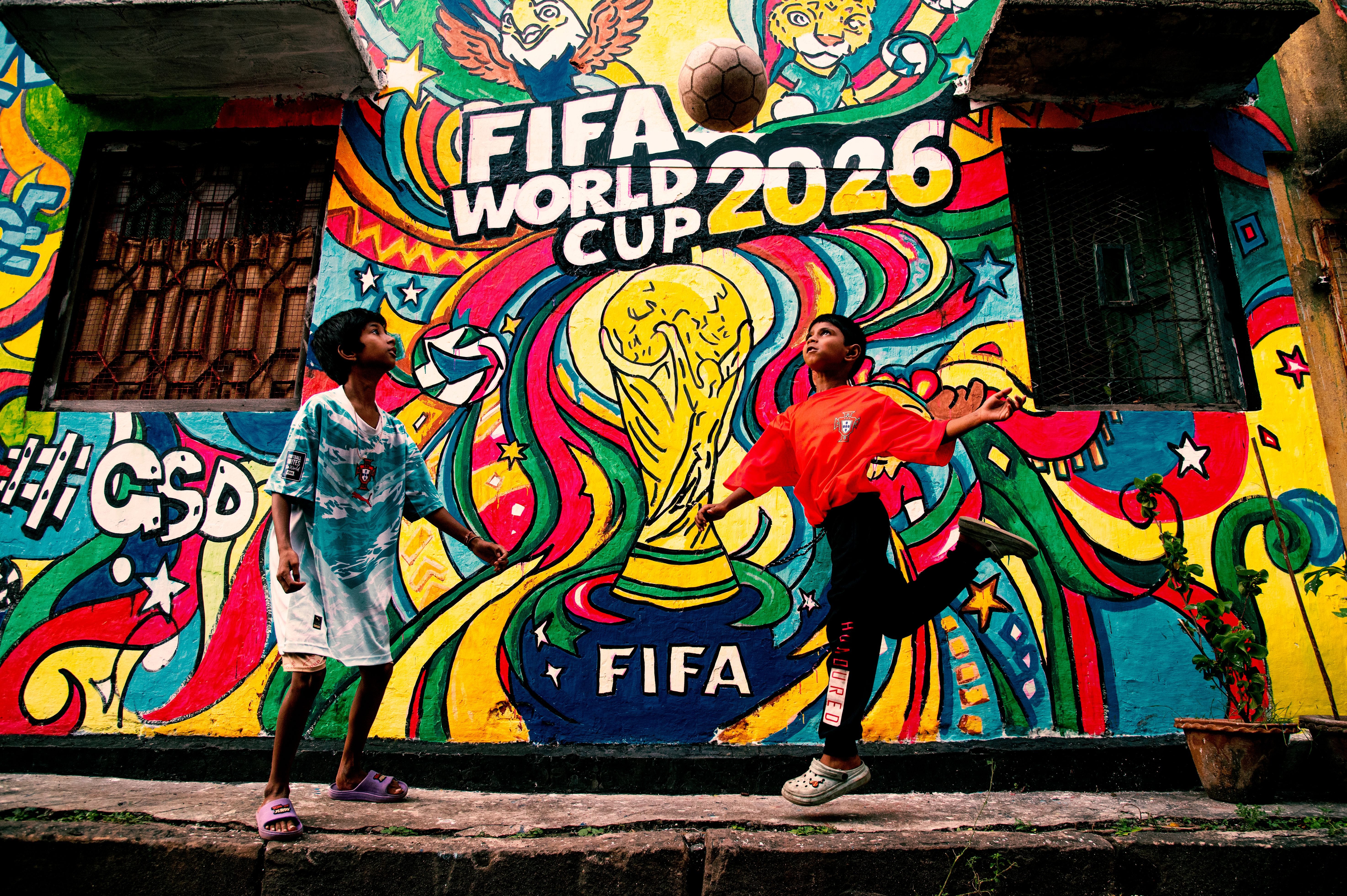
For six weeks, this World Cup was a surrealist mural — some images beautiful, some images ugly, some distorted and difficult to discern — and, at times, the only appropriate description was, “This is not a World Cup.” When the intense despair — and cruel disparity — of our times inevitably bled into the world’s definitive tournament, it felt more like a carnival of culture wars than a World Cup.
“The World Cup, historically, is brutal and unforgiving,” Oliver Kay of The Athletic wrote of how unusual it is that the world’s biggest stars also headlined this World Cup.
France captain Kylian Mbappé became the first man to win two Golden Boots — 10 goals, four assists — but he needed a brace in a wild third-place match loss to England to supersede Lionel Messi’s eight goals and four assists. Messi, 39, and Cristiano Ronaldo, 41, became the first men to appear in six World Cups, with Messi cementing his GOAT status. Erling Haaland, in his World Cup debut, led Norway on a historical run to the quarterfinal with seven goals. Jude Bellingham set England’s all-time World Cup goals record (7), and Three Lions captain Harry Kane was right behind him with six.
On the pitch, the beautiful game was kind to those stars and several more household names, but the World Cup was still brutal and unforgiving in that players and teams became avatars for agendas and, in some cases, targets of abuse by people who had zero genuine investment in the sport or World Cup.
After France beat Paraguay in the Round of 16, Paraguayan senator Celeste Amarilla attacked Mbappé with racially charged insults about his character. Mbappé fired back by calling Amarilla “a despicable woman” who is “unworthy of your position” and denounced her, in part, for “recklessness and brazen racism” that unfairly stained how Paraguay represented itself at the World Cup. “I will never allow people like her the freedom to spread their hatred and racism across the world,” he wrote. (Amarilla later retracted her statement, deleted the post, and claimed she’d been hacked.)
The U.S. men’s national team, especially breakout star striker Folarin Balogun, had won over the nation, but then U.S. President Donald Trump admittedly called FIFA President Gianni Infantino to “ask for a review” of Balogun’s red card and suspension. In an unprecedented move, FIFA suspended Balogun’s red card, which allowed him to play in the loss to Belgium in the Round of 16. Last week, Balogun disclosed that the controversy and ensuing “outside noise” impacted the team negatively.
Bellingham and Haaland, former Borussia Dortmund teammates, captured the zeitgeist, both as excellent, wholesome individuals and for what the BBC designated as “football’s best bromance,” but even they weren’t totally safe. Haaland did not ask to become MAGA’s posterboy, based solely on his blond hair and white skin, but they projected on him anyway. (They must have been gutted to find his old tweet condemning racism and discrimination.) Bellingham, meanwhile, faced racist coverage from British media and fans before the World Cup.
The list goes on and on — from Harry Kane disclosing a past golf outing with Trump to the U.S. Department of Homeland Security Secretary Markwayne Mullin kicking his feet with glee once Iran exited, the U.S. government denying visas for journalists. federation members, and referees from African countries and Iran, the corrupt relationship between Infantino and Trump, and the most expensive tickets in World Cup history freezing out everyday people.
At the same time, the best of humanity was on full display in the everyday fans flooding cities across Canada, Mexico, and the U.S., in the meshing of cultures, even in the clashing of rooting interests.
“There’s so little that human beings can pay attention to together that is even moderately positive, and I don’t want to minimize the corruption of FIFA, which is horrific,” bestselling author John Green said on “Pablo Torre Finds Out” in late June. “This is all inseparable. You can’t have that corruption unless you have this incredibly powerful thing. Most people on this Earth are, at some point, going to pay attention to this World Cup, and that’s not true for any other thing.”
“FIFA doesn’t own the World Cup; we do,” Daniel Alarcón added. “They might own the branding, they make all the money, and they might have successfully weaponized our love of the game against us, but [...] it means something that FIFA can’t touch.”
It all came to a head when Argentina met Spain in the World Cup final in East Rutherford, New Jersey, on Sunday. The matchup was a football purist’s dream: Could the mythical magic of Messi power Argentina past Spain, the best all-around team? Can you believe those photos of 20-year-old Messi with 5-month-old Lamine Yamal from 2007? Would Argentina become the first repeat men’s World Cup champion since Pelé’s Brazil in 1958 and 1962, or would Spain’s defense prove the best in World Cup history?
If only it ended there.
“Political leaders don’t represent their people,” acclaimed Spanish actor Javier Bardem said during Zeteo’s livestream after his beloved La Roja defeated Argentina in extra time to win Spain’s first men’s World Cup since 2010. “It has brought this extra weight to the match that I don’t think belongs to the match, but of course, it’s in the ambience. I don’t think it’s fair because there are many people from Argentina that really don’t support [President Javier] Milei, as many people in the States do not support Trump.”
Messi’s presence distracted from the Argentina national team’s questionable track record, and Spain — winning as a collective machine and through suffocating competence rather than housing one goalscoring maniac — flew relatively under the radar all summer.
But then Argentine players waved a banner about the sovereignty of the Falkland Islands after ousting England in the semifinal, which the White House World Cup task force defended. That sparked questions over whether Yamal would be afforded the same freedoms if he waved the Palestinian flag, as he’s done in the past. Tensions ratcheted when Benjamin Netanyahu, Israel’s Prime Minister, came out in full-throated support of Argentina. The political and social implications were unavoidable, but they weren’t the whole story.
“There’s that great line in ‘Ulysses,’ where someone asks Bloom what a nation is, and he says, ‘A nation is the same people in the same place,’ and then he pauses and says, ‘Or in other places,’” Green said. “And how do you understand yourself as part of the same people if you’re in other places? I think football is one of those ways.”
When it was all over, Spain captain Rodri patiently waited for Trump to waddle off the stage before hoisting the trophy. Then, Infantino tried to drag Trump away, to no avail. Eventually, Rodri got tired of waiting, turned toward his teammates, and celebrated despite Trump lingering on the edge. It was a fitting final image of the World Cup, especially after the Spanish men’s national team photoshopped Trump out entirely.
And maybe that is the World Cup: a lesson that we cannot wait for the darkness to leave before harnessing the light for ourselves; we cannot let what belongs in the periphery ruin the whole canvas.
Megan Armstrong is a freelance journalist, podcast producer, and perpetual content consumer. Her work has appeared in Billboard, Boardroom, Esquire, GQ, GRAMMY.com, NYLON, Teen Vogue, The Kansas City Star, The Hollywood Reporter, UPROXX, and elsewhere.
Great article! Thank you.