


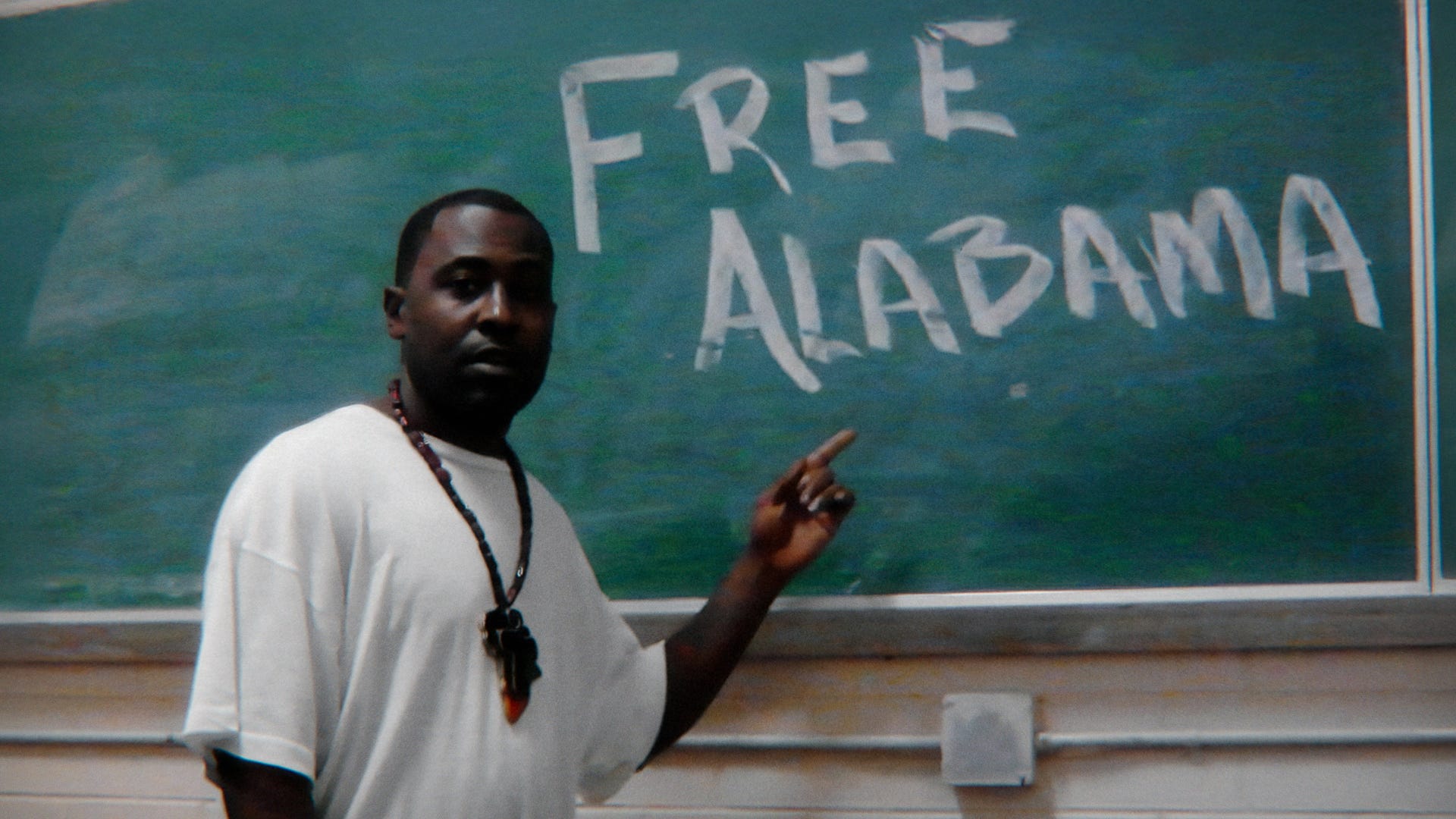
When Andrew Jarecki starts making a documentary, he rarely knows where the film is going to take him — or even whether he’s making a documentary at all.
But the director has a bloodhound-like ability to sniff out a good story, and a willingness to follow up a hunch with a tremendous amount of legwork, as evidenced by documentaries like Capturing the Friedmans, about a father and son accused of child molestation, and The Jinx, which helped lead to Robert Durst’s conviction for murder, both of which feature jaw-dropping twists and revelations.
The same can be said of his latest documentary, The Alabama Solution, which is nominated for an Academy Award.
Using video footage filmed by incarcerated men on contraband cell phones over many years, the documentary paints a harrowing portrait of life inside Alabama’s prisons, which are among the deadliest in the United States, with the highest murder, overdose, and suicide rates in the country.
The journey to making the film began in 2019 when Jarecki, at the urging of his teenage daughter, read a memoir written by Anthony Ray Hinton, a wrongfully convicted man who spent 30 years on death row in Alabama.
Soon enough, Jarecki started making trips to the state to look into its notorious prisons, where conditions are so dire that in 2016 the Department of Justice opened an investigation into whether constitutional rights were being violated.
Although members of the media are generally prohibited from prisons in the state, a warden invited Jarecki and co-director, Charlotte Kaufman, to film a revival at Easterling Correctional Center in Barbour County. They figured that documenting an event on the prison grounds, however carefully curated it might have been, was better than nothing.
Numerous incarcerated men approached them off-camera and urged them to dig deeper into what was really going on inside the system. They shared horrific stories about fellow prisoners being held in solitary confinement for years and others brutally getting beaten by guards.
“Once we started to understand that, we thought, ‘We have to make a film about this,’” Jarecki recalled in a phone interview with The Contrarian this week.
In order to make that happen, they relied heavily on footage recorded by a group of incarcerated activists: Melvin Ray, Robert Earl Council (who goes by Kinetic Justice), and Raoul Poole. Using phones obtained on the prison black market, they document nightmarish images: floors soaked with blood; drug-addicted men passed out on the toilet and left unattended; rat-infested cells. They face extraordinary repercussions for their efforts to bring these conditions to light, especially Council, who is nearly killed by guards, loses sight in one eye, and spends years in solitary confinement.
These men also tip Jarecki and Kaufman off to the killing of Steven Davis, who was beaten to death by correctional officers in 2019, in what the state has claimed was a justified act of self defense (an account that is contradicted by numerous other witnesses). He is one of more than a thousand people who have died in Alabama prisons since the DOJ investigation was launched in 2016.
The Alabama Solution exposes a system of almost unimaginable cruelty that is largely motivated by profit. According to statistics cited in the film, incarcerated workers produce more than $450 million a year in goods and unpaid services for the state of Alabama.
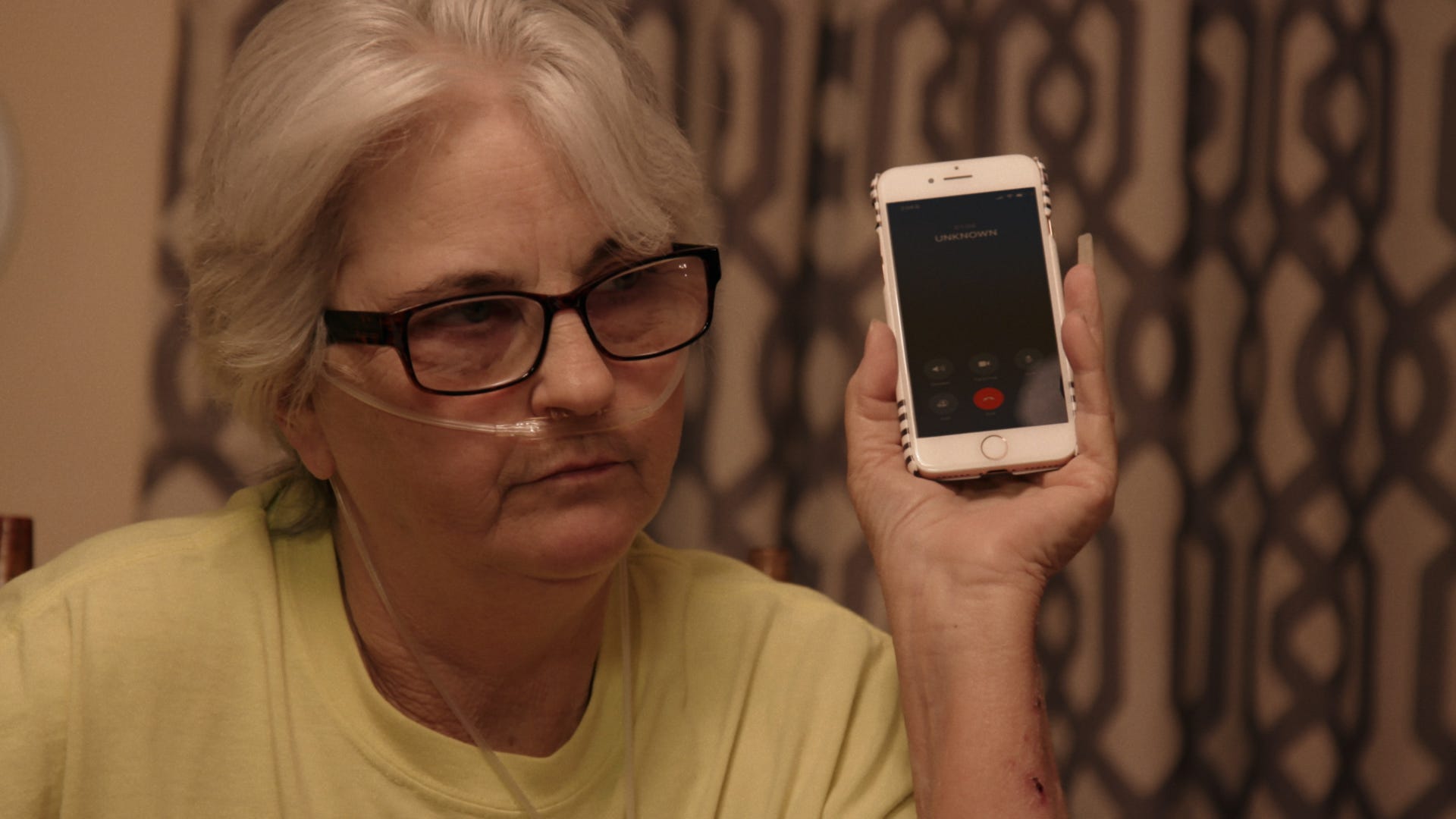
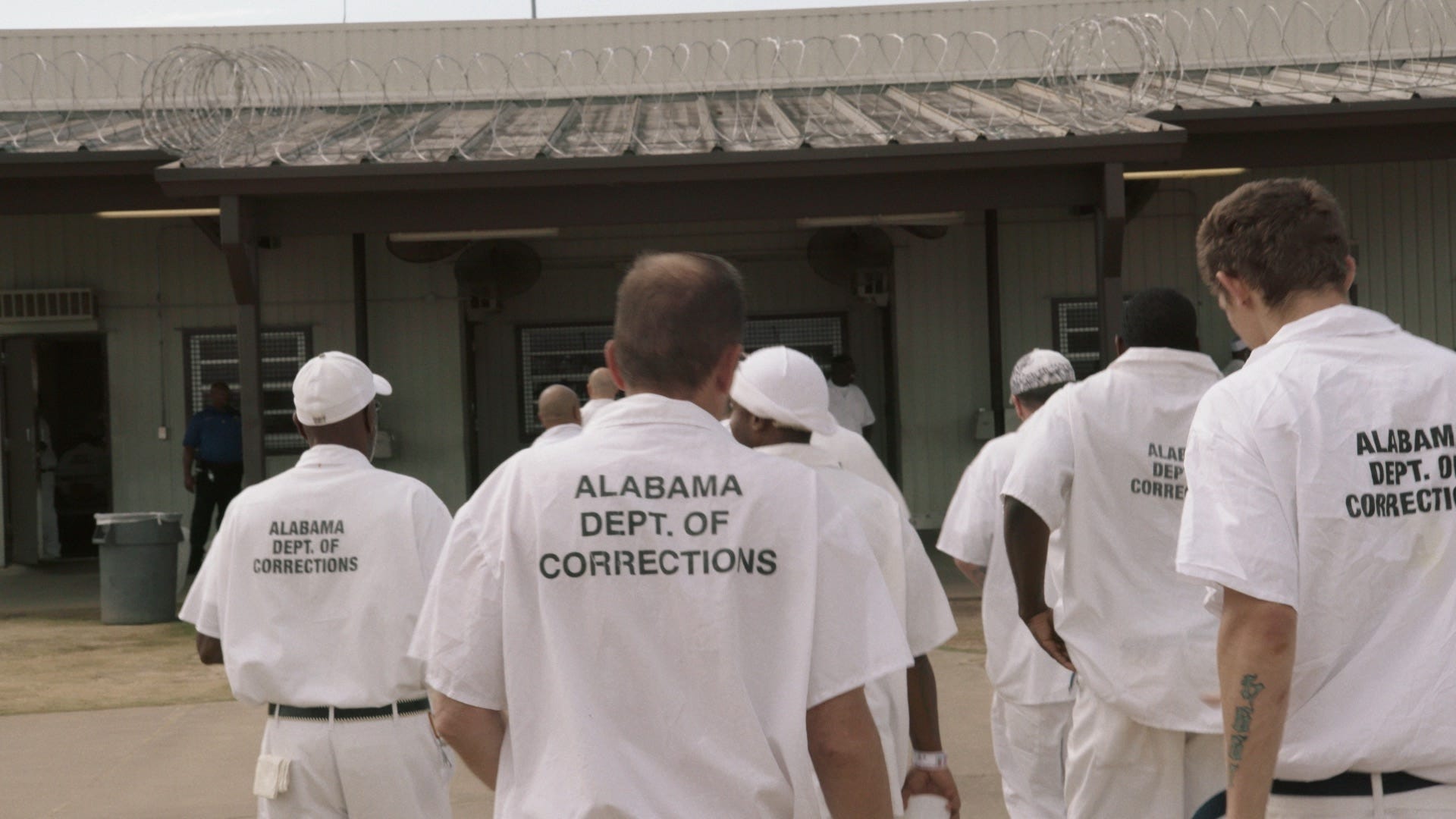
The men featured not only work in prisons, they are also loaned out to private companies, including fast food restaurants and government agencies (incarcerated men tend the grounds at the mansion where Governor Kay Ivey resides), despite the fact that many have also been deemed too dangerous to be granted parole.
This ultimately leads Council and his fellow activists to organize a weeks-long work stoppage in 2022.
“The state of Alabama continues to thrive on the bodies of Black, Brown and poor white people,” Council says in the film. “The institution of slavery is real. You can change the name of it but the undergirdings of it are the same: exploitation.”
Premiering on HBO in October, The Alabama Solution has helped bring attention to the activists trying to improve conditions in the state’s prisons — and in facilities across the country — a fight that is ongoing. In late January, Council, Ray, and Poole were moved to solitary confinement by Alabama officials after they called for a work stoppage.
Ahead of the Academy Awards on March 15, I talked to Jarecki about this urgent, alarming film. The following interview has been edited and condensed for clarity.
Tell me about how you were able to get this video while keeping these prisoners safe?
They’re very, very strong humans. It was clear when we started talking to [Robert Earl Council] that it was part of his mission to get this material out. He’s never been afraid to speak out. Amazingly enough, when we first got in touch with him, he was just coming out of solitary. He had been in solitary, at that point, for the better part of five years. When he spoke to Charlotte [Kaufman], my co-director, he was immediately engaged and wanted to participate. We were worried that he would not be ready to keep speaking about it. Most people wouldn’t. It’s an incredible level of commitment and bravery.
The cell phone video was a practical solution for you as filmmakers who couldn’t get inside the prisons. But creatively, it also allows these men to tell their own story.
That line from Melvin [Ray] early on is so powerful. [During a video call], Charlotte asks, “Would a regular phone call be better?” And he says, “No, we want to be able to show our whole selves, not just our voices.” He’s onto something, of course, which is that prisoners, in general, are so dehumanized by the system. The less you know about somebody who’s incarcerated, the easier it is to accept the conditions of their incarceration.
When people see this film, sometimes they’ll awkwardly say, “It’s the first time I’ve ever [heard from] somebody in prison.” They have no contact with anyone who’s incarcerated, because that’s hard-wired into the system. These people don’t have their First Amendment rights. They’re not allowed to speak, which means they’re not allowed to be seen as humans, so it’s much easier for us to accept treating them in inhumane ways.
That’s why the Constitution talks about cruel and unusual punishment. Theoretically, that’s the minimum level you’re supposed to observe when you’re taking responsibility for somebody else’s life. But it’s easy to ignore even that if you’re told that the people inside are just this sort of monolithic evil.
Attorney General Steve Marshall says in the film, “I think there are evil people in this world, people that have no regard for human life,” This is a person who is overseeing death camps. He doesn’t see the irony in that at all, because he’s just so willfully blind to it. There’s comfort with a level of cruelty. It’s also politically expedient for people to say that they’re keeping the horde of horrible, dangerous people at bay, and therefore we should be thankful, even if they do it without any regard for human rights.
To what extent is this driven by greed?
Certainly, it’s a huge part of it. It’s such a valuable system. To have $450 million a year in unpaid labor is something that people will jealously protect.
Can you say more about who’s making the money?
It’s pretty diffuse. One of the reasons why it works the way it does is because everybody gets some benefit from it. It’s not that there’s one evil boss at the top of the whole thing.
To go a little wider than the free labor, the drug trade [inside prison] is a source of a tremendous amount of the employees’ compensation. They were getting $36,000 - $38,000 a year as corrections officers when we [started making the film]. I talked to corrections officers who said, “Without the drugs, I’m making half as much money. Without the [contraband] cell phones, I’m making half as much money.” It’s not a minor driver. It’s such a big part of the survival of the people involved, who are living in an impoverished community and don’t have a lot of opportunities for jobs.
These people are making money because the system is allowed to be filled with drugs. It’s reasonable to say that the Department of Corrections is the largest law enforcement agency in the state of Alabama, and it’s also the largest drug dealing operation.
You’ve got wardens who are making money. You’ve got captains making money. You’ve got rank and file officers making money. And the same goes for the cell phone trade and anything that’s contraband. Going all the way up the ladder, you have politicians getting reelected because they’re talking about how you have to be tough on crime.
Then when you get up to the next level, you see that there’s an enormous industry around the prisons. So if you’re McDonald’s, you’re benefiting. If you’re Burger King, if you’re Hyundai, if you’re the local Budweiser distributor, you’re using prison labor, and can benefit not only from getting advantageous pricing, but from the fact that [the workers] have no protections. They’re not unionized. You can work them whatever way you want.
And then you get into the whole issue of construction. Sometimes we call it the “Alabama Department of Construction,” because they don’t address their prison problem unless there’s an opportunity to line the pockets of contractors. [Governor] Kay Ivey was trying to build these new prisons. She said they were going to cost $900 million. That was a fantasy. The first one has now cost more than $1.3 billion, and it’s still not finished. It’s clearly just open season for the contractors to come in and start making money.
As of January, Melvin, Robert, and Raoul were in solitary confinement in what could be seen as retribution for their involvement in this project. Can you share any updates?
I don’t think they’re being punished for their involvement in the film, because the film was out for a year [after debuting at Sundance] before that happened. Remember, they have been retaliated against consistently for a long time, even before we met, and it’s almost always happening around labor. [State officials] obviously don’t like them being outspoken — no matter what. But in this particular case, their supporters had announced a new labor strike for the beginning of February, and [they were put in solitary confinement] in advance of that. My expectation is that Alabama just did not want another labor strike, because labor strikes are so effective. They’re so disruptive.
The film has been in some ways protective of the men, because I think Alabama doesn’t really want to have a lot of stories showing up in the press about retaliating against these me. People are paying attention to who they are. A lot of people who saw this film had gone to the website where we put out a call to action. There were thousands of people who wrote letters and called. And Melvin was actually released from solitary shortly after that. It’s always touch and go with them. But the opportunity for them to be able to speak out continues to be valuable to them, and to the people that they care about.
Your must-watch clip of the week
If anyone is looking for some inspiration today — and who isn’t? — I’d urge them to watch this interview with dissident Iranian filmmaker Jafar Panahi, who sat down with Jon Stewart on The Daily Show Monday to discuss his brilliant Oscar-nominated film, It Was Just An Accident, a darkly humorous look at a group of former political prisoners considering revenge on the man they suspect of being their tormentor. (You can now stream it on Hulu. And you really should!)
Stewart referred to Panahi (who has continued creating movies despite being banned and imprisoned by the regime) as “a real hero of mine.” In December, while in the U.S. promoting the film, Panahi was sentenced in absentia to a year in prison for “propaganda against the regime.” He has repeatedly said he plans to return to Iran when Oscar season is over, no matter what awaits him.
As he told Stewart Monday, “Everyone will find a way to show resistance, even in death. I too will find a way in my job to work and to resist, and I know that resistance will come with a price. I’m not doing anything extraordinary. What people are doing is much bigger than what I’m doing.”
According to The Daily Show, Panahi’s visit was already booked when the United States attacked Iran over the weekend, but the timing made this conversation — between two artists whose countries are currently at war — even more essential.
Meredith Blake is the culture columnist for The Contrarian