

Donald Trump inhabits his own world.
Unfortunately, it is the one we all inhabit. Given his power as President of the United States, he can disrupt the flow of our lives. Or certainly try to.
Therefore, imagine for a moment that you are president of a mid-size country in Eastern Europe (Volodymyr Zelensky’s Ukraine), bombarded nightly by an aggressive super-power (Vladimir Putin’s Russia), and at the same time beholden to the leader of a competing super-power (Trump’s USA). You would learn quickly that your freedom of action is severely limited. Trump demands unquestioned loyalty, even as he negotiates your country’s future with Putin, your proven enemy. Under former President Joe Biden, the working diplomatic formula was “No Negotiations About Ukraine Without Ukraine.” Now, the formula has been changed. U.S.-Russian negotiations about Ukraine no longer require Ukraine in the opening round. It is largely in Trump’s hands, and he obviously believes Zelensky cramps his style.
Thus, the big question that now looms over the negotiations: when Trump and Putin are finally finished, whenever that be, will Ukraine be free and independent, linked to the West, or a vassal state, subordinated to Moscow’s needs?
The answer rests uneasily with Trump, not so much with his strategy, which is uncertain and fumbling, but with his ego, which knows no limits and dominates the negotiations. Trump sits like a king atop a global throne, absolutely certain he knows what’s best for everyone, even though he entered the rushed Alaska summit with no plan, no strategy, no advance spade work by experts—relying instead on his presumed charm and intellect to gain Putin’s approval for a ceasefire, (which he never got), or “security guarantees,” which are yet to be clearly defined, or a bilateral or trilateral summit with Putin, Zelensky and Trump, which is yet to be arranged. Whether Putin will agree to negotiate with Zelensky, whom he considers illegitimate, is still an open question.
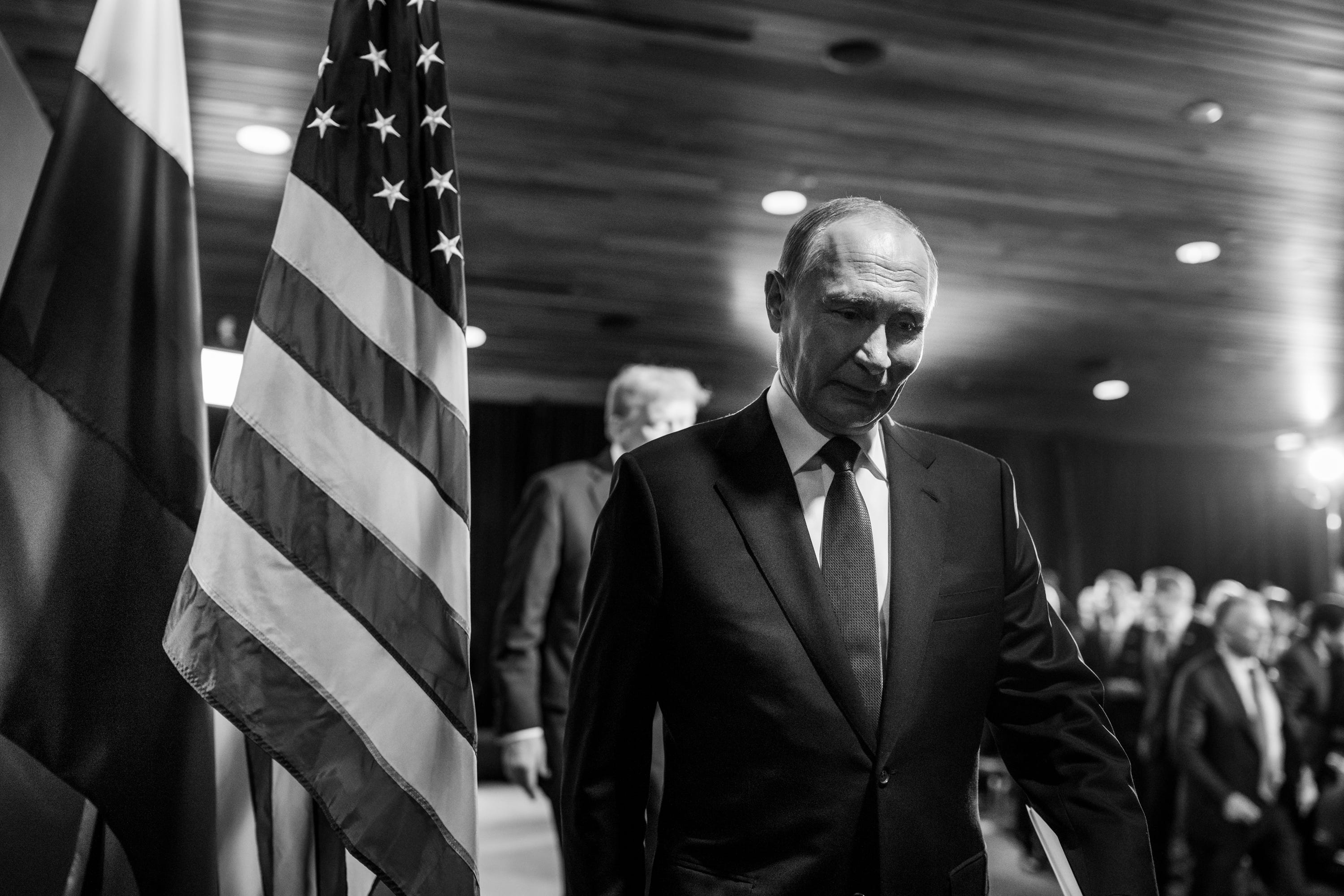
Days later, having inflated the diplomatic world with unrealistic expectations about Putin’s “Article 5-like security guarantees,” Trump sat behind his Oval Office desk, facing a semicircle of anxious West European allies looking like school boys and girls, concerned about not ruffling the teacher’s sensitive feathers, and articulating a troubled allegiance to his style of negotiating a “deal” to end the war. Throughout, Zelensky, now carefully attired, played to Trump’s ego. He complimented and thanked the president more than a dozen times in his short speech about the need for a meaningful American role in the continuing negotiation. Trump seemed satisfied, assuring the Europeans a “peace agreement” was “very attainable…in the near future.” Then they flew home, tired but hopeful that at least the Trump effort was real.
Trump has been boasting that he has already negotiated an end to many wars, six by his count. Look at India/Pakistan. Look at Azerbaijan/Armenia. He deserves a Nobel peace prize, “people” say. He agrees. “He’s a great negotiator.” “I know exactly what I’m doing,” Trump told a Fox News interviewer, “and I don’t need the advice of people who have been working on all these conflicts for years and were never able to do a thing to stop them.” He seemed to be saying he’s proven he can stop wars and knows “exactly” how to end the Ukraine war. That is far from apparent.
A relieved Zelensky escaped this White House encounter with a very unpredictable Trump (there was no angry exchange this time), but he could be sure of nothing as he returned to Kiev, his wounded capital, the continuing target of Putin’s missile and drone attacks. How could he trust Trump, who has been running hot and cold on helping Ukraine? With Putin, his other chronic migraine, he knows the answer. He faces a cruel and implacable enemy, determined in one way or another to win the war he himself started in February 2022. It remains Zelensky’s awesome responsibility not only to stop Russia’s military advance, which continues relentlessly, but also to somehow undermine Russia’s twisted historical justification for the war.
Since Ukraine’s proclamation of independence in 1991, it has been assured time and again by the international community, including Russia, that it could live in peace, backed by strict diplomatic language that says Russia would not attack Ukraine. In 1994, Ukraine agreed (naively, it might be argued) to transfer control of its atomic weapons to Russia in exchange for a solemn agreement by the United States and Great Britain to protect Ukraine’s independence. Obviously, this agreement was never honored. Russia seized Crimea and attacked the Donbas region of Ukraine in 2014. The US and Britain filled the airwaves with rhetorical criticism of Russian aggression but did nothing more to offer support on the ground. In 2015, as Russia continued its attacks in Donbas, France and Germany joined Ukraine and Russia in the so-called Minsk agreement to end the fighting, withdraw foreign troops, and accept a peacekeeping force. Negotiations started, but the war continued, leaving Ukrainian leaders justly-skeptical of any Russian assurances about peaceful coexistence. They live with the reality of a groping, restless, dissatisfied Russia.
When Leonid Brezhnev decided in December 1979 to invade Afghanistan, he justified the attack by proclaiming Russia’s right to defend any “socialist state” from capitalist plunder. It was called the “Brezhnev doctrine”—once socialist, always socialist, it stated. He’d also hid behind this doctrine earlier when he dispatched Russian troops into Czechoslovakia to crush the “Prague Spring” in 1968. Russians find a measure of satisfaction in justifying military action with ideological doctrine. So, when Putin decided openly to attack Ukraine in 2022, he felt he needed an historical justification. Dipping into Russian history, a passion for Putin, he reached into a rationalization for action against Ukraine by tweaking the Brezhnev doctrine, as noted by a Putin acolyte, Konstantin Zatulin. “Everywhere that a Russian soldier has put his feet,” he bellowed, “will undoubtedly be kept by Russia.” If language has any meaning in Putin’s diplomacy, Russia seems to believe that it can own any part of Ukraine where once a Russian soldier fought.
Does Trump appreciate the depth of Putin’s commitment to Russian mythology and history? I doubt it, but Zelensky does. As president of his country, he is obliged to defend Ukrainian interests, even if that defense offends Trump’s eagerness, one way or the other, to claim that he ended the fighting in Ukraine. Zelensky currently enjoys the backing of his West European allies, but this seems dependent on Trump’s backing. Everyone knows that is problematic, because it is rooted in and subject to Trump’s uncontrollable ego, not in America’s national interest. Therefore, many Western experts have come to the reluctant conclusion that so long as Putin remains in power, a true, lasting peace in Ukraine is impossible. The war continues.
Marvin Kalb, Murrow professor emeritus at Harvard, former network diplomatic correspondent and author of 18 books, most recently “A DIFFERENT RUSSIA: Khrushchev and Kennedy on a Collision Course.”
I believe the Euros could stand up to Trump if they stood together. Trump is weak. Threaten Trump, stop being afraid of him. And go full steam ahead on giving Zelensky the help it needs militarily and troops. Make Trump the loser by stealing the initiative because the only way Putin will leave Ukraine is if he is forced to.
As someone who has followed Marvin Kalb for over sixty years, his vast experience and wisdom remains incredibly welcome.