


Twenty-five years ago, America changed forever.
For the third of Americans under 25 today, September 11, 2001 is a history lesson. But I remember that day clearly. I was on my way to work, walking through Times Square, when I looked up at the jumbotrons and saw the planes hit the towers. My cousin and his wife lived directly across from the World Trade Center and saw people jumping out of windows to escape flames. They evacuated their home and walked four miles to my apartment. They lived with me for a month, and together we reassured family in Pakistan that we were OK, tried to make sense of what happened, and mourned the neighbors, friends, and acquaintances lost. Millions of Americans experienced those days in similarly vivid and heartbreaking ways.
I also remember what came next.
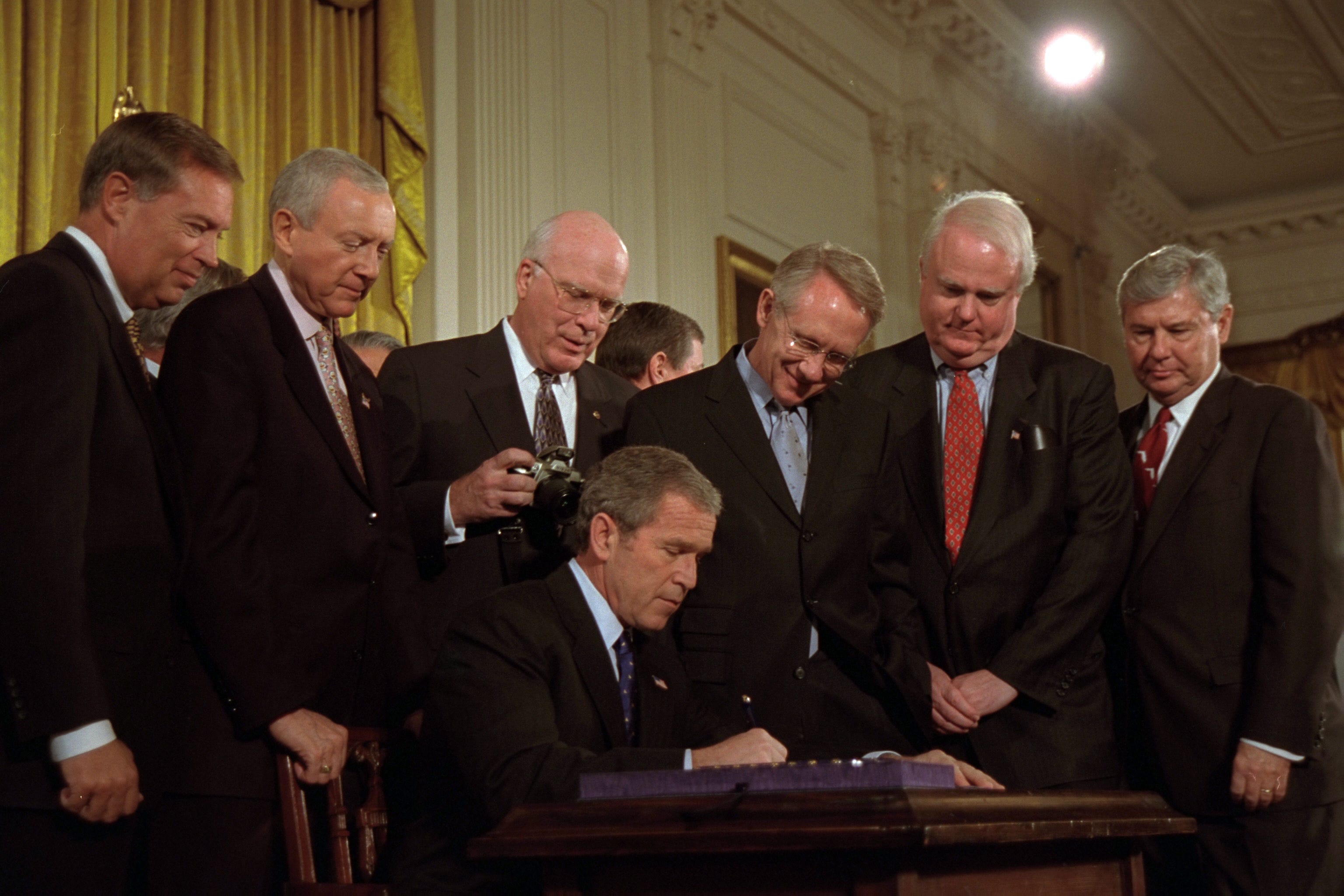
The nation poured its energy into security, searching wildly for threats. Mosques were surveilled and infiltrated. A prison was built at Guantánamo Bay. Justice Department lawyers wrote memos sanctioning torture. The Patriot Act passed in six weeks. Joint terrorism task forces expanded their focus to communities inside the country. And my cousin — a Muslim man in his twenties who had just watched his neighbors die — was ordered to report to City Hall to be questioned, fingerprinted, and entered into a new National Security Entry-Exit Registration System.
My cousin had done nothing wrong. Like millions of his fellow New Yorkers, he was a witness to the attack, not a suspect in it. But he was also a male visa holder from a predominantly Muslim country — and the government decreed that he, and thousands like him, needed to be watched. That was the shape of those years: fear justified as discrimination and violence, and the denial of constitutional rights (including due process).
It was just as the government’s “War on Terror” was beginning that I joined the ACLU, which worked to protect Americans against government overreach and defend constitutional rights by challenging provisions of the Patriot Act, combating mass surveillance, opposing torture and extraordinary rendition, and defending free speech.
As time passed, I began to worry about the long shadow of post-9/11 policy: how would we put this genie back in the bottle? No government builds a set of tools for militarization, surveillance, and criminalization and then watches them disappear. They are not dismantled when the emergency passes. They remain — in statute, in agency practice, in the case law, and in public memory.
Since the war in Gaza, and the U.S.-Israel war on Iran, the tools of the War on Terror have been reprised against Muslim Americans. In Texas, the mosque-siting fights are back. There is renewed fearmongering about Sharia law in Congress and state capitals like Florida, where new laws also target Muslim civil rights groups like the Council of American-Islamic relations. The Trump Administration’s Muslim travel ban is back, and now more widespread.
But the machinery does not stay pointed where you aim it first, and The Trump Administration is using the old weapons on a broader target list than ever. They are using the surveillance architecture built to monitor Muslim Americans to deport immigrants — AI and license plate-tracking Flock cameras make surveillance much easier — and applying the anti-terrorism frameworks written for al-Qaeda to American citizens by charging anti-ICE protesters with providing “material support” for terrorism and designating nonprofits as part of a “domestic terror movement.”
They are trying to silence political dissent, target free speech, and threaten lawsuits against critics. Sending law enforcement to the homes of citizens who criticize them online. Trying to kick TV hosts off the air. Intimidating reporters and restricting freedom of the press. Suppressing social movements and community resistance. Weaponizing government to punish the marginalized and their allies.
At the Open Society Foundations, where I lead our U.S. work, we are supporting organizations that protect rights and freedoms, defend democracy, and counter discrimination including against Muslim Americans, through research, education, and fostering interfaith solidarity. We stand with the many Americans who are saying no to discrimination and government abuse. Their actions give me inspiration.
When a gunman murdered worshippers at the Sikh temple in Oak Creek, and when eleven people were killed at the Tree of Life synagogue in Pittsburgh, communities that had no obligation to one another showed up anyway. When a mosque in San Diego was attacked in May, Jewish organizations were among the first to stand with the Muslim community. In Minneapolis this winter, when federal agents surged into neighborhoods, it was ordinary residents — teachers, nurses, clergy, business leaders — who stood up: people who were not themselves targets but recognized the violence as out of line with their long tradition of decency and democratic values.
Across the country, we are seeing individuals and organizations advocate for justice. We are seeing Muslim and Jewish groups build solidarity in the knowledge that the fights against antisemitism and anti-Muslim bigotry are connected. And we are seeing real resistance to the tools of injustice — the ones used a quarter century ago, and the ones being built today.
To me, that is the measure of what we’ve learned in twenty-five years. Americans today are seeing government overreach, and they aren’t looking away. We know that the tools built in a moment of fear can outlast the fear that built them — that they can be trained on new ‘targets,’ and that new technologies can make them more powerful. What can turn them back is when people decide a neighbor’s problem is their own. That decision is still ours to make, this year and in years to come.
Laleh Ispahani is the Managing Director for Programs in the United States at the Open Society Foundations, where she leads their grantmaking and advocacy work.

The Patriot Act has gone too far in that it had taken away some of our liberties. It has been an assault on democracy.
Labeling people by their ethnicity or national origin is both common and irrational. There are good and bad people in every group. I have known a number of Jewish and Muslim individuals. In every case they were caring, good people. There is more that binds us than separates us. Studies have shown that there is more variation with groups than there is between groups.
Americans near the Canadian border have reported having their tires slashed. This despite the fact that most Americans are appalled at what has happened. Americans are the recipients of this counterproductive behavior.