

By Frederic J. Frommer
If the 2025 World Series goes to a seventh game, the Los Angeles Dodgers and Toronto Blue Jays will have the luxury of playing at Toronto’s Rogers Centre, which features a retractable roof. That kind of technology would have come in handy for the 1925 World Series.
The Washington Senators and Pittsburgh Pirates played Game 7 of the Fall Classic under some of the worst conditions in baseball history—in cold rain, fog, dark skies, and thick mud. As the New York Times observed the next day, “It was a great day for water polo.”
The ‘25 series pitted a couple of upstarts who had taken down an early 1920s New York City duopoly. From 1921-1923, each Fall Classic featured the New York Giants against the New York Yankees. In ’24 the Senators upended the Yankees to win the American League pennant, then upset the Giants in the World Series.
The next year, it was the Pirates’ turn, dethroning the Giants to win the National League pennant. Over in the AL, the Senators repeated as pennant winners behind their ace pitcher, Walter Johnson, who went 20–7 with a 3.07 ERA. In an early version of L.A.’s two-way superstar Shohei Ohtani, Johnson also excelled at the plate, batting .433 with a 1.033 OPS—similar to Ohtani’s 1.014 this year.
The Senators—like the Dodgers starting Friday night—were seeking to repeat as World Series champions. And, after winning three of the f irst four games, they sure looked like they would. But the Pirates stormed back to tie the series, then pounded Johnson for 15 hits in a 9-7 Game 7 victory, becoming the first team to overcome a three-games-to-one deficit.
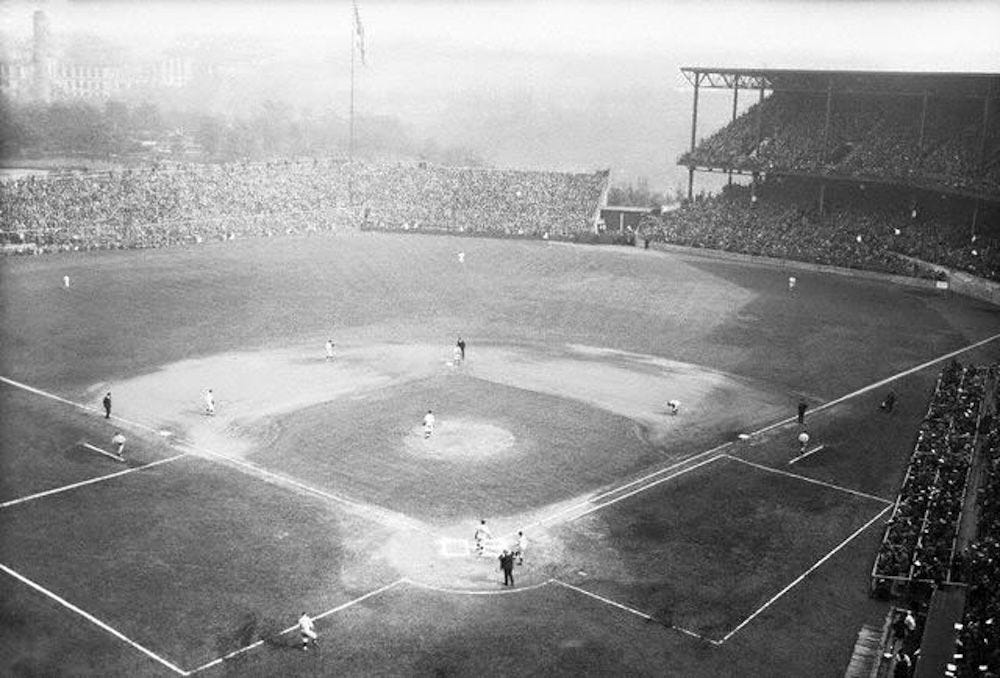
The teams played that game on a wet Forbes Field a day after the originally scheduled finale had been rained out. The grounds crew in Pittsburgh pulled out all the old-school stops to get the diamond ready, including spreading sawdust and burning gasoline to try to dry out the field. Still, the conditions were awful for baseball, decades before the high-tech drainage systems that teams now employ.
“In the wettest, weirdest and wildest game that fifty years of baseball have ever seen, the Pirates today proved their right to the mud-horse, twilight and all other championships of the national game,” the Times quipped. “In mire and rain and fog they beat the Senators 9 to 7, and won back the title which went away from here fifteen years ago. Water, mud, fog, mist, sawdust, fumbles, muffs, wild throws, wild pitches, one near fistfight, impossible rallies—these were mixed up to make the best and the worst game of baseball ever played in this country. Players wallowing ankle deep in mud, pitchers slipping as they delivered the ball to the plate, athletes skidding and sloshing, falling full length, dropping soaked baseballs—there you have part of the picture that was unveiled on Forbes Field this dripping afternoon.”
The Washington Post reported that rain “had made the playing field a mass of tricky, sticky mud. The outfield was filled with puddles.” And it rained during most of the game, requiring delays so that players could dry off their bats with towels. “Low-hanging clouds and smoke spread a misty curtain over the playing field,” the paper added, and it was hard to make out the outfielders from the stands.
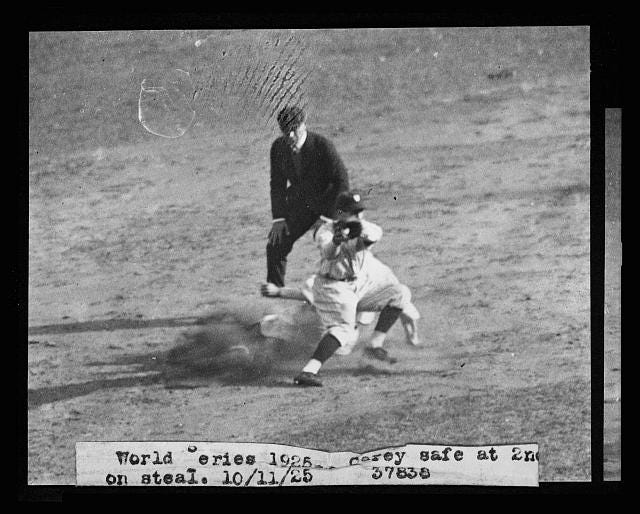
In the ’24 World Series, Johnson lost his first two starts before coming out of the bullpen to win Game 7 in extra innings. But 1925 proved to be a mirror image: He won his first two starts before the Pirates—who had led the National League with a .307 batting average—throttled him in the Game 7 loss. Outfielder Max Carey, a future Hall of Famer, led the attack by going 4-for-5 with three doubles, capping a series in which he hit .458.
The game was a mess right from the start. The Senators sent 10 men to the plate in the top of the first inning to take a 4-0 lead, despite getting just two hits in the frame. The Pirates helped with two errors, two wild pitches, and three walks.
But just as Pittsburgh’s pitcher struggled in the elements, the 37-year-old Johnson also had trouble getting traction on the muddy field, and the Bucs chipped away, tying the score at 6 in the bottom of the seventh. A pair of errors by shortstop Roger Peckinpaugh, that season’s AL MVP and a hero of the ’24 World Series, helped the Pirates score five runs in the seventh and eighth innings, enough for the victory.
Still, the biggest story was the collapse of Johnson, the future Hall of Famer and Americans’ sentimental favorite, who gave up nine extra-base hits and nine runs – though only five were earned.
“It was a tragedy to the entire Washington team, but it was a stark disaster for Walter Johnson,” the Post wrote.
“Probably the old veteran would have liked to have gone home and gone to bed,” the Times wrote in copy that would have been flagged for ageism today, “but he stuck it out with a great heart and a wise head against a team of youngsters who were just beginning to unleash the strongest batting attack in the game.”
Washington’s fiery player-manager, 28-year-old second baseman Bucky Harris, left himself open for second-guessing by leaving an aging, tiring pitcher in against the Bucs’ swashbuckling bats. At 37, Johnson was the same then as Dodgers pitcher Clayton Kershaw is today. But unlike Washington, L.A. has used its future Hall of Famer sparingly this postseason—just two innings—relying on its younger stud pitchers to carry the load.
Back in 1925, Harris’s decision to ride Johnson for the entire game earned him a rebuke from American League president Ban Johnson (back when baseball had league presidents).
“You sacrificed a World’s Championship for our league through your display of mawkish sentiment,” he lectured Harris in a telegraph.
“You run the American League, and I’ll manage the Washington baseball team,” Harris replied.
Frederic J. Frommer, a writer and sports and politics historian, has written for the Washington Post, the New York Times, the Atlantic, History.com and other national publications. A former Associated Press reporter, Frommer is the author of several books, including “You Gotta Have Heart: Washington Baseball from Walter Johnson to the 2019 World Series Champion Nationals.” Follow him on X.
The tragedy of baseball now is that Americans can no longer rely on the World Series to bring them together, in agreement or in discord. Only a handful of baseball fans now watch it, due to the expense and even difficulty of figuring out how to watch it these days.
Before the money folk confiscated free television sports, even nonfans could enjoy the camaraderie or rivalry of the ultimate contest once a year, giving Americans a common topic of conversation. What does that now? When we most need baseball, we don't have it. So kudos to Mr. Frommer for keeping history alive in this article, at least. And no, this year, I can't afford to watch the World Series.
Walter Johnson donated land on which sits my former high school, named after the great man. WJ!