

By Shalise Manza Young
The jubilant atmosphere of last month’s 30th WNBA All-Star weekend meant that, for a couple of days at least, talk about the league’s problems was quieted.
Barack Obama, Barbie dolls, beloved legends, and a baby-faced young star punctuating all of it with a beautiful dunk — for those of us who were part of the first generation of post-Title IX athletes, it was the stuff of long-ago dreams.
But my goodness, the glow of that weekend faded fast.
After the highs of signing a landmark media-rights deal and collective bargaining agreement in March and welcoming two new teams into the league, the WNBA has been dealing with quite a bit of negative drama of late.
Not only does it threaten the sisterhood that has always underpinned the league, but it seemingly could also do long-term harm to a league that has fought and scrapped for 30 years for everything from basic respect to media attention to higher salaries, particularly since the league’s leaders not only don’t seem made for the moment but added fuel to the fire.
With a player population that is roughly two-thirds Black and many who are queer, the WNBA is the most diverse and most progressive professional sports league in the country.
Time and again, they’ve used their platform for good trouble, as the late John Lewis would call it. Their most impactful activation came in 2020, when players had a not-small role in getting Sen. Raphael Warnock (D-GA) elected, a response to the open homophobia and racism of then-Sen. Kelly Loeffler, who was also a co-owner of the Atlanta Dream.
Though there have been inter-personal beefs over the years, players have always presented a united front.
Since America is America, anti-Black and anti-queer sentiment has been background noise since the league’s inception; in its early days, league officials presented star players as wholesome (read: straight) and encouraged those who were lesbians to stay in the closet.
But attacks against players have been intensifying in recent years, thanks in part to MAGA glomming onto 2024 draft pick Caitlin Clark during the 2023 NCAA women’s national championship game; Clark, who is white, and her Iowa team lost to Angel Reese and Louisiana State, and when Reese threw some of Clark’s trash talking and showboating back at her, known misogynists took to Twitter to dispense some misogynoir.
It was only the beginning of the onslaught of hate against Reese, and now other Black women in the WNBA are on the receiving end of that kind of invective, especially if they commit a common hard foul on Clark. Things have escalated to the point that last year the league created an app for players that tracks instances of online abuse.
(For her part, Clark has said multiple times that such behavior shouldn’t happen, though she hasn’t pushed back hard enough for some WNBA fans online.)
Add in Clark’s on-court theatrics, and in the weeks before the All-Star game, things were getting tense.
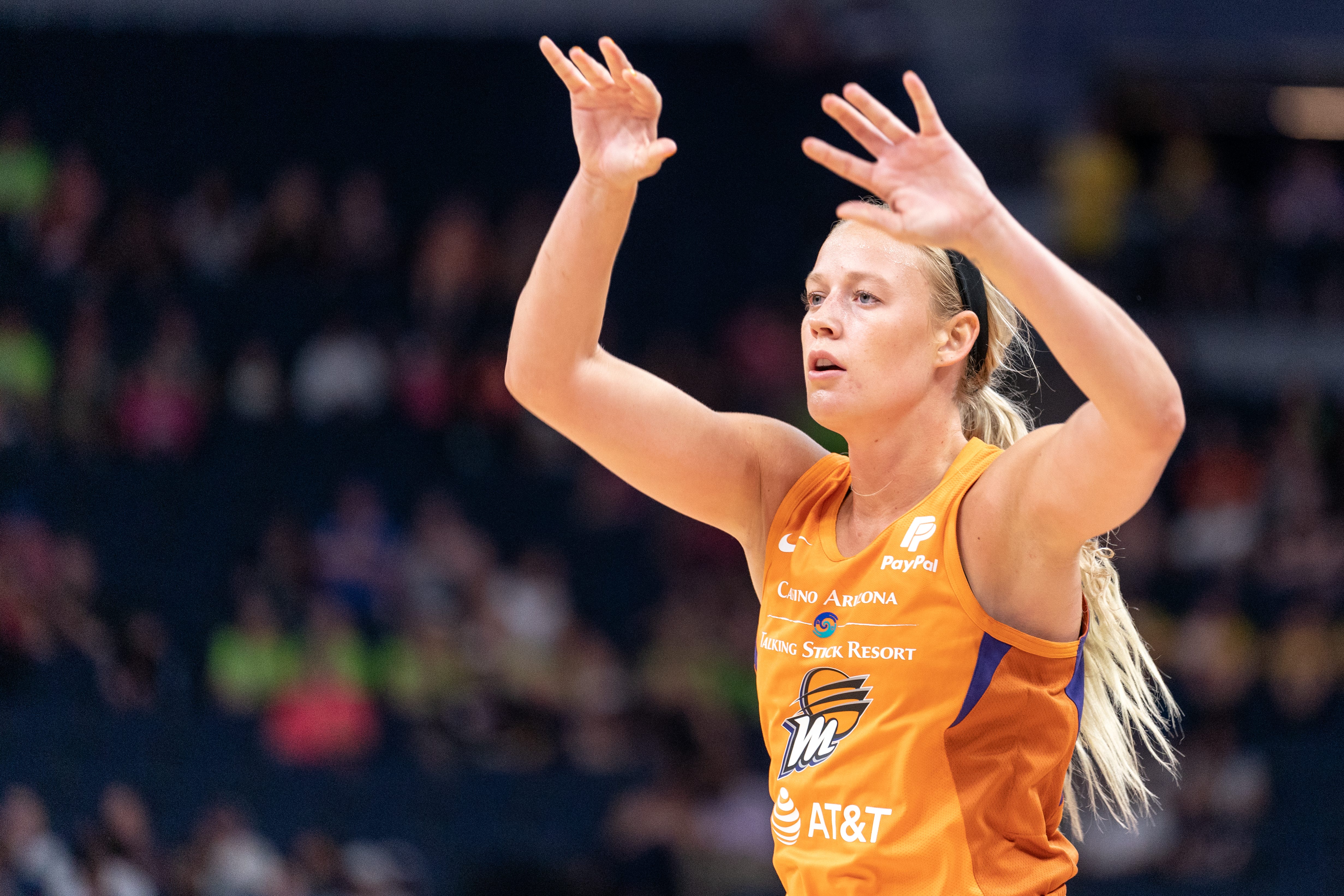
And then Sophie Cunningham made everything far messier.
Cunningham, a teammate of Clark’s on the Indiana Fever and a backup player for most of her career, said in an interview with ESPN that she wants to protect “young girls in sport who shouldn’t have to go against biological men,” repeating the trope demonizing transgender girls and women. She hasn’t backed down from her comments.
In fact, she’s embracing the notoriety it has brought, with her behavior suggesting that this is exactly what she was hoping would happen. Riley Gaines, whose entire claim to fame and public personality come from tying for fifth place with a trans woman in a collegiate swim race, was courtside for Indiana’s game with the Minnesota Lynx. Cunningham posed for photos with her.
There have been lightly attended rallies supporting Cunningham’s bigotry outside arenas where the Fever play. Inside arenas, Cunningham is showered with boos every time she handles the ball.
(One quick aside that Cunningham & Co. conveniently ignore: The New York Liberty and other WNBA teams regularly practice against men because there is a strict 12-player roster cap in the league, and the men are needed to simulate the play of upcoming opponents.)
Though other players and coaches have come out in full support of trans athletes — Minnesota head coach Cheryl Reeve wore a “trans kids belong” shirt for the game against Indiana and gave a detailed, informed, and beautiful answer when asked about the issue, saying in part, “what I know is, exclusion is not the answer” — it has become clear that league higher-ups are not handling the issue well.
WNBA commissioner Cathy Englebert does not seem made for this moment. Yes, it is a tough needle to thread: Cunningham is entitled to her opinion, no matter how narrow-minded and awful, but she plays in a league that was built by Black and queer women and is supported by legions of LGBTQ-identifying fans.
The first “support Sophie” event was in Seattle, the Fever’s first game after the All-Star break. Two young women who were courtside wearing shirts with the logo of an apparel company that raises money for anti-trans efforts and had paid for their high-priced tickets said that Seattle minority owner Celeste Keaton called them “insane.”
The league responded by fining Keaton and banning her from the team’s next five home games. It was an instant win for the far-right crowd suddenly “interested” in WNBA games. For the record, there are no transgender players in the league, and now that the NCAA has buckled to the bad-faith arguments and has disallowed the few trans girls playing high school sports to compete, there won’t be any at the college level either.
Top players have been critical of Englebert’s leadership for quite some time. She apparently has done little to cultivate relationships with league leaders — four-time WNBA most valuable player A’ja Wilson half-joked that the only time she speaks with Englebert is when she’s getting trophies — and the current situation is further hurting her standing, though Englebert works for team owners, not the players.
But she’s seemingly risking the well-being of the league (and its bottom line) broadly and players specifically — and for what, exactly? The bigot brigade brought out by Cunningham’s comments has shown time and again that it has no actual interest in girls and women in sports or, in many cases, girls and women period.
They blow in, do as much damage as possible, and then move on to their next target. They have no interest in supporting the WNBA long term, and some are already turning on Clark because she didn’t support Cunningham’s stance when asked by reporters. The league’s actions, or lack thereof, could drive away the very people who have supported it for years or even decades.
The WNBA exists in a weird space. It is not fully independent from the men’s NBA, and, as such, NBA commissioner Adam Silver has a lot of sway despite Englebert having the same title for the W.
But the two of them need to figure something out, stat. The WNBA and NBA have been leaders among American professional leagues in supporting diversity and inclusion, and this has the potential to make a situation that was already getting bad for players in terms of their mental, emotional, and physical safety, far worse.
Shalise Manza Young is an award-winning writer focused on the intersections of race, gender, politics, and sports. She is the director of track and field at Phillips Andover Academy. She and her family, including Contrarian Pet of the Week Coco, live in Boston. You can find her on Bluesky @shalisemyoung.
I know I'm ignorant about a lot of things. I really would like to understand where the author's views come from. She implies that Sophie Cunningham's opinion springs from phobia and hate. I don't know what evidence backs that up. Maybe there is plenty of evidence, but it isn't detailed in the article. It seems to me (in my ignorance) that Cunningham's comments could just as likely have come from her perception that trans competitors can have the advantage of greater size, weight, and strength. Surely that isn't universally true, but in some cases, it will be true. So is Cunningham simply reacting to that element of unfairness? Does she deserve to be vilified?
The thing that amazes me is so far, nobody seems to have mentioned Renée Richards.
This is not a new issue. And it's not the cataclysmic threat that the radical right-wing would have us believe. We've lived with this for a long time just fine.