


Abdulaziz al-Muzaini is a Saudi Arabian writer and producer who founded the animation studio, Myrkott, known for the satirical YouTube series Masameer, which took a humorous look at social changes in the conservative kingdom and tackled once-taboo subjects.
In 2020, his company signed a five-year deal with Netflix, which brought new seasons of the series exclusively to the streamer (where its title is Masameer County) and yielded two feature films. Al-Muzaini, who has dual Saudi-US nationality, also wrote Head to Head, a live-action slapstick comedy about a limo driver who mistakenly picks up a crime lord.
He became a poster boy for the nascent Saudi entertainment industry, and gave a talk about “empowering Saudi creators” at Prince Mohammed Bin Salman College.
“Saudis don’t have a long history of making films, so there’s no safe bets right now,” he told Arab News, the government-controlled newspaper, in 2023.
His words turned out to be prescient.
Last year, in a video he posted on social media—then quickly deleted—al-Muzaini revealed that he had been tried and convicted in a Saudi terrorism court. It was alleged that he “sponsored and supported terrorism and homosexuality” through Masameer, which also used “insults and slurs.”
He was reportedly forced to shut down Myrkott, and was facing a 13-year prison sentence plus a 30-year travel ban. As of last summer, al-Muzaini said he was waiting for the Supreme Court to issue a final ruling on the case.
Netflix declined to comment, though Masameer County is still available to stream in the United States.
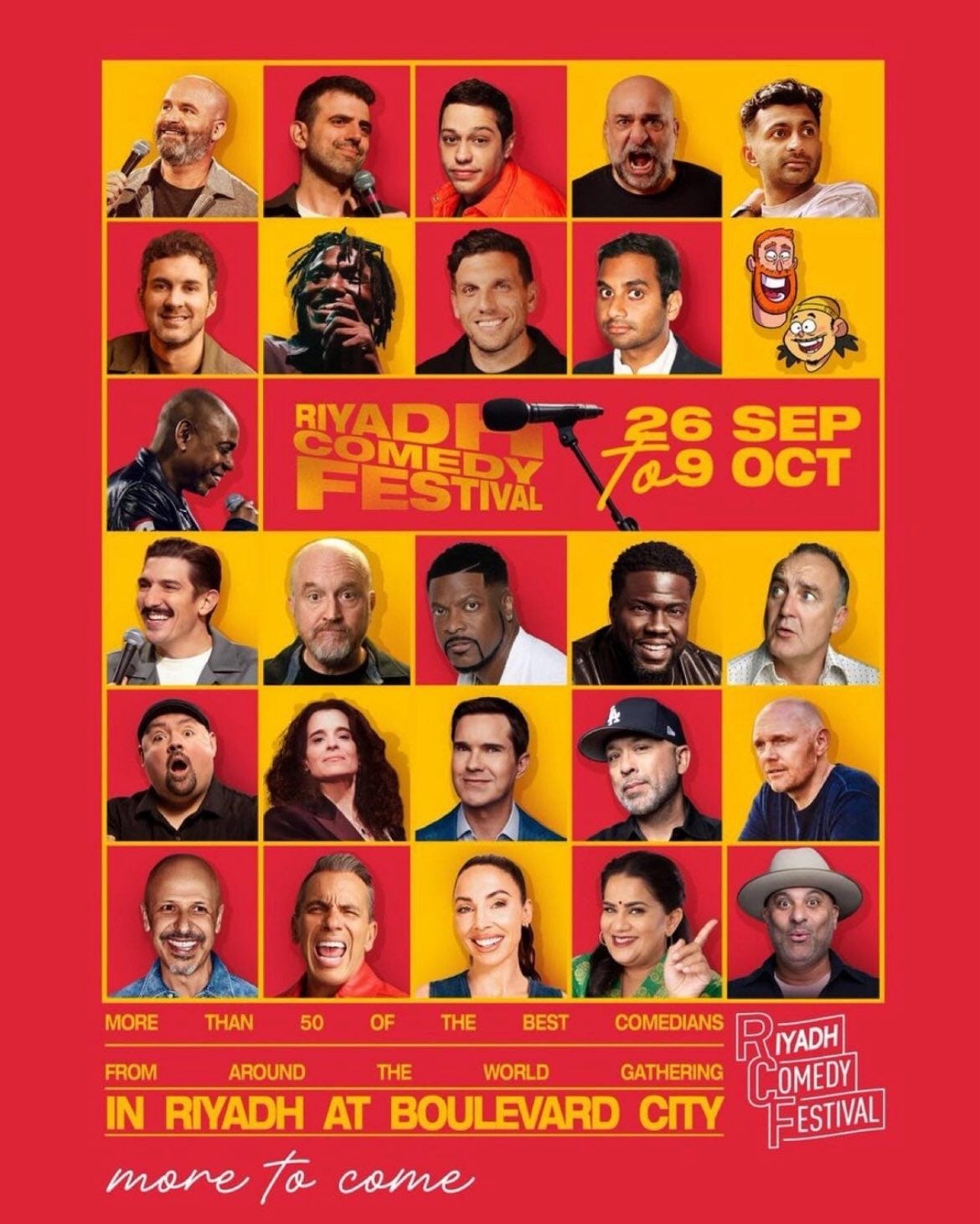
Needless to say, al-Muzaini is not one of the A-listers asked to appear at the inaugural Riyadh Comedy Festival, which kicked off last week and features some of the biggest names in stand-up, including Dave Chappelle, Louis C.K., Aziz Ansari, Bill Burr, Kevin Hart, Hannibal Buress, Whitney Cummings, Pete Davidson, Tom Segura, Jo Koy, Jeff Ross, and Jimmy Carr.
Billed as the “world’s largest comedy festival” and organized by the kingdom’s General Entertainment Authority, the event is part of a government effort to diversify the Saudi economy by establishing the country as a world-class destination for entertainment, culture, and sporting events.
Or, put another way, it’s part of a massive, extravagantly well-funded rebranding campaign designed to make the rest of the world forget about the kingdom’s atrocious human rights record.
To achieve this goal, Crown Prince Mohammed bin Salman— the same guy who ordered the murder and dismemberment of journalist Jamal Khashoggi —has been throwing piles of cash at any celebrity who will take it.
Which, it turns out, is a lot of them.
Hollywood shunned the kingdom in the immediate wake of Khashoggi’s murder, but the industry has since warmed to Saudi money and shown a willingness to self-censor.
The Red Sea Film Festival in Jeddah has attracted luminaries like Gwyneth Paltrow, Will Smith, Johnny Depp, Spike Lee, Michelle Williams, and Eva Longoria—with some receiving seven-figure paydays (and little pushback) for attending.
In recent years, big-name musicians including Jennifer Lopez, Celine Dion, Christina Aguilera, and BTS, have played in Saudi Arabia, and gotten relatively little flak for doing so.
The situation has been very different for the comedians appearing in Riyadh, who are reportedly receiving payments of up to $1.6 million for their services. At a fraught moment for political comedy in the United States, they are facing withering criticism for taking money from an oppressive regime that punishes journalists, activists, and, yes, comedians for even the appearance of dissent.
“We cover these high-profile entertainment events that happen in Saudi Arabia all the time, but this is the biggest wave of coverage and outrage that we’ve seen on Saudi in a while,” said Joey Shea, Saudi Arabia researcher at Human Rights Watch, which has denounced the festival as part of a whitewashing campaign and urged the participating comedians to call for the release of detained activists in the kingdom.
Some of the most barbed disapproval is coming from their peers in the tight-knit world of stand-up. Marc Maron recently mocked the festival as “two weeks of laughter in the desert,” and noted the comedians were being paid by the same guy who ordered people “to bone-saw Jamal Khashoggi and put him in a fucking suitcase.”
“Now there’s a lot of drips, killjoys and dweebazoids who are saying, ‘Oh, they shouldn’t do comedy over there, because it’s whitewashing a regime that, just in June, killed a journalist and killed Jamal Khashoggi and played a big role in 9/11. Shut up!’” said Zach Woods in a brutally sarcastic video posted on social media last week. “Name one comedian who hasn’t hired themselves out to a dictator!”
David Cross posted an even more scathing rebuke on his website, saying he was “disgusted and deeply disappointed in this whole gross thing.”
“That people I admire, with unarguable talent, would condone this totalitarian fiefdom for…what, a fourth house? A boat? More sneakers?” he wrote. “We can never again take seriously anything these comedians complain about.”
Cross and many other critics have noted the blatant hypocrisy of many of the Riyadh performers, many of whom fancy themselves champions of free speech and are known for griping about the supposed excesses of “cancel culture.”
Perhaps the most egregious example is Dave Chappelle, who seems to believe the First Amendment begins and ends with his freedom to make gazillions of dollars mocking transgender people over and over and over again. In his Riyadh set, he reportedly joked about the free speech debate raging in the United States in the wake of Charlie Kirk’s murder and Jimmy Kimmel’s brief suspension. British comedian Jimmy Carr has described himself as a “free speech absolutist.” Jim Jefferies defended his choice to perform in Riyadh by arguing that “basically, we are freedom-of-speech machines being sent over there.”
Bill Burr, who said billionaires should be put down “like fucking rabid dogs” all the way back in February, performed at the festival’s opening night last week. On the latest episode of his podcast, he described the gig as “one of the top three experiences I’ve ever had” and noted that “the royals loved the show.”
“It’s going to lead to a lot of positive things,” he said.
Then there’s the cruel irony that Pete Davidson’s father, a New York City firefighter, was killed on 9/11. The former Saturday Night Live sitar and serial dater recently told Theo Von that he was getting paid enough to not care. “I get the routing, and then I see the number, and I go, ‘I’ll go,’” he said.
But this money allegedly comes with abundant strings attached. On Threads, Atsuko Okatsuka said she turned down a Riyadh booking, unlike “a lot of the ‘you can’t say anything anymore!’ comedians” who agreed “to adhere to censorship rules about the types of jokes they can make.”
She then posted a screenshot of the alleged offer, which stipulated that the artists must not perform:
“[A]ny material that may be considered to degrade, defame, or bring into public disrepute, contempt, scandal, embarrassment, or ridicule A) The Kingdom of Saudi Arabia, including its leadership, public figures, culture, or people; B) The Saudi royal family, legal system, or government, and; C) Any religion, religious tradition, religious figure, or religious practice.”
The content restrictions also seem to apply to what the comedians say outside of Saudi Arabia. Tim Dillon, a MAGA-curious comedian who said he was getting paid $375,000 for appearing at the festival, was “fired” for making jokes about the country’s alleged use of slave labor on his podcast.
Shane Gillis and Mike Birbiglia also say they declined to participate.
Human Rights Watch has not asked any of the comedians to drop out of the festival. Instead, the organization has urged the performers to call for the release of high-profile human activist Waleed Abu al-Khair, who is currently serving a 15-year sentence, and Manahel al-Otaibi, a female fitness instructor and women’s rights activist who was sentenced to eleven years in prison for social media posts (the sentence was later reduced to five years.)
“If these comedians were collectively calling for their release, I have no doubt in my mind that there would be movement on their cases,” she said. (So far, none of the artists, even those who have dropped out, have spoken out on behalf of these prisoners or called for more accountability in Khashoggi’s murder.)
The push to “modernize” Saudi Arabia by embracing outside entertainment and culture has been coupled with what Shea calls “an intense crackdown on other basic rights and freedoms, like freedom of speech, assembly and association.”
“Saudi Arabia was never a bastion of free speech before MBS, but the situation now is far worse than before he came to power.,” Shea said.
Events like the festival are “deliberately made to detract from the reality of the human rights crisis on the ground,” she added. “So instead of thinking about Jamal Khashoggi being murdered in a consulate in Istanbul, people think, ‘Oh, the 2034 FIFA World Cup is coming to Saudi Arabia.’”
Jefferies, who is Australian, tried to downplay Saudi Arabia’s track record in a recent appearance on Von’s podcast. “One reporter was killed by the government. Unfortunate, but not a fucking hill that I’m gonna die on,” he said. “You don’t think our governments fucking bump people?”
This, of course, wildly understates the reality. Saudi Arabia has executed at least 241 people in 2025, according to HRW, including Turki al-Jasser, a journalist and blogger who was killed in June. He operated a satirical Twitter account called Kashkool which investigated the royal family and “made jokes at their expense,” Shea said. “It really got under the skin of MBS, which is perhaps why they went so far as to execute him.”
The government has targeted not just traditional activists, but also the kinds of influencers and creators who’d probably host popular podcasts if they lived in the United States.
Al-Muzaini is not the only homegrown comedy star to catch the eye of Hollywood—then face the wrath of the MBS regime. Fahud al-Butairi, a promising stand-up performer who got his start doing open-mic nights at the University of Texas and was once dubbed the “Seinfeld of Saudi Arabia,” was arrested in Jordan in 2018 and “handcuffed, blindfolded and put onto a plane for Saudi Arabia.” His apparent crime? Being married to Loujain al-Hathloul, a prominent women’s rights activist who was jailed around the same time.
The Riyadh comedy crew and — for that matter — all of Hollywood should keep these stories in mind as they cash their checks from MBS, Shea said: “If you are being paid hundreds of thousands of dollars by the Saudi government to perform at a government-backed event, then you have a responsibility to make sure that that business relationship does not contribute directly to human rights harms.”
Meredith Blake is the culture columnist for The Contrarian
I'm glad for the principed folks who couldn't be bought. Shame on all the rest of them. Thank you for reporting this.
I’m appalled, too. All these guys whining about how they can’t say anything in America and then let themselves be censored for the right price.
Most of these folks aren’t old enough to remember South Africa in the 1980s, where there was a major movement of artists not to perform there. And those that did - notably Queen - got a lot of flak for doing so. John McEnroe turns down $1 million for an exhibition against Bjorn Borg.