


The United States has lost its status as a liberal democracy.
That’s according to the V-Dem Institute, a leading quantitative index measuring global democracy, which earlier this year cited President Trump’s attacks on the rule of law, attempts to quash dissent, and his renewed assault on the tenets of constitutional democracy at fault for the decline. “The speed with which American democracy is currently dismantled is unprecedented in modern history,” the V-Dem report observed.
Yet many in the United States still haven’t quite grasped how best to respond to these political conditions, which can feel foreign and outside the tradition of American politics. Cable pundits draw lessons from campaign victories in places like New York and Virginia, calling on all Democrats to adopt economic populism. Some strategists say politicians should talk less about Trump’s civil rights offenses for fear of alienating swing voters. Others say it’s precisely these grievances that will push people to change their votes.
These theories miss the mark in part because they live in the domain of the strategist, not the citizen. “Talk about affordability” is advice for a politician, not for a neighborly conversation. More importantly, these ideas fail to recognize that authoritarianism is defined by the willingness of a leader to throw out old norms and established rules. The kinds of maneuvers that have succeeded in the past will have limited impact. An authoritarian will always be Teflon to conventional wisdom about what works in a democratic system.
Americans have trouble accepting that what we’re seeing actually is authoritarianism in part because we think of ourselves as separate from the rest of the world. This is one manifestation of exceptionalism — the notion that we’re immune from broader trends that are playing out elsewhere.
Many Americans aren’t even aware that democracy is in peril globally. Liberal democracy is now the least common form of government in the world, and nearly three out of four people on earth live under some form of authoritarianism. Never before in recorded history have this many nations slid simultaneously toward authoritarian rule. The United State is one significant data point in this trend.
The reality has also been slow to set in because authoritarianism looks different than it used to look. It no longer rides into town on the back of a coup; instead, it now often happens through elections. Russia’s Vladimir Putin, Hungary’s Victor Orban, Brazil’s Jair Bolsonaro, Venezuela’s Hugo Chavez all came to power in elections before gradually closing off the civic airspace. What we see in many of these other backsliding nations is that elections are not enough to escape an autocratic tilt. They’re an important tool, but it’s much more difficult to be successful inside an electoral system once the system itself has been corrupted.
Pushing back will require learning a new grammar of dissent, a new language of activism. I spent a year interviewing political dissidents on five continents for my new book, On Courage: How to Be a Dissident in an Age of Fear, with Julia Angwin. The book offers sixteen lessons for how Americans can learn from others who have faced political repression to preserve our democracy. In our reporting, I’ve come to believe there are a few specific shifts Americans can make to their mindsets — to reorient themselves to this political reality and help slow the forward march of authoritarianism in America.
The first is to look for opportunities to puncture the air of inevitability that authoritarianism creates. Recall the first day of the Trump presidency, when at the inaugural prayer ceremony at the National Cathedral, the Episcopal bishop Mariann Budde used the pulpit to address the President directly and ask for “mercy” to LGBT people and immigrants. That single act reverberated outward, piercing the sense that a vindictive president was in total control and the country’s fate had already been decided.
Democracy is a practice of exercising choices. The dark magic of authoritarianism is to make it feel like you have fewer and fewer of them. That’s why one individual really can have a major impact. A man standing in front of a tank, yes; but also a young lawyer creating friction at a firm considering cooperating with Trump’s coercion or a local librarian fighting book bans. All of us can help reclaim civic space and demonstrate to the people around us that they still do have choices.
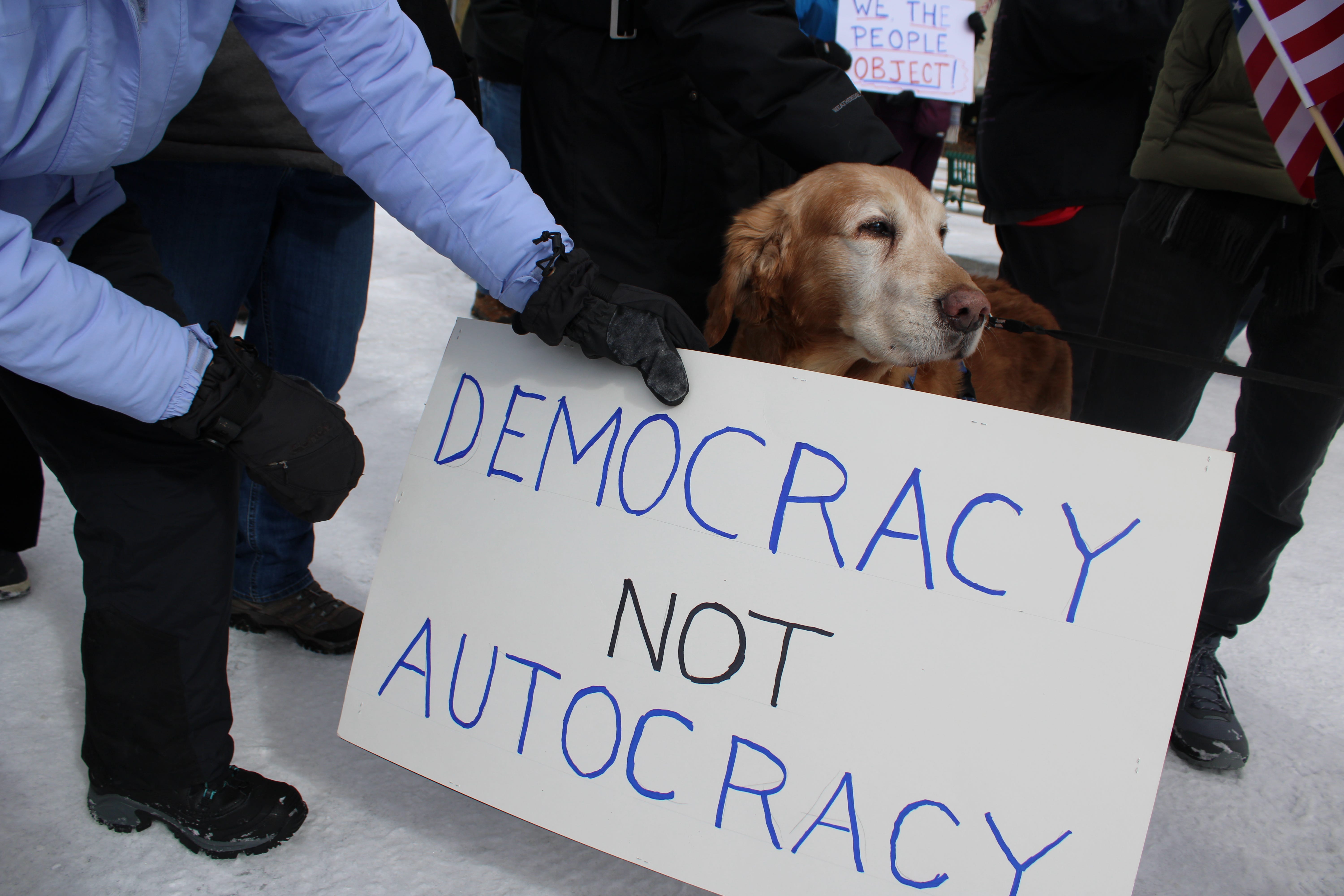
The other role Americans can play is to enlist their own people in the work of dissent. There’s science behind this: In 2005, sociologists at the University of Arizona set out to determine what makes people decide to take on political risk. They found that the single strongest predictor of protest participation wasn’t age, education, or political affiliation. It was whether a person had been asked to participate.
We saw this play out in our reporting. In Serbia, which is seeing the biggest anti-corruption protests since the movement that brought down Slobodan Milošević more than a quarter century ago, student protestors said the way they got their skeptical friends involved in movement organizing was just to ask them to bring blankets to protestors staging sit-ins on the front line. That small, manageable task gave their peers a window into the movement. It led them to start giving more, like money or baked goods, and ultimately brought them to stand on the protest line themselves.
Labor organizers here in the United States told us that the first step in a campaign to unionize a workplace is to give little tests to workers at a worksite who show leadership potential. If someone can sign up ten co-workers to the union drive they’ll probably be a good leader and feel more invested. Another community activist said he likes to ask new people to bring snacks or to help set up the meeting room.
It’s those asks — to show up, to take on a job, to be in charge of something — that make people feel connected and invested and eventually take on more consequential risk and responsibility.
Seeking something tangible and familiar we can do to fulfill our civic duty and defy the Trump Administration’s sustained attacks on the rule of law, Americans of conscience keep reaching for actions within the longstanding norms of American political culture. But what we really need in this crisis is something closer to a philosophy. An orientation. A prism that helps us see the problems of authoritarianism and confront them wherever they arise. The first step in a mindset shift. Action will soon follow.
Ami Fields-Meyer is the co-author of On Courage: How to Be a Dissident in an Age of Fear, a manual of practical steps Americans can take to preserve our own democracy, which will be published on June 30th. A senior fellow at the Harvard Kennedy School, he was a senior policy advisor in the Biden White House, where he led U.S. initiatives on civil rights, technology policy, and consumer protection. His writing has appeared in The New York Times, The New Yorker, The Atlantic, and Foreign Policy.

The V-Dem classification is worth taking seriously on its own terms, but there's a narrower question this raises: what obligations does a citizen of a constitutional republic have when institutions are under pressure, and where do those obligations come from?
The Founders did not assume civic participation would sustain itself through ordinary political incentives. They built a system that assumed an informed, engaged citizenry as a precondition — not a product — of republican government. On that point, the article's emphasis on direct civic action over electoral strategy is consistent with the republic's actual architecture. The Serbian blanket example and the union organizer's "small ask" both describe how civic capacity is built from the ground up, which is closer to the town-meeting tradition than to campaign mechanics. Where the article is less precise is in treating "authoritarianism" as a sufficient analytical frame for American institutions that were specifically designed with separated powers, federalism, and judicial review to resist executive overreach — tools that remain formally intact and whose use or disuse is itself a civic act. The strength or weakness of those structural safeguards is the more specific question citizens and their representatives need to be answering right now.
This paragraph: "It’s those asks — to show up, to take on a job, to be in charge of something — that make people feel connected and invested and eventually take on more consequential risk and responsibility." At 76 I'm disinclined to get in a physical confrontation with ICE. However, our city has a very large refugee population whose SNAP benefits are not being renewed when they apply. I am canvassing a local farmers market on the weekends with a community group and collecting donated produce that is immediately turned around and distributed for free to apartment complexes that house numerous refugees. I also help teach English through a World Relief ESL program to refugees. I'd rather love and support them than get tear-gassed by ICE. I'm leaving that to the young zealous ones - I was one of those myself during Vietnam and Civil Rights. "To everything there is a season ..."