

By Alan Light
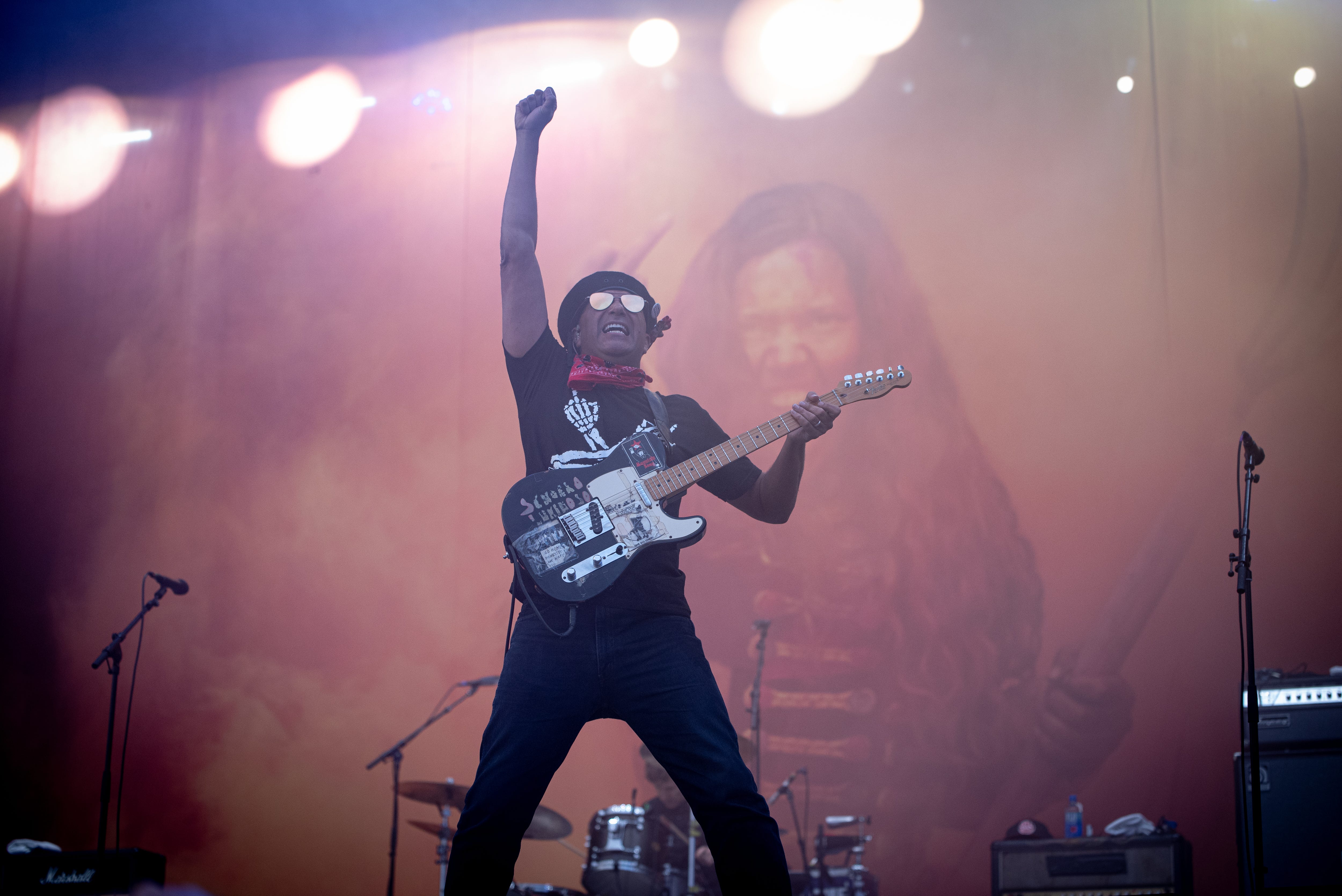
_(53817912489).jpg)
“I didn’t choose to be a guitar player,” says Tom Morello. “That chose me. And it’s been my intention to find a way to weave my convictions into that vocation. I think that’s a good starting place for anyone — not to just say, “Musicians should stand up for what they believe in their songs.” Well, so should journalists, and so should carpenters, and so should students, et cetera, up and down the line.”
Morello has been one of music’s most fearless activists since forming the groundbreaking agit-prop band Rage Against the Machine in 1991. After Rage released its final album and broke up in 2000 (there have been several touring reunions since then, and they were inducted into the Rock & Roll Hall of Fame in 2023), he has worked with multiple bands in various configurations, including occasional stints as a guest with Bruce Springsteen and the E Street Band; he joined them for their most recent, politically-charged outing this spring.
Now the incendiary guitarist has released his first-ever solo rock album, Everyone Gets Everything They Want, which maintains the fury of his sound and the urgency of his message. Tomorrow, a week after the album’s release, he will host the Power to the People benefit concert at Maryland’s Merriweather Post Pavilion (and streaming on YouTube), for which he assembled a slate of superstars including Springsteen, Foo Fighters, Dave Matthews, Public Enemy, and many more. “This is a fight for me that doesn’t feel like I’m anywhere near the end of it,” he says of this current flurry of activity. “It feels like we’re mid-chapter right now.”
Recent months have also seen a fascinating and emotional generational shift in the Morello family. His mother Mary, a longtime activist dating back the Civil Rights movement, died in July at the age of 102 (he is honoring her legacy with the ongoing efforts of the Mary Morello Memorial Project). Meanwhile, his son Roman has emerged as a powerhouse guitarist himself, featured prominently on the album and in Morello’s live show. The proud father calls Roman a “secret weapon,” noting that they just played the Newport Folk Festival and the audience “had no idea a 15-year-old kid was going to kick their ass.”
Morello believes that at this point, it may not be his generation that leads our way out of the current global chaos. But that doesn’t slow down his commitment to the work.
“With every show that I’ve played over the last 35 years,” he says, “you create a little bit of the world you’d like to see one day in that room. You make people feel that it’s possible, and feel a celebration of resistance and a commonality in the audience. Some people are there for the mosh pit in in the dirt, and some people are there for the mosh pit in their minds.”
At a moment when leadership pays no attention to what people actually want or what people are actually saying, what is the role of protest?
Well, I would say that the people in charge are indeed paying attention to what people are saying — but what very particular people are saying. [They’re] responding to the most garish moneyed interests. I was the scheduling secretary for Senator Alan Cranston for two years, so I got to see how the sausage was made, and whatever you imagine it is, it’s worse than that.
We are at an absolutely terrifying juncture where we may be seeing the death throes of an empire, and that could be very dangerous for everybody. But I have a feeling that the ideas that will save us may not be coming from 62-year-old musicians with my tried-and-true ways of protesting from the anti-apartheid struggle at Harvard in the ‘80s — that there’s going to be younger folk who are going to be finding a way to thread this needle.
Does it feel like you have a different role or function? These are very much battle songs that you write. Is that in a different context now?
Definitely. I write anti-racist songs for anti-racists and anti-fascist songs for anti-fascists and, for example, a song like “Date Night” on my record, anti-Nazi songs for anti-Nazis. And to find in this day and age that that is controversial is an upsetting thing. “Date Night” is about three Dutch girls in World War II who lured Nazis into the woods and killed them, and if a song about that makes people angry — well, you don’t need an abacus to do the math about what that means about where we’re at.
Tell me about the Power to the People event.
I’ve been hosting and curating charity shows and activist shows over the course of the last 35 years. But I was the musical director of the “Back to the Beginning” show, the last Ozzy Osbourne-Black Sabbath show, which was a massive show with a livestream. I saw we could do this on a bigger scale and create something that could be significantly impactful, not just texting my friends and saying, “Let’s jam and raise $1,500 for a homeless charity.”
I reached out to a lot of people, but what turned the corner were the ICE murders of Alex Pretti and Renee Good. In the immediate aftermath of that, my phone started ringing with people saying, “Remember that show you were talking about? What can I do? How can I be involved?” Among artists who are not lifers in this space, it became a real wake-up call, and what can you do when you’re a bass player in a band or a singer-songwriter? Well, one thing you can do is gather the tribes. And one thing you can do is play a show to celebrate resistance. And one thing you can do is raise money for voting rights organizations. And one thing you can do is let people know they are not alone. And that’s what Power the People will hopefully do.
This is coming out as your first solo rock album, which sounds a little crazy after the many dozens of things you’ve done. Does that bring a different responsibility or framing?
It does, and it’s reflective of the shows that I’ve been playing with my band the Freedom Fighter Orchestra. It’s an embracing of the totality of my career. This is the 22nd record that I’ve made — there have been band records that have been rock records, solo records that are acoustic Americana records, rock-ish albums that are collaborative affairs with multiple lead singers. But to me this record feels similar to the first Rage Against the Machine record, the first Audioslave record, where it’s embarking on a thrilling artistic chapter of writing kick-ass riffs that are the hardest that I’ve ever written; as a guitarist, I feel that I’ve never played better. It’s a record that is going to deliver the fucking goods to people who like rock & roll music, but also a record that is unrepentant in its point of view at this critical historical juncture.
Music journalist and author Alan Light is the former editor in chief of Vibe and Spin magazines and a former senior writer for Rolling Stone. A frequent contributor to the New York Times and Esquire, he co-hosts the music news podcast Sound Up! Alan’s latest book is Don’t Stop: Why We (Still) Love Fleetwood Mac’s Rumours.