



By Richard W. Painter, Virginia R. Canter, Christopher J. Swartz, and Norman L. Eisen
Weeks before the midterm elections, with President Trump’s approval rating languishing in the 30s, the Trump Administration produced and ran a 30-second ad on Fox News and Newsmax featuring images of Donald Trump accompanied by the song “Love Me” by JMSN, while his voiceover rails against communism and highlights his administration’s policies. The ad begins with Trump extolling that “[t]ogether, we will defeat communism, socialism, and Marxism in America” and concludes with a disclosure stating that the advertisement was “Paid for by the U.S. Government.” Over the weekend, the Administration released another ad. This time, the ad was nothing more than a repurposed political commercial that first ran during Trump’s 2024 presidential campaign, with the notable difference being that the new ad drops the invitation to join the Trump campaign and adds the disclosure that it was “[p]aid for by the U.S. Government.” Our tax dollars are hard at work. And, we believe, probably illegally so.
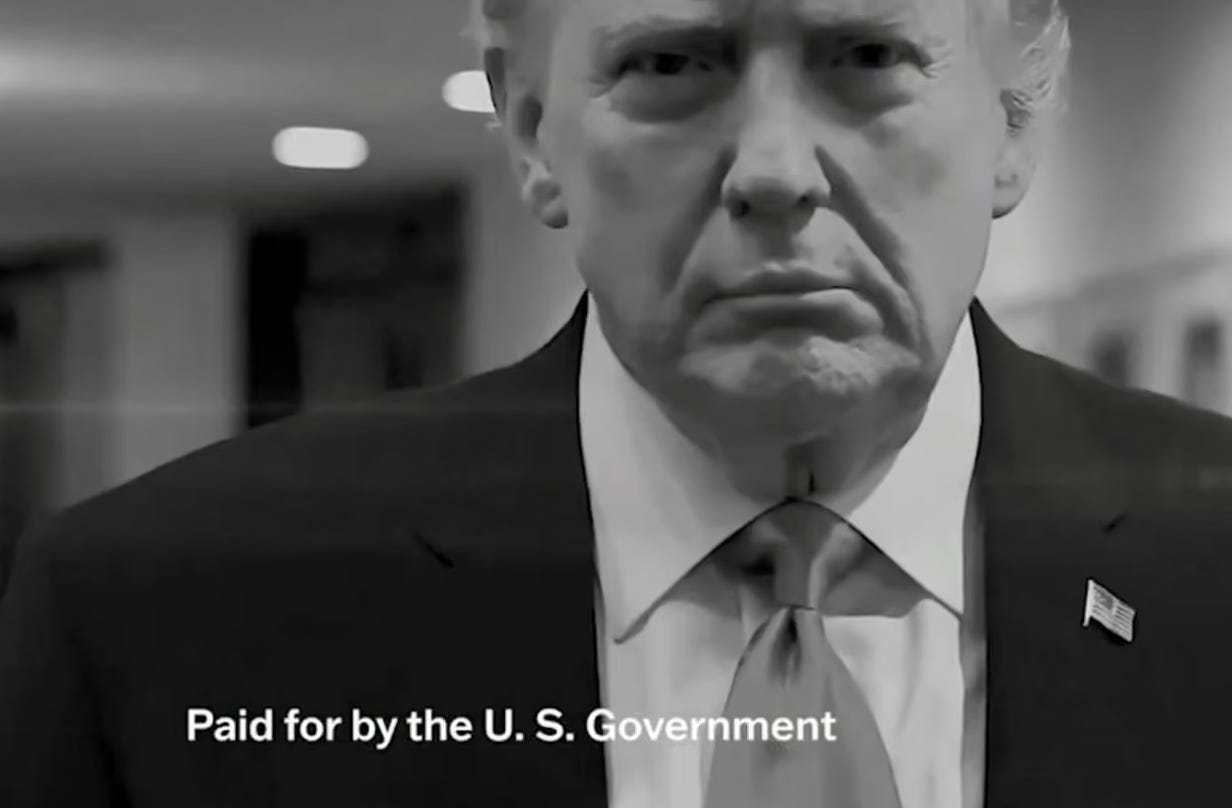
These videos are not “public service announcements” as the White House claims. They are clear attempts to boost Republicans’ chances in the impending midterm elections given their sagging poll numbers. The timing, content, and format of the videos all suggest they are covert attempts directed at the success of the Republican party. Trump’s exhortation in the first video that “we will defeat” “Marxism” and “communism” is nothing but a coded call to support Republican candidates. President Trump frequently calls his political opponents “Marxists” and it is clear the real targets of the ad are Democrats running for office in November whom he wants to frame as communists. Trump’s second video falls in the same mold, calling on the audience to “liberate America from these villains once and for all.” The villains in question? The “deep state,” the “globalists,” the “sick political class,” and the “fake news media.” All coded terms for Democrats, whom he was running against in 2024 when the ad was first produced. Even during the height of the McCarthy era and the Cold War, the United States government never came anywhere close to making an ad like this.
Political activity by government officials is highly regulated, and for a good reason. As the Supreme Court noted over 50 years ago, “it is not only important that the Government and its employees in fact avoid practicing political justice, but it is also critical that they appear to the public to be avoiding it, if confidence in the system of representative Government is not to be eroded to a disastrous extent.” That principle is enshrined in the Hatch Act, which prohibits abuse of authority that is directed to the success or defeat of any political party, candidate, or group.
While President Trump himself is legally exempt from the Hatch Act, any federal employee who worked on or used government resources to produce or disseminate these ads is bound by the statute’s provisions. The Hatch Act, among other things, specifically provides that “an employee may not use his official authority or influence for the purpose of interfering with or affecting the result of an election”
Any federal employee who was involved with the transfer or use of federal funds to make these ads or to run them on Fox News or Newsmax surely would have known that they would promote Republican party prospects in the impending midterms. Coded attacks are attacks nonetheless. As the Office of Special Counsel said just last week, “[a] communication need not contain express electoral advocacy for that communication to constitute ‘political activity.’” Rather, what matters is whether the activity is directed to the success of a political party. The Administration’s issuance of these inflammatory ads appears to serve no purpose other than to invoke fear against the Democratic party right in the middle of the midterm election. That is made all the more clear by the call to action that “Together, we will defeat communism, socialism, and Marxism” in America. These are the words of political mobilization that serve no clear non-electoral purpose. Any federal employees who participated in the creation, funding, and promotion of these messages most likely violated the Hatch Act.
The ads also appear to violate longstanding federal appropriations laws that prohibit using funds for “publicity or propaganda purposes within the United States.” Annual spending bills passed by Congress contain strict anti-propaganda clauses (such as Section 718 of the 2026 Consolidated Appropriations Act), which explicitly prohibit the use of taxpayer funds for publicity or unauthorized propaganda within the U.S.:
“No part of any appropriation contained in this or any other Act shall be used directly or indirectly, including by private contractor, for publicity or propaganda purposes within the United States not heretofore authorized by Congress.”
This prohibition prevents use of funds for the exact type of self-aggrandizement and partisan political messaging that is at the heart of these ads. Put another way, this prohibition ensures that the United States, a democracy of “We the People,” cannot maintain a government sponsored propaganda machine aimed at discrediting and neutralizing political opposition. Congress knew in its foresight that the executive branch might seek to violate that principle and use the immense powers of government to glorify government officials and engage in political propaganda. That is why the representatives of the people utilized the power of the purse to make sure that federal funds are not used for publicity that is not expressly authorized by Congress (for example, public service announcements that address public health, law enforcement, and similar subjects).
When the Trump Administration converts taxpayer money to use for partisan hype-pieces, it not only affronts the law, but it inevitably leads to the diversion of taxpayer funds from important government programs that support the American public. And in using taxpayer money to do so, Administration officials run the risk of violating the appropriations laws, including the Purpose Statute (which prohibits using money for any purpose other than is provided by law) and the Antideficiency Act (which prohibits any government official from using money in excess of the amount provided for by Congress).
The principle is clear: no president should be able to raid the Treasury for his own political goals or glorification. At base, ads that serve no purpose in supporting the proper administration of the nation’s laws, but are simply partisan messaging and propaganda, have no role in the governing of our country. While private citizens exercising their First Amendment right to free speech may take any position they want, the awesome powers of the United States government should never be used to entrench political propaganda lest we invite the creation of an American version of George Orwell’s infamous Ministry of Truth.
Richard W. Painter is the S. Walter Richey Professor of Corporate Law, University of Minnesota Law School, and former Associate Counsel to the President and chief White House ethics lawyer for President George W. Bush.
Virginia R. Canter is chief counsel and director for ethics and anticorruption at Democracy Defenders Fund and former associate counsel to President Barack Obama and President Bill Clinton.
Christopher J. Swartz is Senior Counsel and Deputy Director for Ethics at Democracy Defenders Fund and former Acting Chief of the Ethics Law and Policy Branch at the U.S. Office of Government Ethics.
Norman L. Eisen is executive chair and founder of Democracy Defenders Fund and former special counsel to President Barack Obama. He is the publisher of The Contrarian.