


For days before President Donald Trump met Xi Jinping and Vladimir Putin — his Chinese and Russian counterparts — in Shenzhen, news coverage invoked the 1945 Yalta Conference. The comparisons invited audiences to imagine three powerful leaders preparing to reshape the world, much as Franklin Roosevelt, Winston Churchill, and Joseph Stalin had done during the final months of World War II.
A trilateral summit between the current leaders would be unprecedented and the photographs promised to be memorable. There was just one problem. Little in the geopolitical realities of today suggested that they were about to reshape the international order.
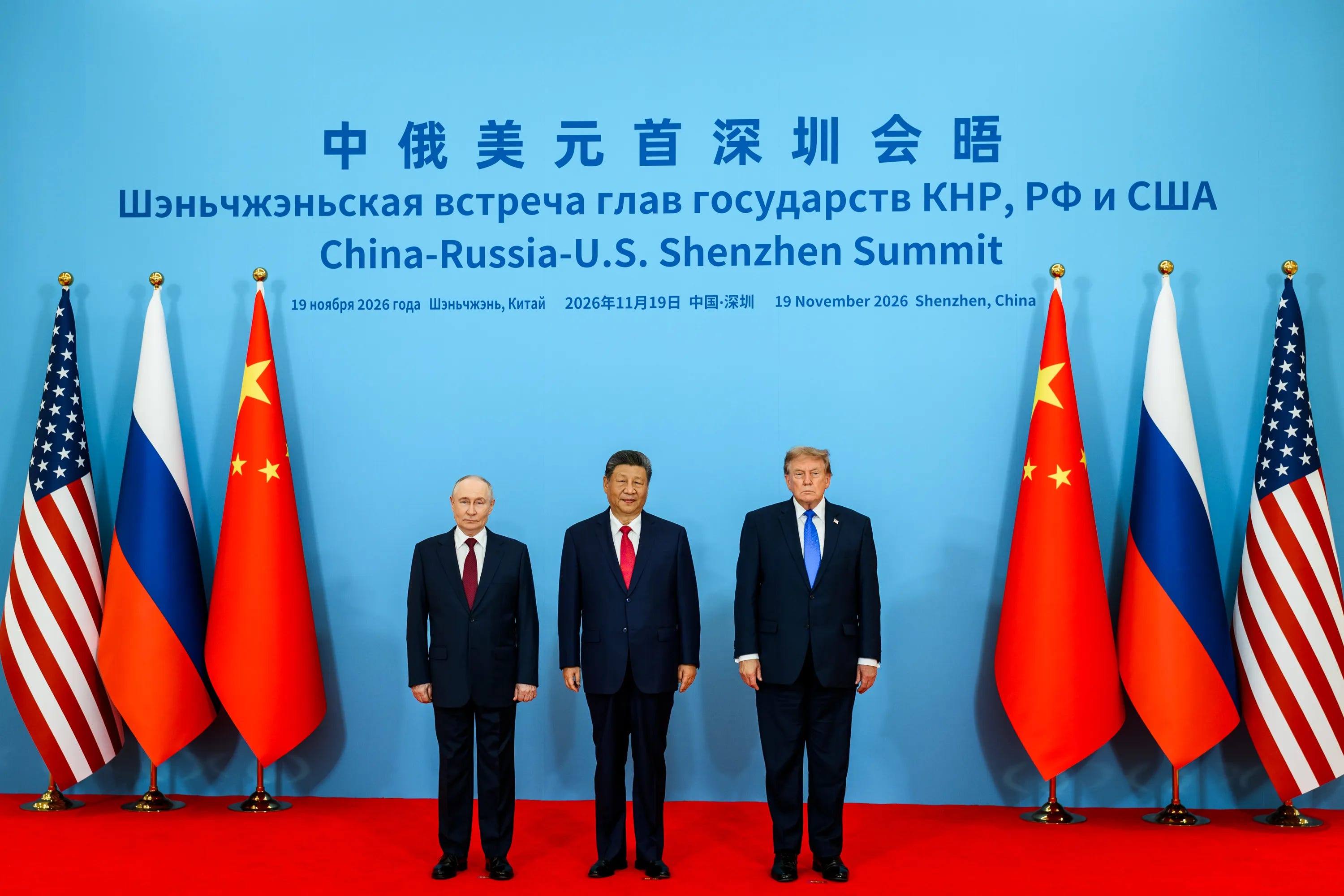
When the meeting ended after less than 90 minutes, the results were expectedly modest. The leaders pledged to increase supplies of refined petroleum products, continue dialogue on nuclear risks, reform the United Nations, and reaffirm their rejection of the International Criminal Court’s authority
The gap between the advance coverage and the summit’s meager results was striking. It reflected journalism driven more by the need to attract an audience than by the discipline of reporting. Trump could hardly have asked for more accommodating coverage.
Trump has long cultivated a Churchillian portrayal of himself, convinced that personal determination can bend history to his will. The practiced scowl and insistence that only he can solve the world’s problems all serve that image. And the summit gave him a chance to reaffirm that image after his party’s drubbing in the midterms.
Xi and Putin understood this.
Both have spent years feeding the ego of the American president, who craves personal recognition, elaborate hospitality, and expressions of respect. They know that indulging Trump’s self-image can be more productive than challenging his claims of diplomatic mastery.
Consider Trump’s remarks to Xi before their meeting. He praised their personal relationship and suggested that as long as the two men remained in charge, their countries would never have a problem.
That is an extraordinary assertion about two countries whose competing interests extend from Taiwan and the South China Sea to technology, trade, and nuclear weapons.
Trump said a key objective for him was to begin reducing the nuclear arsenals of the United States, Russia, and China. Since the expiration of New Strategic Arms Reduction Treaty in February, the world’s two largest nuclear powers no longer operate under its binding strategic weapons limits. China continues expanding its considerably smaller arsenal and has resisted American efforts to bring it into arms-control negotiations.
Shenzhen produced a “declaration of peace” that “nuclear war cannot be won and must never be fought” — a principle Ronald Reagan and then-Soviet President Mikhail Gorbachev articulated in 1985. Reaffirming it is sensible. Calling it progress toward disarmament is delusional.
The other commitments were hardly more impressive.
For Putin, the meeting itself was a prize. After years of war in Ukraine, the Russian president sat alongside the American and Chinese leaders as an equal participant in discussions about international security. He obtained another measure of diplomatic rehabilitation without agreeing to withdraw troops, moderate his demands, or end his invasion.
There was considerable irony in Putin lecturing the world about preserving international law while his military continues its assault on a sovereign neighbor.
Xi had a different objective: maintaining the status quo. Beijing has little reason to alter its strategic course when it can buy time to strengthen its position simply by flattering Trump. Red carpets, expressions of friendship, and assurances of mutual respect are a small price for diplomatic stability without new constraints on China’s behavior.
What the three leaders left out of their final declaration is just as important as what they announced.
Trump discussed the war with Ukraine separately with Putin, but the declaration contained no commitment to ending the invasion, restoring Ukrainian sovereignty, or changing Moscow’s demands.
Xi raised Taiwan during his bilateral meeting with Trump. But the trilateral declaration offered nothing addressing China’s continuing military pressure or its attempts to intimidate the island nation.
Trump had identified Iran as a subject for discussion. Yet the joint statement contained no commitment from China or Russia to alter their relationships with Tehran or address the consequences of the ongoing conflict.
The summit left the most consequential disputes largely where they stood before the leaders assembled. Which brings us back to Yalta.
Roosevelt, Churchill, and Stalin confronted the realities of a world war and the difficult decisions that would shape its aftermath. Trump, Xi, and Putin met amid competing ambitions but produced little evidence that they had altered the international order.
Xi and Putin did not need to divide the world at Shenzhen. They needed only to preserve their interests while allowing Trump to believe he had made history.
And Trump probably does.
Brian O’Neill, a retired senior executive from the CIA and National Counterterrorism Center, is an instructor on strategic intelligence at Georgia Tech. His Safehouse Briefing Substack looks at what’s ahead in global security, geopolitics, and national strategy.
