


Any summit Donald Trump hosts or attends carries the same expectation. If he is meeting with an authoritarian leader, the tone is often indulgent. If he is dealing with allies, it is usually grievance first, qualified solidarity later.
The NATO summit in Ankara this week followed that script. President Trump arrived saying he was “not happy with NATO”; stating that he doesn’t want “anything to do with Spain”; criticizing France, Germany, Italy, and Britain for not backing the U.S.-Israeli war against Iran; reviving his demand for Greenland; and casting doubt on the Iran ceasefire, calling the leadership in Tehran “cuckoo.” Later, seated beside Ukrainian president Volodymyr Zelenskyy, he compared Russia’s war against Ukraine to two children fighting in a park — a brawl that, in his telling, may be worth allowing to tire itself out before an adult intervenes.
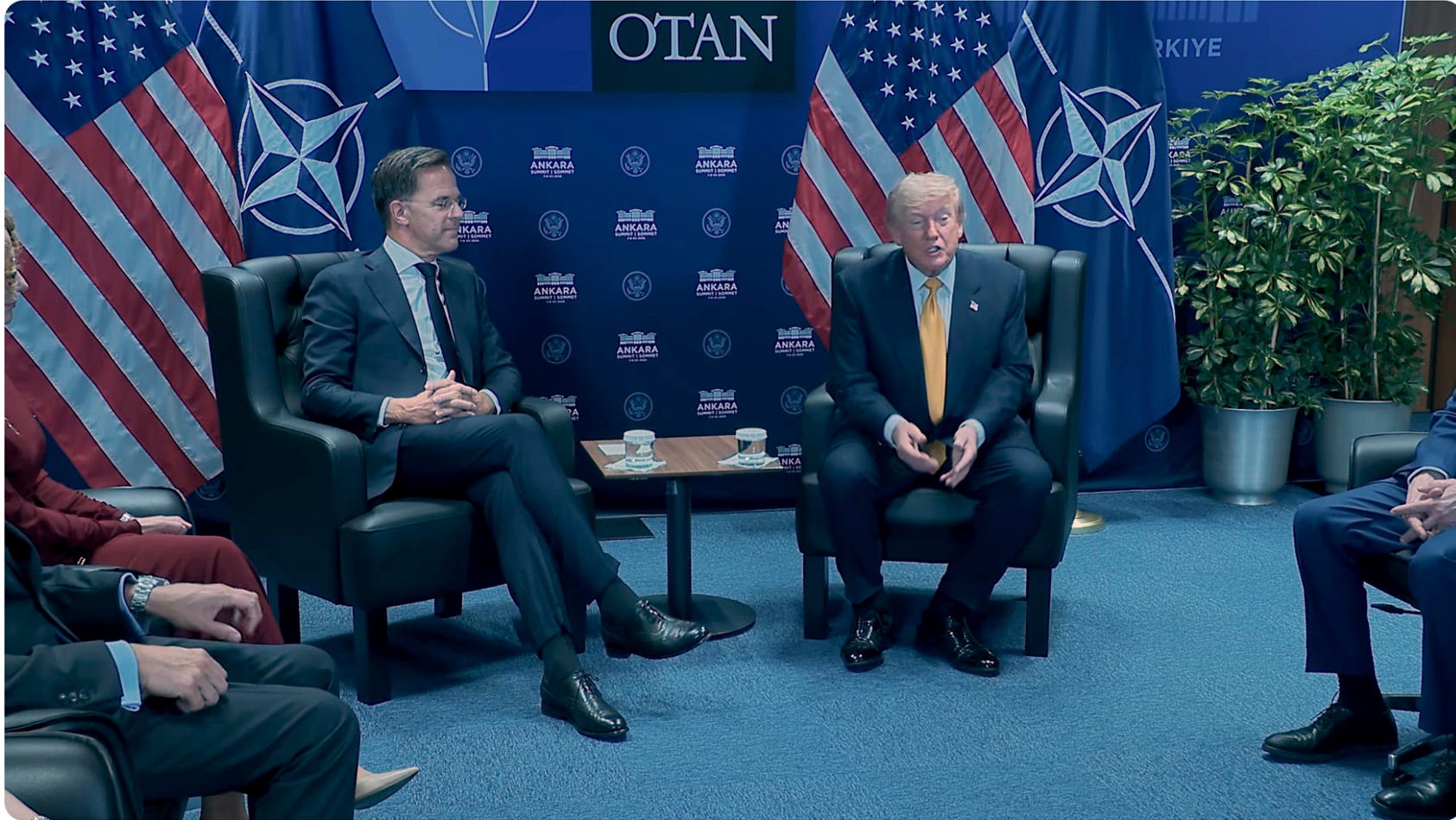
By the closing press conference, he was praising Turkish president Recep Tayyip Erdoğan, NATO secretary-general Mark Rutte, and NATO’s “tremendous unity” and “tremendous love.”
That sequence offered little solace and even less clarity. It also ensured that much of the press coverage would focus on Trump’s performance rather than the summit’s outcome.
That is understandable, but hiding behind Trump’s proclamations of being a master negotiator and recounts of his endless successes were a number of positive developments.
Ukraine did not get NATO membership, nor did it receive the kind of formal security guarantee that would make Russia’s war a direct war with the alliance. It did receive a set of practical gains that may matter more in the near term than another carefully negotiated sentence about Ukraine’s eventual place in NATO.
Zelensky received a renewed aid pledge from Europe and Canada, reportedly totaling about $80 billion over this year and next. Some of that money repackages earlier commitments, but the direction is still important. The alliance is not simply asking whether the United States will keep arming Ukraine. It is trying to create enough European and Canadian support to sustain Ukraine even as Washington becomes more conditional, transactional, and politically unpredictable.
The most notable Ukraine announcement came with Trump announcing that he would grant Ukraine a license to manufacture Patriot air-defense systems. “We’ll give them the right to make Patriots,” he said. “We’ll show them how to do it.” He also framed the offer in characteristically transactional terms: “This way, you can’t complain that we’re not giving them enough.”
A Patriot license will not result in Ukraine immediately manufacturing interceptors. The system involves complex components, supply chains, subcontractors, certification, and U.S. defense firms that Trump said had not yet been informed. The practical effects could range from symbolically important to strategically significant. Meaningful production could take years.
But even an imperfect licensing decision would mark a conceptual shift. Since Russia’s full-scale invasion, NATO summits have often been judged by what they said about Ukraine’s membership path. Vilnius in 2023 removed a procedural obstacle but withheld an invitation. Washington in 2024 called Ukraine’s path “irreversible,” a word that sounded stronger than it was. In 2025, the mood darkened: JD Vance berated Europe, and Trump told Zelenskyy in the Oval Office that Ukraine did not “have the cards.”
Ankara did not give Ukraine the card it wants most, but it did give Kyiv a place deeper inside NATO’s wartime supply chain.
For the first time, the United States publicly signaled a willingness to move Ukraine beyond the role of customer. Until now, NATO’s support has largely been measured by what it was willing to transfer. The Patriot announcement suggests Washington is at least prepared to discuss what it is willing to share.
At the end of the summit, NATO issued a communiqué that reaffirmed Article 5, restating that an attack on one member is an attack on all. The language does not eliminate doubt among members in Europe and Canada about the United States’ commitment to the alliance, but it preserves the formal commitment at a moment when even formality has strategic value.
For NATO, that may be the summit’s most important achievement. The alliance bought itself more time. In the past year, European governments and Ottawa have been preparing for a NATO in which American military power remains indispensable but Washington’s long-term commitment is questionable.
The value of that time is practical. Europe and Canada are engaged in the largest military rebuilding effort in a generation. Higher defense budgets are only the beginning. New production lines, expanded munitions capacity, missile defense, strategic lift, logistics, intelligence support, Arctic capabilities, and command structures all require years to build. Ukraine has become part of that effort — not only because it needs weapons today, but because its battlefield experience and industrial capacity are increasingly viewed as assets for Europe’s own long-term security.
None of that means NATO’s underlying problems have been solved. The summit reaffirmed Article 5, but words do not answer the far more difficult question hanging over the alliance: whether the Trump administration ultimately reduces American troop levels in Europe or continues to make U.S. security guarantees contingent on political and commercial concessions. Those possibilities remain real. They simply were not realized in Ankara.
That may explain why European leaders probably left Turkey cautiously satisfied. They secured the symbolic deliverables they needed, avoided an open rupture with Washington, preserved support for Ukraine, and bought another stretch of time to rebuild their own capacity.
Trump probably left the summit satisfied for different reasons. He dominated the cameras, claimed credit for allied spending, showed off his Qatari-supplied Air Force One, and treated allied deference as proof that foreign leaders now bend to his terms. For him, that may be enough.
For NATO, the real measure of Ankara will come later: whether the alliance used the time it bought, or whether the next summit begins with the same questions under worse conditions.
Brian O’Neill, a retired senior executive from the CIA and National Counterterrorism Center, is an instructor on strategic intelligence at Georgia Tech. His Safehouse Briefing Substack looks at what’s ahead in global security, geopolitics, and national strategy.

"The Patriot announcement suggests Washington is at least prepared to discuss what it is willing to share."
I'm not so sure about that. While it sounds like a typical Trump toss-off--"I'll let you in on that licensing deal"--if the cabal realizes that production will take so long, they see it as nothing more than an unredeemed coupon. The war will likely be over before then, Trump will be gone, and whoever takes the WH next is left holding the bag, if there is one.
More likely in Trump's mind, though, a licensing agreement is one of the few things he recognizes, and somehow, he always gets a cut too.
Miles Taylor of Defiance.org
“US allies used to see Trump's moods
like bad weather, nasty but short.
They've concluded his temper tantrums are
the diplomatic equivalent of climate change.
Long-term & system-changing.
Now, they're planning for a future without us.”
https://x.com/milestaylorusa/status/2067574788478955535?s=61