


Last Thursday, the White House released its National Security Strategy (NSS)—a report since 1987 that every president has been required to send to Congress to spell out his administration’s strategic goals and priorities. This document provides Congress, the executive branches, and the public—and world leaders, allies and adversaries alike—a shared map of how the president understands the world and plans to act.
I’ve contributed to versions of such strategies from both the intelligence and policy side. They are, in one sense, window dressing. By the time an NSS is released, the speeches and decisions have already told you what really matters to an administration.
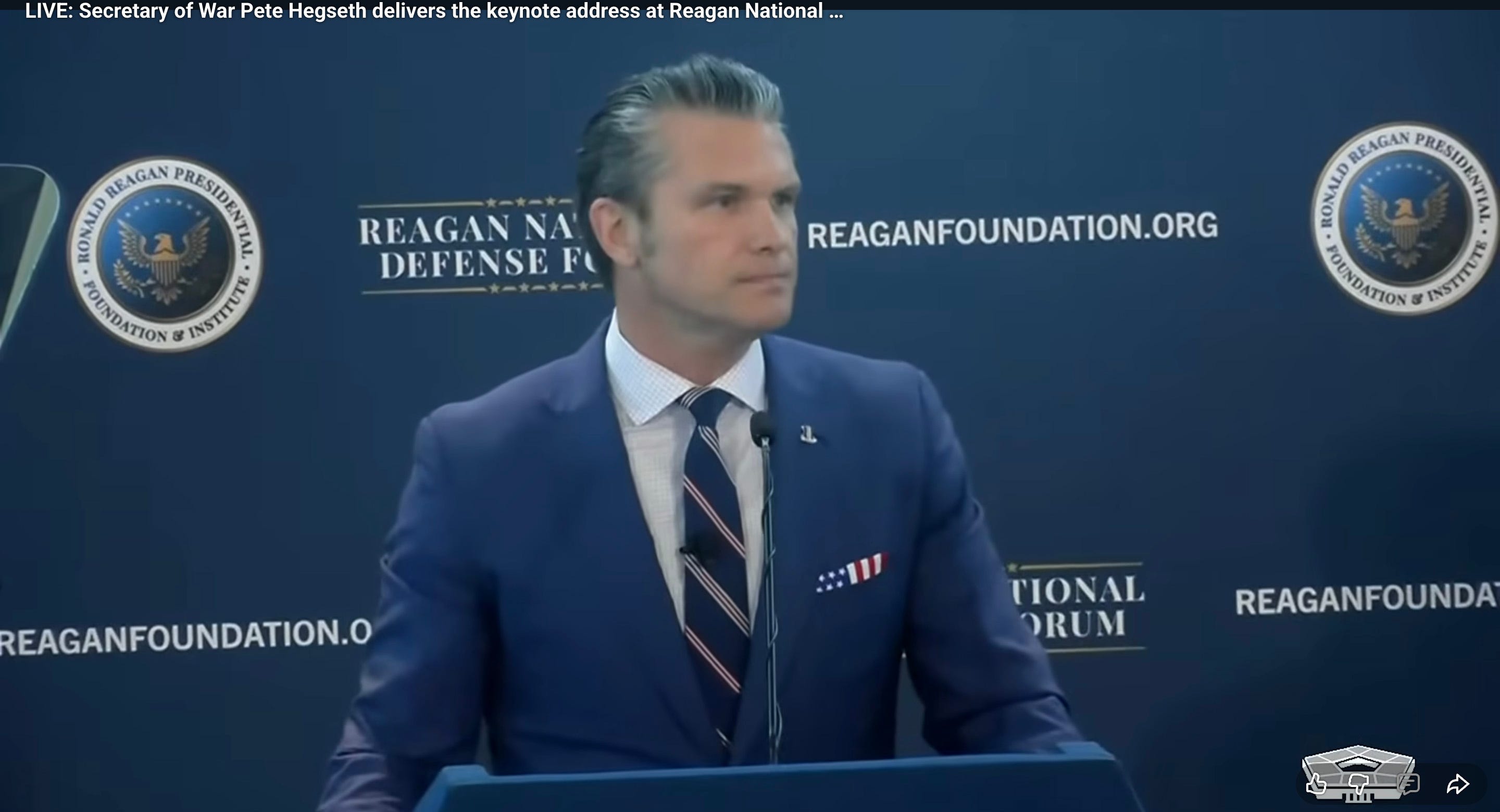
But they do capture an administration’s psyche—how a White House wants to explain itself to the country and to history. Measured against that standard, Trump’s new strategy stands out in ways we have not seen since the 1930s—a vibe that was clear on Saturday at the Reagan National Defense Forum, where Defense Secretary Pete Hegseth sold it as a doctrine of hemispheric dominance and civilizational struggle.
You can see the contrast by looking at NSSs from previous administrations. The 2017 Trump strategy reflected his “America First” theme, but it still looked like a normal product of the national-security machine. You could see the fingerprints of the “adults in the room” at the time. Joe Biden’s 2022 strategy also reflected the seriousness and qualifications of his national security team, which said its priorities were built around working with allies so together they were stronger than any aggressor—but with Washington still steering.
Trump’s new strategy comes from a different ecosystem. Trump’s current cabinet and national-security circle are dominated less by retired generals and national security specialists than by former television personalities and podcasters, and loyalists and foreign lobbyists whose main qualification is their on-air devotion. The result is an NSS that borrows the format of a strategy but keeps the argumentative style of cable news: enemies everywhere, friends sorted by loyalty tests, and constant assurance that whatever Trump favors is always what America “must” do.
The authors love posing one question: What do we want? The document revolves around “What Do We Want Overall?” and “What Do We Want In and From the World?” followed by pages of bullets that begin “We want.” It’s foreign policy as wish list. In under 30 pages, the document says the United States wants something 45 times and opens dozens of sentences with “We want.” But nowhere is there a serious explanation of how to pay for any of this, what gets less so something else can get more, or how these goals might collide with one another.
Superlatives do the rest of the work: “the world’s most powerful, lethal, and technologically advanced military,” “the world’s most robust industrial base,” “the world’s most robust, productive, and innovative energy sector,” and “unrivaled ‘soft power’,” all at once. The adverb “most” appears 40 times.
The biggest policy shift is an unapologetic return to an old idea: the Americas as “our” backyard. Under the section “What Do We Want In and From the World?,” the document says the United States will “assert and enforce a ‘Trump Corollary’ to the Monroe Doctrine”—the 19th-century policy that told European powers to stay out of the Western Hemisphere. The new strategy promises to keep the region “reasonably stable” to prevent large-scale migration and to block “hostile foreign” powers from owning key assets.
This isn’t just nostalgia. The Western Hemisphere chapter calls for shifting U.S. military focus back into the Caribbean and Latin America; more suitable Coast Guard and Navy deployments to “thwart illegal and other unwanted migration”; and using “targeted deployments…including where necessary the use of lethal force” against drug cartels and traffickers at sea. It also tells the National Security Council, backed by intelligence agencies, to map strategic resources and supply chains in the region and help U.S. firms move in, using federal financing.
Under “Promoting European Greatness,” the strategy says Europe’s real problem is the “stark prospect of civilizational erasure.” The accused culprits could have been lifted straight from speeches of Europe’s extreme-right parties: Brussels bureaucrats, immigration “transforming the continent,” censorship, low birthrates, and the loss of “Western identity.” “We want Europe to remain European,” the document announces, urging a revival of “civilizational self-confidence.” The hypocrisy—and the almost schizophrenic reflection of the administration’s real policy bets—is hard to miss: one side quietly cheers on nationalist, “civilizational” projects in Europe, while the other insists Washington has no interest in shaping other countries’ internal politics.
On economics, the themes are familiar. Trade deficits and “so-called free trade” are blamed for hollowing out U.S. factories; allies and rivals alike are accused of taking advantage of American openness. The cure, we are told, is tariffs, subsidized “reindustrialization,” “energy dominance,” and a sharp rejection of climate and “Net Zero” policies that supposedly weakened Europe and “subsidize our adversaries.”
Asia gets tough talk but thin substance. The strategy pledges to keep Asia and the Pacific “free and open,” deter war over Taiwan, and prevent any rival from dominating the South China Sea, while pressing Japan and South Korea to spend more on defense. There is almost nothing on what the United States is willing to build—trade rules, regional institutions, big infrastructure projects—beyond tariffs and arms deals. Africa gets even less: a short passage about shifting from aid to investment and securing minerals, even as China and Russia pour resources into ports, bases, and political influence there.
Trump’s strategy treats national security as if it were a game of Risk. The board’s map looks the same, so Trump behaves as though he can simply declare the rules changed and everyone else will accept them, as if other players’ needs, capabilities, and resources are irrelevant. In that world, a 1935 “fortress America” playbook looks logical. In the real world, many of the players are edging away from the table and setting up new games with different partners.
National Security Strategies are always part analysis, part sales pitch. This one adds something else: a kind of interwar nostalgia, as if the 1930s were a template rather than a warning. A fortress-hemisphere mindset, civilizational talk, and economic grievance made sense for middling powers trying to stay out of trouble. Coming from a superpower with global bases, a dominant currency, and unmatched intelligence and strike tools, this strategy looks less like “realism” and more like a promise to use those tools in service of something smaller than strategy: what one man, and the circle around him, happen to “want.”
Trump has been eager to say, in effect, “Where we’re going, we don’t need roads”—no allies, no institutions, no guardrails, just American leverage and will. The problem is that everyone else sees the potholes ahead, and more than a few are already looking for another route.
Brian O’Neill, a retired senior executive from the CIA and National Counterterrorism Center, is an instructor on strategic intelligence at Georgia Tech. His Safehouse Briefing Substack looks at what’s ahead in global security, geopolitics, and national strategy.

We were once a nation built by labor and innovation. Now it's just a bunch of hot air. Our adversaries are easily smarter than Trump and will figure out how to pop the balloon.
The US is a bunch of “gimme” and a whole lot of “thank you, ma’am“ but nothing of doing anything to earn the adjectives of best and most. Nothing there to encourage actually building and doing anything to benefit the community, state, nation or humankind. Thank you, Dr O’Neill.