

By David Bernell
The growing divide between the United States and Canada continues, driven by Donald Trump. The President has chosen to sow animosity and engage in a trade war, disrupting $872 billion in commerce and poisoning relations with what has been a friendly, peaceful, loyal neighbor. It’s difficult to find a reasonable explanation for Trump’s behavior because there isn’t a good reason to inflict such damage to a relationship that has been so close for so long.
Trump’s ego, his desire for dominance (and for others’ acknowledgement of their subordination), and his view of international relations that sees trade and alliances as a burden and cost to United States are the only motives that can plausibly be offered for his ongoing dispute with Canada. If the president cannot impose his will on other people and countries — no matter the issue — he seems to view this as weakness, both personal and national.
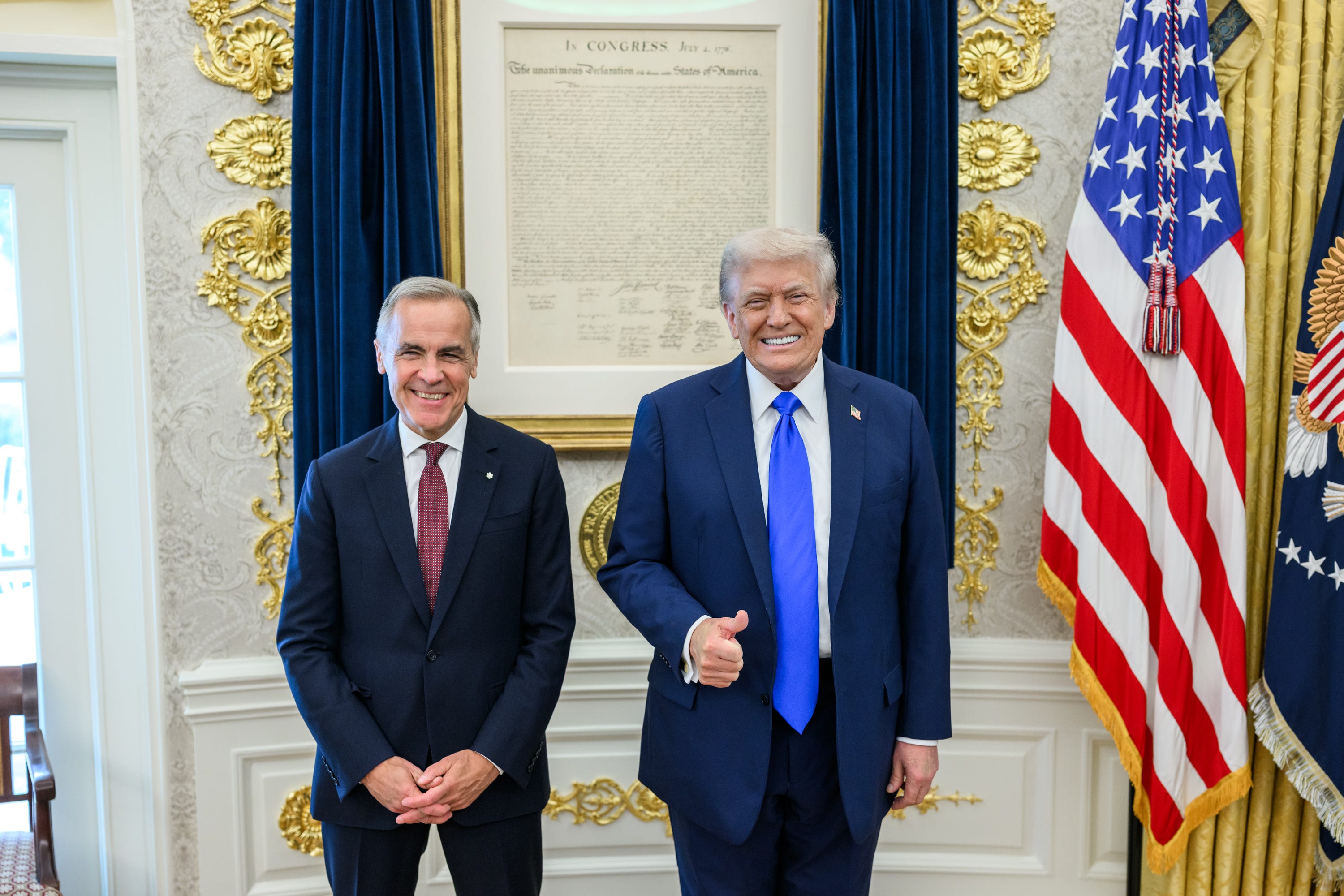
Trump’s drive for supremacy and the subservience of others has been a feature of his presidency and the element fueling the exercise of his power. Selecting incompetent people for his Cabinet (see Pete Hegseth and Robert Kennedy for starters) and getting Republican senators to fall in line and confirm his nominees (see Bill Cassidy) even though they knew unqualified people were being put in positions of responsibility has been the point. A similar dynamic has been present in NATO. Trump has made repeated threats and demands, while alliance leaders try to limit the damage Trump can do — with regard to Ukraine and Russia, Greenland, trade, and the future of the alliance itself — by appeasing Trump and offering effusive praise (see NATO General Secretary Mark Rutte).
Though Republican members of Congress remain too fearful of Trump to offer much opposition, the tide has been turning overseas, as other countries are less willing to concede to Trump’s ego and mercurial nature to stay in his good graces. The person who has led the way: Canadian Prime Minister Mark Carney.
Mark Carney to Canada’s Rescue
Carney, who replaced Justin Trudeau in March 2025, is meeting the moment, not only for Canada but for the free world. His prior career had been in finance and central banking. After earning a Ph.D. in economics at Oxford University, he worked at Goldman Sachs and the Canadian Finance Ministry. He was governor of the Bank of Canada from 2008 to 2013 and governor of the Bank of England from 2013 from 2020. (These positions are equivalent to chair of the U.S. Federal Reserve.) Though it was widely believed that the Canadian Liberal party would be voted out after several years in power, Carney won an election he called in April 2025 by making it about who would take on Trump and fight for Canada’s interests.
Since his return to the White House in 2025, Trump has had his eyes on Canada. One of his first actions was to impose steep tariffs on Canadian and Mexican imports, saying that these countries were taking advantage of the United States. Trump sees trade as a subsidy to others, so he wanted to make American trading partners pay with tariffs for access to the American market. His erroneous view that other countries are paying for such access — when in reality American companies and consumers pay through higher prices and inflation — has not budged. Trump has also talked repeatedly about making Canada a part of the United States, saying that “Canada would be much better off being the 51st state” and that it is “not viable as a country.” He even repeatedly called Carney’s predecessor “governor” as a taunt.
Carney in effect said “enough.” He argued last year that Canada could no longer count on the United States. Trump’s comments about annexing Canada, he stated, “are not idle threats. President Trump is trying to break us so that America can own us.” Moreover, he told his fellow Canadians that their country was entering a new era: “We are over the shock of the American betrayal, but we should never forget the lessons. We have to look out for ourselves.”
Carney has characterized Trump as a threat to peace, order, and prosperity. At Davos in January, Carney spoke about Trump’s threats to take Greenland by force. He said that in the past, “American hegemony helped provide public goods, open sea lanes, a stable financial system, collective security and support for frameworks for resolving disputes.” But now, he argued, “This bargain no longer works … great powers have begun using economic integration as weapons, tariffs as leverage, financial infrastructure as coercion, supply chains as vulnerabilities to be exploited.” Saying that “the rules-based order is fading,” he maintained that the only honest assessment is to acknowledge that “we are in the midst of a rupture, not a transition.” It was time to abandon hope that countries could “go along to get along, to accommodate, to avoid trouble, to hope that compliance will buy safety.”
Carney’s understanding of Canada’s relationship with the United States informed the latest round of trade negotiations between the two countries, which ended without an agreement as talks broke down on August 18. The on-again, off-again tariffs that the United States had imposed since Trump returned to office had been the subject of months of negotiations. An especially intense three days of talks took place in response to the U.S. imposition in July of 50 percent tariffs on several Canadian goods. It had appeared that a deal would be struck. However, in the end, Carney told his team to suspend the negotiations. He identified two major issues to which he said he could not agree, as they amounted to undermining Canadian sovereignty.
One issue had to do with the French language. Canadian law requires French-only product labeling for goods imported to Quebec, as well as online media and tech companies to promote Canadian content, including French language programming in particular. The United States wanted an exemption from these requirements. Carney responded that this demand was an unacceptable threat to the French language and the culture of Quebec. A second issue was seen as an even greater challenge to Canada’s sovereignty. The Canadian team accused the United States of introducing a demand late in the negotiations that would allow the United States “to be able to review and potentially dictate the terms for Canada’s trade agreements with other countries.” These were seen as going too far, prompting the prime minister to proclaim that he would protect Canada’s culture and would never compromise Canada’s sovereignty: “The attitude, at the negotiation table, that Canada is a subsidiary of the United States … that’s not something we’re going to accept.”
“Unfriending” One’s Friends
The relationship between the United States and Canada has been close and friendly for more than 150 years. The two countries have the longest undefended border in the world. They have shared common interests in advancing liberal democracy, maintaining open trade, and partnering in mutual defense as part of the NATO alliance.
Recent developments serve as another chapter in the story of the American retreat from its post-World War II global leadership role and speak to the larger disengagement from, and even hostility toward, the community of nations to which the United States has bound itself for decades. Trump’s America is not simply redefining its relationships with its friends, allies, and trading partners; it is actively breaking them.
The importance of the United States to the global order can be seen in the reactions to Trump and the U.S. government since January 2025. Seemingly daily, Trump has said, proposed, threatened, or actually done something — tariffs, ending foreign aid programs, picking a fight with Volodymyr Zelenskyy in the Oval Office, rolling out the red carpet for Vladimir Putin, seeking to revive the Monroe Doctrine, longing for Greenland and Canada, withdrawing from international agreements and organizations, ousting the leader of Venezuela, and waging war against Iran — that sparked a substantial global reaction. There has been no shortage of commentary and analysis (including mine) discussing some way in which Trump is destroying so much of what the United States and the world have built over the past 80 years.
This is because the United States has long held global political, economic, military, and institutional influence and power. No other country has rivaled the United States in possessing and exercising such capability. Even though numerous countries may have wanted to ignore Trump’s utterances and policies, the very turbulence of his tenure has illuminated the dilemma others face: America’s centrality meant that Trump couldn’t be ignored.
But things are changing. U.S. significance is being diminished. NATO’s European members are putting up more money to supply Ukraine, U.S. foreign aid to developing countries is slowly being replaced, China’s trade with the world is growing, energy markets are responding to the closure of the Strait of Hormuz and keeping oil and natural gas prices lower than expected. The world is learning how to get along without a vast U.S. role and presence. Moreover, there is widespread recognition around the world of U.S. failures in Iran, growing familiarity with Trump and the realization that it’s possible to disregard what this White House says, hightened realization that the United States cannot be counted on to make a credible commitment, and a willingness to follow through with the type of disengagement Canada is undertaking. All this speaks to a greater ability and disposition to build a post-American order.
Getting to “There” from “Here”
It is unclear what this emerging order will look like. Maybe it will involve a dominant China exercising its own global leadership or dominance. It could involve a multipolar world with one pole being a European-based liberal democratic community. Maybe the United States will have more resilience and standing than appears possible in the middle of the Trump presidency. Or perhaps there will be further descent into upheaval and conflict reminiscent of the 1930s.
No matter what unfolds, there is no going back to the way things were. Even if a Democrat wins the presidency in 2028 and seeks to rebuild what has been lost domestically and overseas, turning the U.S. government and U.S. foreign policy toward something more normal and reasonable, it will not be enough. The United States will find that other nations cannot or will not count on it as fully as they have in the past, and this will be true for a long time. Trust is easy to destroy and hard to rebuild.
Nonetheless, the United States can again be part of building a secure relationship among a community of nations with shared interests. It has done so in the past and can again. As President Bill Clinton once said, “there’s nothing wrong with America that cannot be cured by what’s right with America.”
David Bernell is a professor in the School of Public Policy at Oregon State University. He is coauthor of the Substack newsletters Defending Democracy, and Barrels to Batteries. He is also author of the books Constructing US Foreign Policy: The Curious Case of Cuba, and The Energy Security Dilemma.
Thanks so much for this reasoned look at an unnecessary conflict. At this point, though, Trump does not operate from a transactional standpoint on trade but a xenophobic one. Name a country that he DOES want to fairly do business with. His racism has spilled out over the edges and expanded to hatred of everyone not named Donald Trump.
It was easiest to start close to home, as he did in alienating Mexico and now our most reliable trading partner, Canada. It has nothing to do with trade and everything to do with xenophobic-driven humiliation. When you're as insecure as the poor little rich boy, everyone must be crushed in order to elevate yourself. What's funny is: that doesn't actually work. He's the same guy. You can't escape your failure, Donald.
It so heartbreaking what this clown of a President has done to our core values. Our government is filled with people who put into action nothing but cruel goals. I fear we will never recover.