

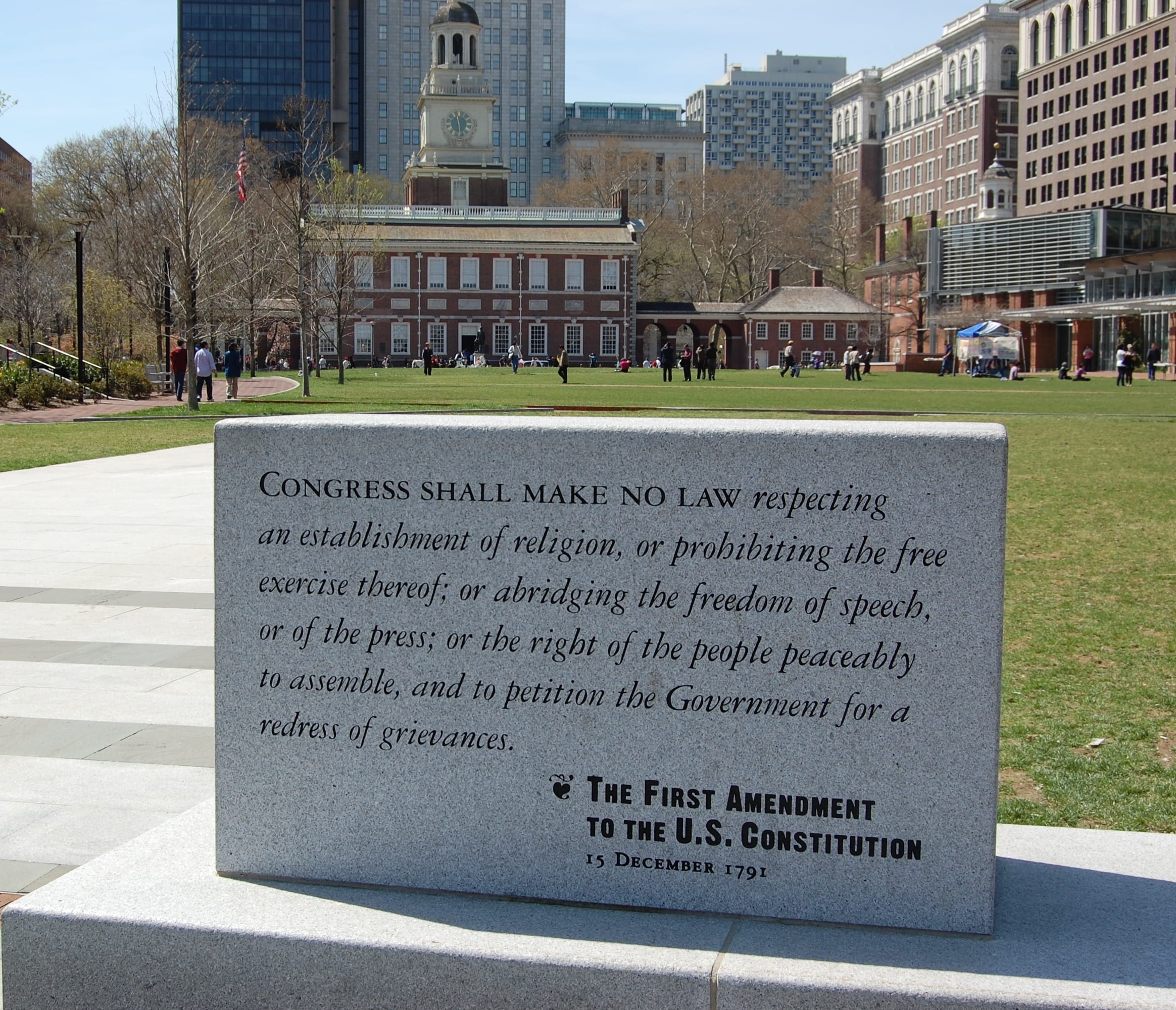
The First Amendment does far more than protect an individual’s right to speak. It protects the independence of the institutions through which ideas are formed, tested, challenged, and debated. Universities, newspapers, churches, law firms, advocacy organizations, and countless institutions of civil society exist not to serve the government, but to remain independent of it.
That independence is no accident. The Framers understood that the government would always be tempted to suppress ideas it considered dangerous, misguided, or simply wrong. They wrote the First Amendment, in part, to restrain our government from deciding what Americans may teach, study, publish, advocate, research, or believe.
Eighteen months ago, I wrote about “Trump’s Woke Presidency,” arguing that an extraordinary letter sent by Edward Martin — then Interim United States Attorney for the District of Columbia — to Georgetown University Law School represented a dangerous departure from that constitutional principle. Time has proven that Georgetown was not an isolated controversy. It was the blueprint.
In February 2025, Martin informed Georgetown that his office would refuse to hire its law school students and graduates unless Georgetown abandoned its commitment to diversity, equity, and inclusion and adopted a curriculum acceptable to him. The apparent DEI controversy was a smokescreen to obfuscate the real issue: whether a federal official could use the power of government to pressure an esteemed, independent university to change its curriculum.
Georgetown Dean William Treanor understood the constitutional stakes immediately. He rejected Martin’s demands, reminding him that, under the First Amendment, government officials have no authority to dictate a private university’s educational program or retaliate against students because of their institution’s viewpoints. Dean Treanor’s response defended more than Georgetown. It defended the constitutional independence of every university in America.
Martin’s office dropped its demands on Georgetown, and Martin’s own story eventually faded into the background after his nomination to become United States Attorney failed in the Senate. Earlier this year, the District of Columbia Office of Disciplinary Counsel charged him with violating his professional responsibilities by attempting to coerce Georgetown through the authority of his office. The Justice Department responded by suing the D.C. Bar, arguing that state disciplinary authorities lack the power to investigate federal attorneys acting in official capacities.
Reasonable people can debate the merits of that lawsuit. But regardless of how that litigation is resolved, it does not answer the constitutional question Martin’s letter first presented: May the federal government pressure an independent institution to adopt the government’s preferred ideology? That question has spread far beyond Georgetown. What began with one law school evolved into a nationwide strategy to use the leverage of federal power to reshape higher education.
Harvard University became the administration’s most prominent target. Billions of dollars in research funding were suspended or threatened. Multiple federal investigations were opened. The administration demanded changes involving governance, hiring, admissions, diversity programs, and other institutional policies. Harvard responded by filing suit, arguing that the federal government was attempting to use its spending power to compel ideological and institutional change rather than enforce federal law.
Columbia University chose a different path. Following the suspension of hundreds of millions of dollars in federal funding, Columbia negotiated with the administration and agreed to significant institutional reforms while seeking restoration of federal support. Whether viewed as a prudent compromise or a reluctant capitulation, the lesson to higher education was unmistakable: institutions that resist federal demands risk losing enormous financial support.
Naturally, the Trump administration’s efforts did not stop there. The University of California system became a target of funding freezes and federal investigations. Public universities and flagship institutions across the country faced increasing federal scrutiny over diversity initiatives, admissions policies, research priorities, campus governance, and institutional leadership. By early 2026, scores of colleges and universities had become subjects of federal investigations or funding disputes.
The strategy has continued to devolve. Rather than addressing universities individually, just last week Secretary of Education Linda McMahon issued a nationwide “Call to Action,” urging university presidents and governing boards to publicly embrace principles reflecting the Trump administration’s “vision” for higher education.
Standing alone, such a request may appear appropriate. Every administration is entitled to advocate educational reform. However, viewed in the context of Georgetown, Harvard, Columbia, the University of California system, and dozens of other institutions, the broader constitutional implications become clear.
The issue is not merely diversity, equity, and inclusion. Nor, for that matter, is it protocol regarding admissions, antisemitism, or campus governance. The issue is whether the federal government may continue its efforts to use its immense financial and regulatory authority to influence what independent universities research or teach.
The same tactics have been applied beyond higher education. Law firms have been targeted because of the clients they represent. Museums and cultural institutions have faced pressure regarding how American history should be presented. Federal employees have encountered restrictions on language and training. Independent institutions increasingly find themselves evaluated not merely on compliance with the law, but on whether they align with the administration’s perception of history, education, and public policy.
Supporters argue these actions merely correct years of progressive excess. They are entitled to oppose affirmative action, reject identity politics, or advocate educational philosophies. The First Amendment protects that debate. It does not, however, permit the government to compel institutions to adopt one side of it.
Simply put, criticism is constitutional, but coercion raises an entirely different question. That distinction lies at the heart of this administration’s objectionable behavior.
A recent Reuters analysis found that federal courts considered First Amendment claims in ninety-three cases involving actions by the administration — and ruled against it in seventy-five of them. Those decisions involved universities, journalists, religious organizations, law firms, protesters, researchers, media organizations, and others asserting violations of free speech, academic freedom, freedom of religion, or freedom of the press. Some rulings have been narrowed or reversed on appeal, but the broader pattern remains abundantly clear. Judges appointed by presidents of both political parties have repeatedly concluded that the administration crossed constitutional boundaries by retaliating against protected expression or engaging in viewpoint discrimination.
The Constitution imposes limits on every administration. It was written because the Framers understood that governments of every political persuasion eventually become convinced that their goals justify extraordinary exercises of power. The First Amendment exists to prevent that temptation from becoming policy.
Looking back, Edward Martin’s letter to Georgetown announced a governing philosophy. The universities, alleged issues, and dollar amounts changed. But the constitutional question has remained remarkably constant. May the government shape what independent institutions advocate, publish, or believe?
The First Amendment answers that question, without qualifications about which political party is in the White House. It answers with a limit on executive power. Governments may persuade or enforce the law. But a government may not use its coercive power to impose ideological orthodoxy on our independent institutions, which serve as the foundations of a free society.
That principle is neither liberal nor conservative — it is the First Amendment.
John F. Terzano is an attorney and social justice and human rights advocate who co-founded Vietnam Veterans of America Foundation (VVAF), an international advocacy and humanitarian organization that addressed the causes, conduct, and consequences of war. Terzano currently lives in Ludington, Michigan, where he continues to work as a social justice and human rights advocate, both locally and globally.
"The strategy has continued to devolve."
Love the word choice here. "Devolve" instead of evolve. Brilliant!
I'll "amen" that!