


The Jan. 28 federal raid on the Fulton County Election Hub outside Atlanta was designed to be theatrical. Federal agents executed a sealed warrant. Ballots, tabulator tapes, ballot images, and voter rolls were removed. Local officials were initially not permitted to see the warrant and were given little explanation. The props were familiar, but the escalation was new: The federal government treating the 2020 election not as settled history but as a live national security dispute.
What made this episode different was not the raid itself — courts sign warrants — but the unexpected presence of the director of national intelligence (DNI), Tulsi Gabbard, captured in one grainy photograph at the edge of the loading dock, phone to ear.
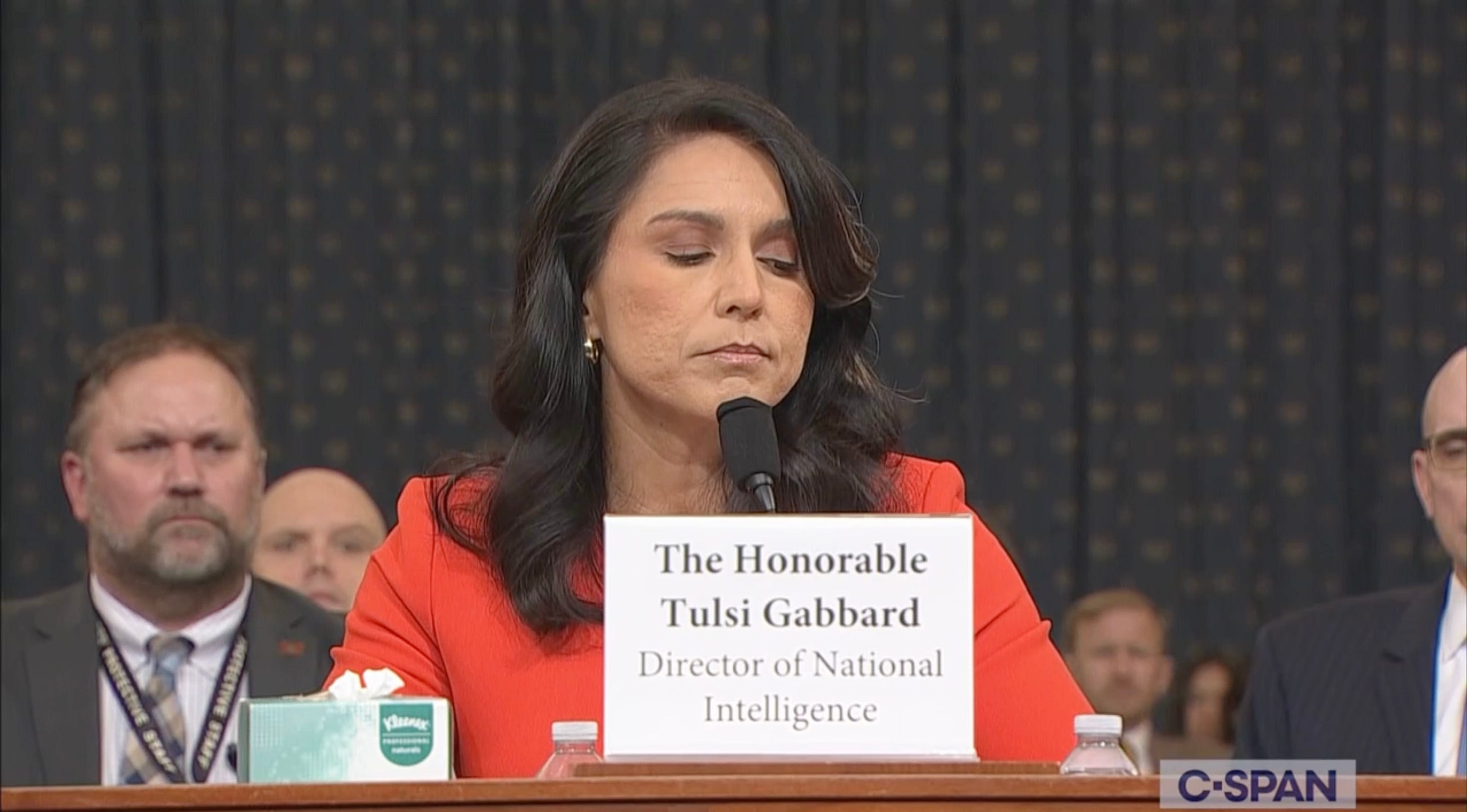
A federal search warrant does not automatically signal abuse. But inserting the DNI into a domestic evidence seizure does something more consequential: It wraps a political grievance in the authority of the U.S. intelligence apparatus. That move matters less for what it proves than for what it signals — to supporters, to agencies, and to Congress.
The Office of the DNI was created after the terrorist attacks on Sept. 11, 2001, to integrate intelligence — set priorities, manage budgets, reduce stovepipes — not to serve as a field presence in domestic law enforcement. The DNI does not attend ballot seizures for the same reason the CIA director does not stand beside immigration agents conducting operations in Minneapolis.
Why, then, was Gabbard there?
The administration’s public line can’t sustain a coherent answer. On Sunday, Todd Blanche said he did not know why Gabbard was present and stressed she was “not part of the grand jury investigation,” even as the White House described the DNI director as working in partnership with FBI Director Kash Patel on the president’s “election integrity” priorities.
Set aside the spin and consider motive.
One possibility is that her presence was meant to lend credibility to a conspiracy theory — recurring, long-discounted — circulating among Trump loyalists: that the 2020 election was stolen through a vast foreign-intelligence conspiracy involving everyone from Iran and Italy to China and Venezuela. These claims have been exhaustively discredited in court filings, audits, and recounts. They persist not because they are credible but because they are narratively useful.
If Gabbard’s presence was meant to signal a foreign-intelligence nexus, the contradiction is immediate — because she has spent her tenure narrowing, not strengthening, ODNI’s election-threat machinery. ODNI’s Foreign Malign Influence Center was built to integrate intelligence on state-backed influence operations, including those that target U.S. elections. The Office of the Director of National Intelligence has said the center’s functions would be absorbed elsewhere under Gabbard’s restructuring — effectively dismantling the dedicated hub while insisting the mission is being protected. That is an odd prelude to showing up at a domestic ballot seizure under the implied banner of “foreign interference.”
And if she genuinely believed there was a foreign intelligence operation behind 2020, she would have an obligation to inform Congress. Sen. Mark Warner (D-VA), a senior member of the Senate’s intelligence committee, said the committee was not briefed on any such foreign nexus. Treating the theory as serious enough to justify intelligence involvement while never taking it through oversight channels would itself be an institutional breach.
Congressional concern is certain to deepen with reporting that Gabbard met privately — when, it’s not clear — with FBI agents involved in the search and placed a call to Trump during the meeting, putting the president on speakerphone with frontline investigators.
Timing sharpens the picture. At the outset of her tenure, Gabbard — much like her counterpart at the Department of Homeland Security, Kristi Noem — invested much effort into building a performative public posture — high-production messaging and personal-branding theatrics. She sidelined the ODNI website — once the central channel for readouts and briefings — in favor of Netflix-style videos with cinematic edits, solemn narration, and stylized framing.
But Gabbard soon became, in an Orwellian sense, a kind of non-person — conspicuously absent since June from the visible centers of action and influence where an administration telegraphs who it trusts. This marginalization became unmistakable when she publicly reiterated the intelligence community’s assessment that Iran was not building a nuclear weapon — just as Trump was edging toward strikes. Trump dismissed her judgment outright: “I don’t care what she said.” She insisted they were aligned.
The signal was clear: Being right was not the currency. Being useful was.
Thereafter, the pattern was not that she stopped talking. During the administration’s most consequential foreign operation to date — the Jan. 3 mission to seize Venezuelan President Nicolás Maduro — the White House released “war room” photos that placed CIA Director John Ratcliffe at the president’s side. The only photos of Gabbard could be found on a social-media post — doing beachside yoga with a heart “filled with gratitude, aloha and peace.”
That absence didn’t require a conspiracy theory to explain it. Reporting and commentary at the time described her as kept out of the planning process — so far out that aides joked the initials “DNI” might as well mean “Do Not Invite” — with her public response arriving later and reading like an afterthought.
Georgia offered a path back: show up, be seen, sanctify the story — and claw back to relevance.
Gabbard lent intelligence imprimatur to a narrative about a rigged 2020 election that has repeatedly failed every evidentiary test. She did not need to believe it. She only needed to frame it as plausibly “national security-adjacent.” Once the DNI does that, the intelligence brand supplies legitimacy the claim itself lacks.
The precedent does not stop with elections. If intelligence authority can be used this way once, it can be used again. Protest movements become foreign-influenced networks. Political opponents become counterintelligence concerns. Ordinary democratic conflict is recoded as a security threat. It becomes a template for 2026 and 2028: not necessarily repeated raids, but repeated insinuation that results are an open question — because the intelligence community is “looking into it.”
This is how institutions erode.
In an administration where usefulness outweighs judgment and loyalty is rewarded over competence, the temptation to wrap politics in intelligence is strong. Atlanta should be read not as a one-off stunt but as a warning about what happens when the nation’s intelligence integrator decides that being back in the room matters more than protecting the room itself.
And for Gabbard, relevance is for the only goal — with the intelligence community as collateral and public trust as the price.
Brian O’Neill, a retired senior executive from the CIA and National Counterterrorism Center, is an instructor on strategic intelligence at Georgia Tech. His Safehouse Briefing Substack looks at what’s ahead in global security, geopolitics, and national strategy.

That she would call the President asking him to address the agents suggests they may have balked at their orders and wouldn't take her word on the matter. He avoids giving instructions but gives the agents some praise and encouragement to blah blah blah be patriots and make america great again. This is insane and it needs to be widely exposed and litigated. In addition we need much more direct action resistance. We need sympathetic hackers, leakers and creative non-violent tricksters moving to gum up the machinations of ICE, FBI, NSA etc etc etc. See 'Boston Tea Party' or Edward Abbey's novel 'The Monkey Wrench Gang."
It scares me to death what this regime is doing to undermine a republic that has lasted almost 250 years. They invented fake news to use against anything they don't want to hear, and now they use it to disregard litigated outcomes again and again! All the men and women that paid the ultimate price for this country are turning over in their graves. It's a sad state of affairs!