


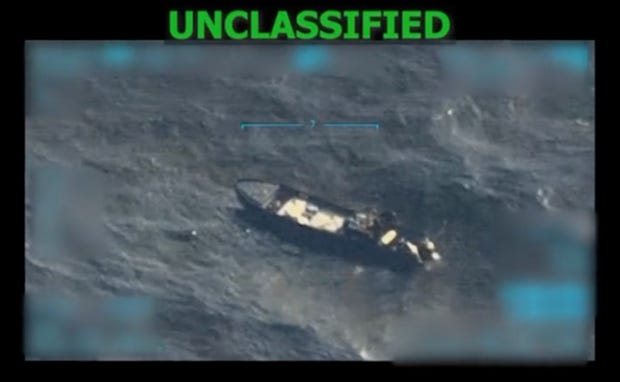
President Donald Trump said last week that he had authorized the CIA to conduct covert action in Venezuela—an extraordinary public confirmation of an instrument designed to be unacknowledged. He paired that with a hint of escalation: Having struck alleged drug-smuggling boats at sea, he is now “looking at land.”
That statement did not arise in a vacuum. Over recent weeks, U.S. forces have conducted multiple lethal strikes on suspected drug-smuggling vessels in the southern Caribbean Sea; casualty counts vary by incident reporting, but press tallies place the deaths in the dozens. Caracas has already asked the United Nations Security Council for an emergency session, warning an attack might be imminent; U.N. officials are urging restraint. Citing the death of a Colombian fisherman in a mid-September U.S. boat strike, President Gustavo Petro accused Washington of “murder”; in response, Trump threatened to cut aid to and impose tariffs on Colombia. Petro then recalled Bogota’s ambassador
The operational picture is not subtle. Open-source defense analysts have tracked the MV Ocean Trader—a U.S. Special Operations “ghost ship”—working the Caribbean approaches, and the Air Force staged a high-visibility B-52/F-35 “attack demo” near Venezuela’s airspace. These are scaffolding moves: They advertise options beyond episodic maritime strikes and create a menu for quick expansion if the White House orders it.
Let’s put aside, for a moment, that this president behaves as if he’s role-playing in a shabby 1960s spy movie—more Austin Powers than James Bond—and focus on the substantive consequences of his declaration.
First, covert action is defined in U.S. law as an activity intended to influence political, economic, or military conditions abroad but where that role “will not be apparent or acknowledged publicly.” Announcing it undercuts plausible deniability, invites countermeasures, and turns an intelligence instrument into a political prop. It also hands Venezuelan President Nicolás Maduro a ready narrative at home and at the United Nations.
The immediate effect is that it buys Caracas time—to harden targets, seed deception, and mobilize sympathetic governments for procedural fights. The longer-term effect is corrosive: allies, assets, and liaison services start to question whether sensitive authorities will be turned into applause lines the next time a microphone appears.
Second, the pattern points to a bigger frame. The administration is signaling a hemisphere-first doctrine—a Monroe in modern clothes. Keep extra-regional powers out of the Americas; accept more risk elsewhere. That frame is migrating from podium to policy. The forthcoming National Security Strategy (NSS)—a formal statement of presidential priorities required by Congress—is expected to elevate the Western Hemisphere under a “protect the homeland” banner. The companion National Defense Strategy, which translates the NSS into military planning and posture, will mirror it. In parallel, the Army is moving to consolidate Army North, Army South, and U.S. Army Forces Command into a Western Hemisphere Command at Fort Bragg/Fort Liberty.
The sales pitch is simple: migration pressure, transnational criminal networks, and rival powers’ footholds in ports, telecom, and space-tracking sites across Latin America demand priority. There’s a policy case for that triage. There’s also a risk that theatrics outrun tradecraft.
Consider the public rationale for the maritime strikes. The White House casts the interdictions as fentanyl defense tied to Venezuela. Open reporting and long-standing route data point chiefly to Mexico-linked supply chains for fentanyl into the United States; Caribbean lanes tend to move other drugs to different markets. A strategy that overclaims the fentanyl link in these waters might satisfy a talking point, but it weakens legal footing, alienates neighbors, and does little to affect the overdose crisis at home.
Bragging about “covert” action helps the regime you’re pressuring. It also spooks the very partners you need. Regional leaders must answer to a public that hears “U.S. covert operations” and remembers a long history of intervention in Latin America; Caribbean states, already navigating great-power competition, will hedge if cooperation looks like complicity. The more Washington appears unilateral, the easier it is for Beijing and Moscow to show up with financing and fewer political strings—and to argue that the United States governs by threat, not by partnership.
History’s ledger on U.S.-driven regime change, especially in the Americas, is stubborn. Overt or covert, imposed change seldom improves the intervening state’s security or bilateral relations. It often produces instability, repression, or years of costly engagement to manage the aftermath. Betting the hemisphere on exceptions to that rule is not strategy; it’s wishful thinking. Even if you believe a narrowly tailored covert program can catalyze better outcomes, you don’t advertise it.
Expect the intelligence community’s public posture to track the shift. The Annual Threat Assessment typically lands in late winter; the 2025 edition already led with non-state networks, opening on Western Hemisphere drug actors and their enablers. If the NSS elevates the hemisphere, the next threat assessment will likely make that tilt explicit—front-loading cartels, illicit finance, and Chinese/Russian influence operations in Latin America. That won’t settle every debate, but it will set a year’s worth of oversight hearings, tasking orders, and resource fights around the near abroad.
If the goal is deterrence and stability, the lesson since the 1950s isn’t to overthrow more governments. It’s that durable influence comes from institutions and incentives—trade, finance, infrastructure, rule-of-law assistance—paired with lawful strategic action and quiet intelligence work. Call it unglamorous. It’s also how you win something you can keep.
Brian O’Neill, a retired senior executive from the CIA and National Counterterrorism Center, is an instructor on strategic intelligence at Georgia Tech. His Safehouse Briefing Substack looks at what’s ahead in global security, geopolitics, and national strategy.

Aren't these attacks in international waters illegal, according to international law, of which the US is a signatory? If so, when is the US military going to start disobeying illegal orders for these attacks?
Trump is as stupid as he is corrupt. He must be stopped. Vote blue every time.