


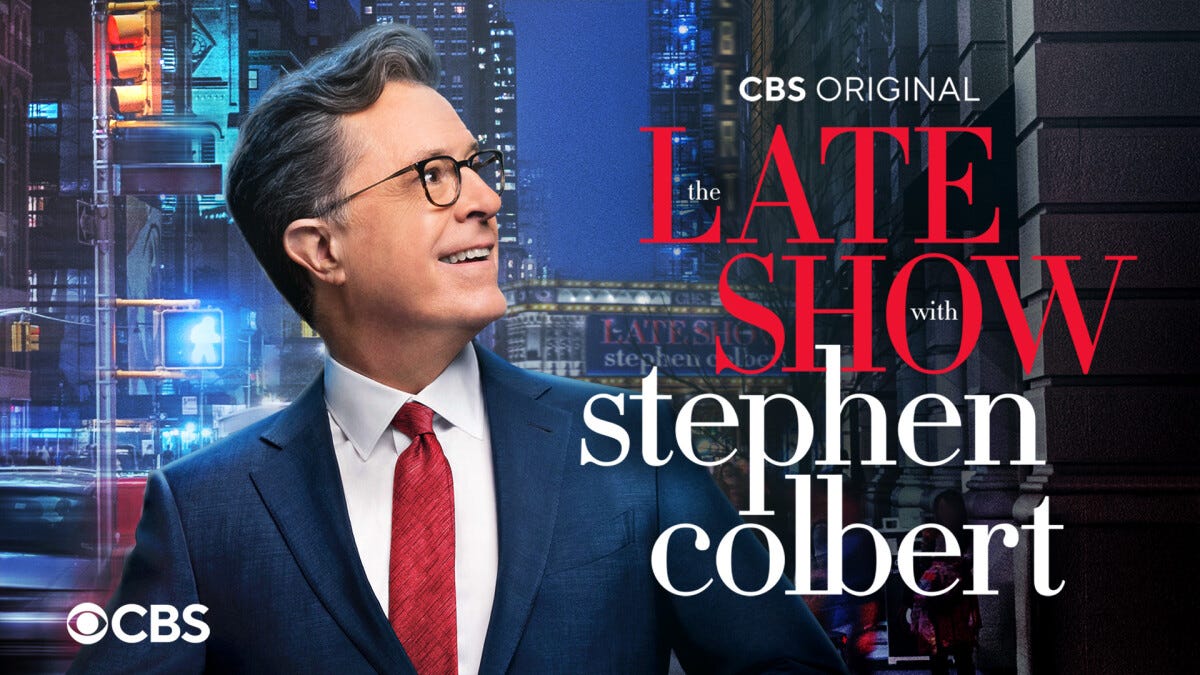
Among the many problems with the legacy media is the so-called “news cycle.” These days, it often seems that we’re supposed to talk about an issue for only half a day before moving on to the next disaster. As a result, we can easily stay distracted and fail to learn important lessons from the latest developments.
I aim to avoid that for They Stand Corrected, my podcast and newsletter fact-checking the news. So in the latest episode, I stopped to look at two big things the media missed about CBS’ decision to cancel “The Late Show with Stephen Colbert.”
In the days after Colbert announced the move, some called it a stark warning that Trump was looking to take down “our actual culture.” “The View” host Sunny Hostin (my former colleague at CNN) said if the move was political, then it marked “the dismantling of our democracy” and of the Constitution, particularly the First Amendment’s protection of free speech.
But the move is really a sign of the need to dismantle something: the power that huge corporations hold over the content we consume. And on that, there's reason for hope.
In a nutshell, here’s what happened. CBS’ parent company paid $16 million to settle a lawsuit from Trump, who alleged that a “60 Minutes” interview with then-Vice President Kamala Harris during the election season was edited to portray her in a more positive light. Rather than standing by the interview, Paramount caved. Meanwhile, Paramount needed the federal government’s approval for a merger with a company called Skydance. And—what a coincidence!—after the settlement, the merger was approved.
Paramount insists that ending “The Late Show” makes sense financially. That might be the case. Either way, the company brought suspicion on itself. But even if the decision was political, it would not be shocking. Corporate powers are going to put the bottom line first, particularly with an $8.4 billion merger on the table.
Colbert has been paid millions all this time, and will certainly get all kinds of big offers now. He’ll very likely be better off, and even freer to say whatever he wants. That's what happens when you get out from under a huge corporation. It’s also why some journalists have left newspapers that are now run by billionaires.
We have every reason to fight for our democracy, and we should call out any and all corporate corruption. But, fortunately, the fact that you are reading this right now shows that freedom of speech remains in place.
That brings me to the second, more complex part of this story: the whitewashing of CBS News. A casual observer could read the Colbert fiasco as simply a matter of corporate powers throwing a comedian under the bus, just as they threw their news department under the bus to appease Trump in that settlement. But it’s not as though CBS News is a paragon of journalistic integrity these days. Just like so much of the legacy media, it has largely become a disaster.
Guests on the network routinely spew falsehoods, uncorrected. Take the time a Trump administration official inexplicably claimed there have been “close to a million and a half deaths” in the war in Ukraine.
Even worse, CBS News announced that it took guidance from the Russian government on how to conduct the interview—a move so out of keeping with core tenets of journalism that it surprised even me.
Meanwhile, a Democratic Federal Communications Commission commissioner is alleging that CBS will have a “government sanctioned ‘truth arbiter’” to prevent criticism of the administration. But it’s not clear that's true; I’ve asked her about this. CBS plans to have an ombudsman for at least two years, reporting to the company president. The position could certainly be misused, but some other news organizations already have ombudspeople (who, incidentally, do little to nothing to fix the massive problems).
None of this is specific to CBS. It wasn’t even the first TV network to settle a suit from Trump. In December, ABC paid $15 million. (In both cases, the networks say the money will go to his future presidential library. Not that that's any less concerning.)
Ultimately, the lesson of all of this is that we must work to end oligarchical control over news and commentary. Corporate greed will keep leading executives and boards to amass power in the hands of a few. So it’s up to all the rest of us to turn elsewhere. In this context, that means turning to new content, across new platforms, where people can talk, discuss, and joke about the truth.
Josh Levs is host of They Stand Corrected, the podcast and newsletter fact-checking the media. Find him at joshlevs.com.
All of what you say is true. What you don't say is how one can afford to access all the different news sites one needs to form a well rounded picture. I am no longer satisfied from getting all my news from one or even a few sources.
Result: I spend most of my day reading different articles on different sites. If I wasn't retired, I couldn't do that, but since I am retired I can't afford to read all the sites I would like to. Talk about a Catch-22!
Thank you for parsing this out, it's in keeping with what my personal thoughts have been, but the narrative tipped toward strictly authoritarian move by the WH despot. You're right about Stephen Colbert's prospects going forward.