


Two Ships: Jamestown 1619, Plymouth 1620, and the Struggle for the Soul of America traces how the political and religious divisions of England’s Civil War became a powerful metaphor for abolitionism and slavery prior to the United States Civil War. Author David S. Reynolds, a distinguished professor at the Graduate Center of the City University of New York, spoke to Abraham Kenmore about the book a few weeks after its publication in early June. The following is excerpted from that conversation with edits for length and clarity.
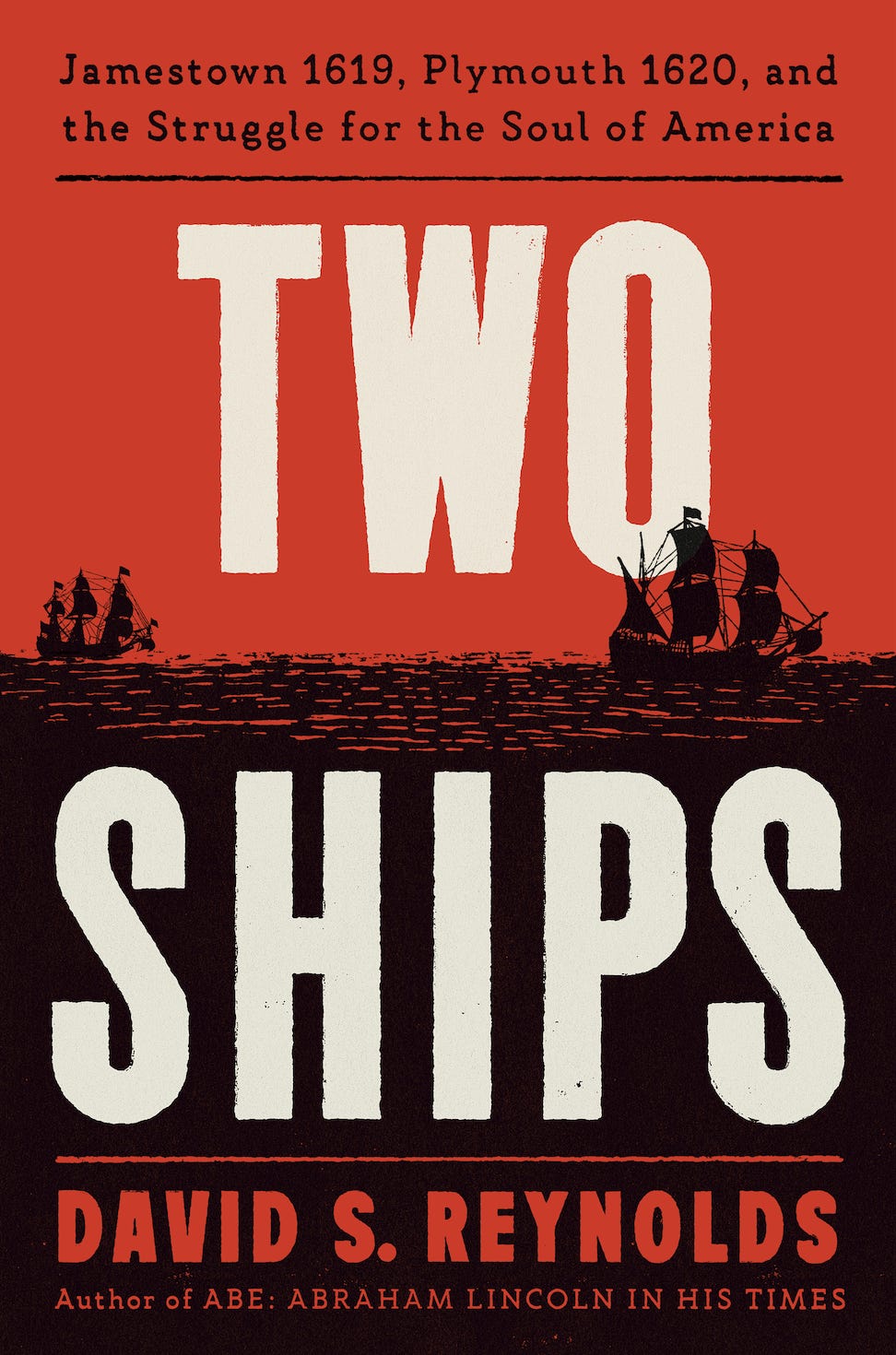
When I first saw the title of the book, I thought, “oh, this is an interesting metaphor to approach American history,” but you’re not really using the metaphor yourself, you’re explaining the history of this idea of there being two ships at the founding of America that gets projected backwards onto the English Civil War. I wonder if you’d talk a little bit about what this metaphor is of these two ships and how it was used through the early decades of the US?
The two ships are the White Lion, which arrives in Jamestown with 20-odd enslaved black people in August 1619, and the other ship is the Mayflower, which arrives in Plymouth — it’s called Plymouth Colony then — in December 1620, and the two of them become seeds of different kinds of society.
In the South, you slowly get the influx of so-called cavaliers. These are royalists from England who had supported Charles I, the monarchy. A lot of them were expelled when the Puritans beat the Cavaliers in the English Civil War, and so the Puritans largely migrated to the north, whereas the Cavaliers went to the south.
And the Mayflower snowballed over time, over the centuries, to represent the anti-slavery North, whereas the Cavaliers, who are much more hierarchical, structured, and also really a slave-based society, snowballed to represent the South. So that by the time of 1860, 240 years later, [when] the Civil War broke out, it was largely seen as a contest between the Mayflower and the “slave ship,” or in other parlance, Plymouth versus Jamestown. It was a real cultural polarization and difference that had emerged over the centuries,
Plymouth Colony itself was quite democratic. It never instituted slavery, unlike Massachusetts Bay Colony — the two aren’t to be confused until they merged in 1691. It was much more democratic. And that’s why, looking back from the Civil War, people like Frederick Douglass, Charles Sumner, anti-slavery people leapfrogged over Massachusetts Bay Colony and said, “aha, the Mayflower, that’s where the real democracy is.”
As you were encountering this metaphor again and again in historical writings leading up to the Civil War, what was the moment when you decided that you were going to write this particular book?
The moment when I decided was [informed by] two things. I read Charles Sumner, who was probably the leading white politician who was the most radical in his demand for rights for African Americans [before and during the Civil War]. And when he says not once, not twice, but several times, “we have a very easy choice here, it’s the Mayflower or the slave ship.” And I said, ‘What, what the heck is he talking about?’ And then Frederick Douglass, and you would think that Douglass himself had such a rich personal history of agonizing engagement with slavery not to worry too much about the white heritage of oppression. But again, in five major speeches, he said, “the choice is between the Mayflower and the slave ship.” And I scratched my head at that time and said, I have to go back to the very beginning and trace how this incredible cultural opposition occurred.
How common was this idea of Roundheads and Cavaliers? It seems like such an abstract or even an outdated analogy, I think, looking from the 21st century. How present was this as a way of conceptualising the South and North for everyday people in the antebellum United States?
The Roundheads initially came from the fact that the Puritans cropped their hair short in general, and the Cavaliers had their long flowing locks and their elaborate clothing. And it was common to use, interchangeably, the Pilgrims with the Roundheads, and for the Southerners to be called Cavaliers. A lot of the Southern generals prided themselves (Robert E. Lee, many others) on being descended from the original Cavaliers who had come over in the 1650s and 1660s. The Roundhead versus Cavalier was widely known.
How much truth do you think was there to this metaphor of there being the New England anti-slavery Puritan society and the Cavalier South, or was this kind of a shorthand that people were using to describe these divisions?
There’s a lot of truth about the anti-slavery Puritan North. Not only because certain Puritans, like Samuel Sewall, Samuel Hopkins, Jonathan Edwards Jr., came out very strongly against slavery, and not only because the Puritans, like Roger Williams, in 1652 passed the world’s first anti-slavery law in Rhode Island. But also by 1770, only 2% of New England were enslaved people; 10% of the middle colonies, like New York, and so forth; and then 40 to 50% of the southern colonies were enslaved people. The South was a slave society; the North was a society with slaves. So that’s how the facts undergird the myth and the polarization.
As you were writing this book, who did you want to read it? Who do you hope will read this book now that it’s out into the world?
I want the average intelligent reader who has any interest in the American past, in American history, or any interest in polarization, cultural polarization, and the two sides of even the current day divide to [read it to] show that we’ve been there before, we were there centuries ago, we’ve been through even worse, yes, but we emerged from it. The more people become informed about history, the more they become informed about today as well. I think anyone reading my book will find similarities there, and maybe pathways out of difference, out of polarization.
I think a lot more people are thinking about the White Lion or the slave ship now with the 1619 project and that 400-year anniversary a few years back. But there’s also Malcolm X’s line about Plymouth Rock that a lot of people think of: “We didn’t land on Plymouth Rock, Plymouth Rock landed on us.” Strangely, they’re both [now] kind of symbols of a unified American origin as a country of oppression. How do you think those metaphors extend into our current moment?
I think the value of the 1619 project was to promote and advertise something that has been pretty well known among academic historians, but that was a journalistic project, which really spread the idea of the importance to African Americans in American history, and the advent of African Americans in the 1619 Jamestown ship.
The point that I make is a little bit different, that yes, that ship was important, but the other ship was equally important — the other ship being the Mayflower. It’s important to know about both of them, not just about one of them. Because it’s knowing about both and how they both compete against each other, and sometimes overlap over time, and goad each other along, that we understand how human rights eventually gets to be collaborative.
Radicals like Malcolm X were really addressing what happened during Jim Crow, which is long after the Mayflower. During Jim Crow, unfortunately, white Americans kind of ganged up together, both northern and southern, against immigrants, against African Americans, against Asian people. So there was this long, very, very uncomfortable and tragic period between roughly 1885 and 1954 when you get Brown v Board, and then Malcolm X says, “Oh, it’s a white hegemony there.” But that’s not the real Mayflower.
For many people today, the Mayflower is just a bunch of quaint pilgrims in hats. They’re kind of like vague wallpaper in American history. “Oh, aren’t they kind of funny and cute” and all that stuff. No, they were the radicals of their era. That whole radicalism was stripped away during Jim Crow, unfortunately. So my book tries to restore the mirror of that progressive revision.
One thing that I’ve been trying to ask authors as I’m interviewing them this year is (other than this book), in this 250th anniversary of the Declaration, if you’re handing someone a book that they should read to better understand American history, how we got to where we are, what is a book that you’re handing someone?
Well, I personally like Gordon Wood’s Radicalism of the American Revolution, because that’s a very fine book. I love Wood’s scholarship, his readability, his ability to really probe a lot of the roots of the American Revolution.
Thank you.
Abe, good to talk with you.

That was very fascinating. Thank you.
What a very interesting thesis! I look forward to reading the book to learn more. A minor note, the Mass Bay Colony Puritans expelled Roger Williams for his views. For a time, he was a Baptist in what is now Rhode Island. Also, it is refreshing to read a current take on the Mayflower legacy that doesn’t exclusively center those hardy survivors as “colonists”. Thanks to the author for the book and to this Contrarian review bringing our attention to it.