


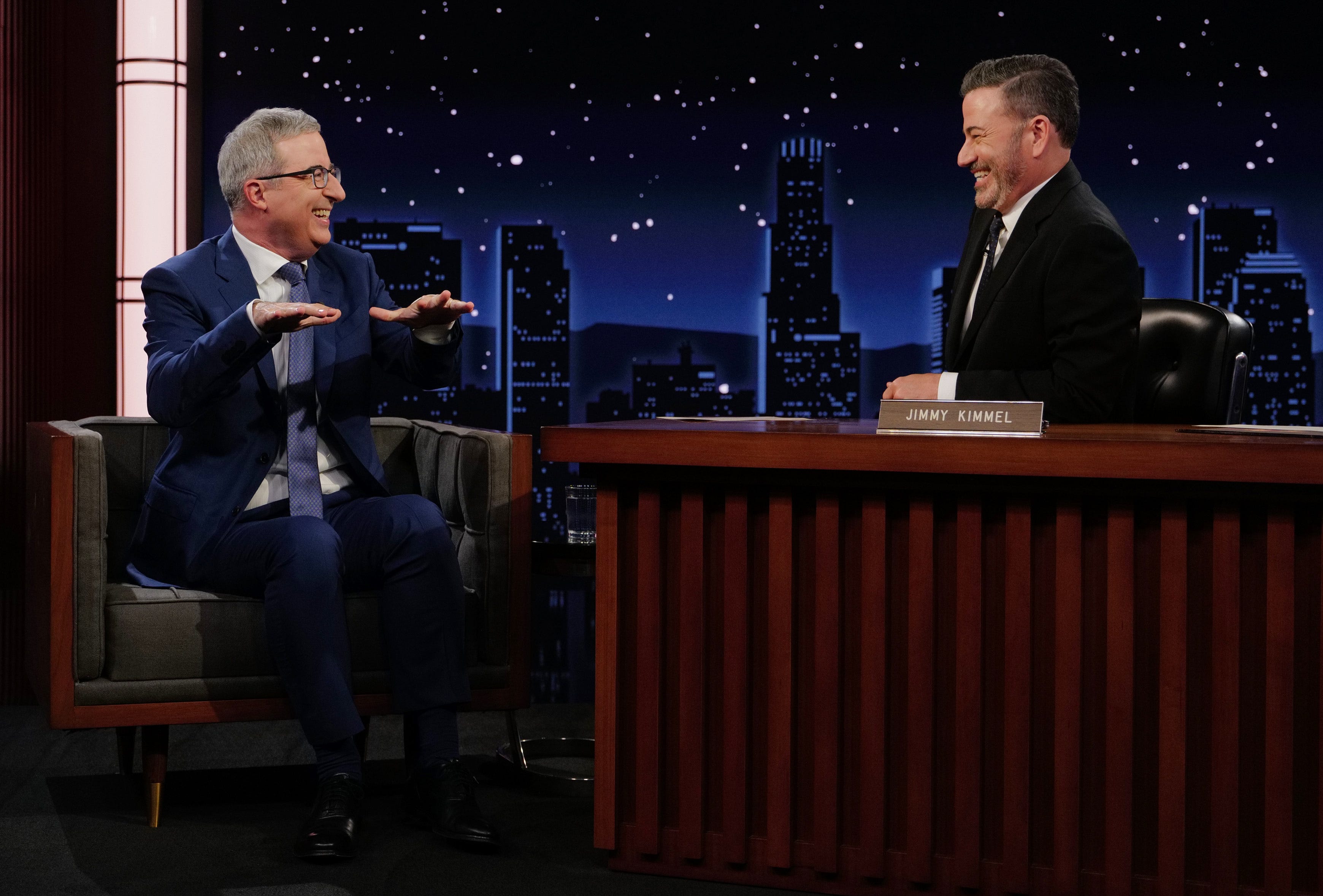
Jimmy Kimmel will return to ABC tonight, less than a week after Disney yanked him off the air “indefinitely.” The swift corporate backpedaling proves that public pressure works, even in an era of creeping authoritarianism.
But it’s also clear that Donald Trump’s grudge-fueled war on free speech won’t end with Kimmel. He has powerful allies willing to do his bidding, including FCC chief Brendan Carr and the ideologues at Sinclair Broadcasting Group, which said Monday that it will continue to pre-empt Jimmy Kimmel Live! And, as my colleague Jen Rubin writes today, supposedly “liberal” Hollywood is run by craven executives who care about little beyond the bottom line. Disney’s decision to bring Kimmel back likely had more to do with the thousands of people who canceled their Disney+ subscriptions than with the corporation’s commitment to the First Amendment.
Trump is hardly the first wannabe tyrant or power-mad bureaucrat to target a comedian for saying something he didn’t like. On social media, many users shared images of a 1939 New York Times headline reading “Goebbels Ends Careers of Five ‘Aryan’ Actors Who Made Witticisms About the Nazi Regime.”
The article, which you can read here, details how Joseph Goebbels, the chief Nazi propagandist, had expelled five performers from the the Reich’s Chamber of Culture—effectively prohibiting them from working—because “they displayed a lack of any positive attitude toward National Socialism and therewith caused grave annoyance in public and especially to party comrades.”
This group included Werner Finck, Peter Sachse, and an act known as “The Three Rulands” (whose members were Helmuth Buth, Wilhelm Meissner, and Manfred Dlugi).
They were, according to the Times, “perhaps the best known German stage comedians who survived previous Chamber of Culture purges and still dared to indulge in political witticisms.”
The men, called “brazen, impertinent, arrogant and tactless” by Goebbels, had made jokes about various elements of the Nazi regime, including Hitler’s Four-Year Plan for the economy and his monumental building program. “One of them even raised the question of whether there was any humor left in Germany today,” noted the Times piece.
Time magazine also reported on Goebbels’ comedy purge. A brief item from the Feb. 1939 piece focuses on the “twinkly-eyed” performer Werner Finck, who is described as “one of the daring, politically sophisticated German comedians who get their laughs at the expense of the Nazis.” Finck was known for mimicking the physical gestures of top-ranking Nazis, including the “gimpy Dr. Joseph Goebbels.”
Finck had been a thorn in the side of the regime for years. As Rudolph Herzog details in his book Dead Funny: Humor in Hitler’s Germany, the comedian “became an underground hit in the early Hitler era for his risky political jokes.”
In 1935, he was arrested and sent to the Esterwegen concentration camp to complete a six-week sentence.
Finck continued to perform, often making sly reference to the fact that he had to censor himself onstage. But Goebbels caught wind of Finck’s subversive act and barred him from performing in 1939. Soon afterwards, Finck signed up for the military, a risky move that, Herzog argues, enabled him to avoid scrutiny from the propaganda ministry. He survived the war and went on to have a long career in German film and television, starring in Rainer Fassbinder’s 1972 miniseries, Eight Hours Don’t Make a Day, and many other projects.
Robert Dorsay was not as lucky. As Herzog details in Dead Funny, the actor was known for playing charming ladies’ men in comedies made by the German film studio UFA. But he also had a propensity for telling jokes about Hitler at parties and had stubbornly refused to join the Nazi party, which made him a target.
Dorsay’s career began to suffer. He was stuck playing minor parts as Jewish characters in antisemitic films and, when even those parts dried up, he turned to cabaret. He was reported to the authorities for cracking jokes about Hitler between sips of wine at a Berlin theater.
In August 1943 was sentenced to two years of reeducation internment. But that sentence was viewed as too lenient. In October 1943, he was retried and “sentenced to death for recurrent agitation against the Reich and for severely undermining our defensive strength,” according to Nazi newspapers. Within a few weeks of sentencing, Dorsay was executed by guillotine.
Even under the Third Reich, people cracked political jokes, but they were generally “ not a form of resistance,” writes Herzog (son of filmmaker Werner). “The vast majority of the jokes during Hitler’s reign were basically uncritical of the system, playing on the human weaknesses of the Nazi leaders rather than on the crimes they were committing.”
THE FBI VS. CHARLIE CHAPLIN
It’s easy to denounce the Nazis for their attacks on dissent. But persecuting politically outspoken artists is also a long-standing American tradition.
Perhaps the most stark example in Hollywood history is Charlie Chaplin, the legendary filmmaker who was driven into exile by a weaponized FBI under J. Edgar Hoover, as detailed by author Scott Eyman in his recent book, Charlie Chaplin Vs. America: When Art, Sex, And Politics Collided.
Chaplin satirized fascism in his classic 1940 film The Great Dictator, but rather than being celebrated as a patriot for ridiculing the Nazi Regime, he was suspected of being a communist. The FBI spied on Chaplin for years, bugging his phone, opening his mail, and monitoring his bank accounts to see if he donated to the Communist Party. As Eyman told Terry Gross last year, “He was the target of the entire security apparatus of the United States of America.”
The agency ultimately compiled a 1900-page file on Chaplin that was full of hearsay, some of it antisemitic. (Chaplin was not Jewish, but that didn’t stop the bigoted speculation.) It also leaked unverified information to sympathetic Hollywood gossip columnists, who eagerly waged a smear campaign against the star (whose messy personal life made him an easy target). In 1952, Chaplin, who was born in the United Kingdom but had lived in Los Angeles for nearly 40 years, was denied re-entry into the United States after traveling to London to promote his film Limelight. He spent the rest of his life in exile. (Though he returned to Hollywood briefly in 1972 to receive an honorary Oscar.)
PUTIN VS…EVERYONE
Vladimir Putin has been silencing journalists, artists, and intellectuals for the last quarter century, sometimes with violent force. And, as John Oliver noted on Last Week Tonight, one of the first things Putin did when he came to power was to go after TV satirists.
As detailed in this Frontline special, in the early 2000s, an independent Russian network called NTV aired a satirical show called Kukly (or “Puppets”). Putin was apparently driven mad by his unflattering portrayal on the series. He sent armed officers to raid the network’s parent company, and the network’s owner Vladimir Gusinsky was imprisoned. Puppets was taken off the air, and Gusinsky ultimately handed the network over to a Putin-friendly oligarch.
Putin consolidated his power “by attacking mainstream media, starting with television and, notably, TV comedians,” wrote Andrei Soldatov in the Moscow Times.
“What was really shocking was that many Russian liberal journalists and public intellectuals were quick to rationalize the attack on NTV and Kukly. They deliberately chose to ignore the early signs of the repressive regime Putin was building, justifying it by saying the country needed fixing and had to become strong.”
But appeasing tyrants by silencing their critics doesn’t work, Soldatov says: “Don’t fool yourselves—you can’t make friends with a crocodile.”
Decades later, Putin’s crackdown on political parody continues. Performers have been prosecuted for appearing in sketches lampooning the Russian government.
Then there’s his current nemesis, Ukrainian president Volodymyr Zelensky, an actor and comedian who played the president on the TV series Servant of the People before he successfully ran for the office in 2019. In an episode of the show that was pulled from Russian TV, Zelensky’s character essentially called Putin a “dick,” a nod to a chant that became popular in Ukraine after Russia’s annexation of Crimea in 2014.
There are countless other examples from around the world. According to Amnesty International, Lebanese comedian Nour Hajjar was arrested in 2023 for making jokes about Army soldiers having to take second jobs. Iranian comic Zeinab Mousavi has been arrested—and once served 25 days in solitary confinement—for satire that offended the regime. Last year, a stand-up comedian named Aleksandr Merkul was held for 10 days in Kazakhstan on charges of “petty hooliganism.”
Petty hooligan? Sounds like someone I know.
Meredith Blake is the culture columnist for The Contrarian.
I would dearly love to see a US version of the former British series "Spitting Image". (From the 1980s, but still available on their YouTube channel.)
After all, so many members of the Trump administration are puppets and caricatures already.
"Disney’s decision to bring Kimmel back likely had more to do with the thousands of people who canceled their Disney+ subscriptions than with the corporation’s commitment to the First Amendment."
Methinks "likely" is an understatement.
Now, America, let's do CBS/Paramount for sacking Colbert. Delayed censorship merits an undelayed reaction.