


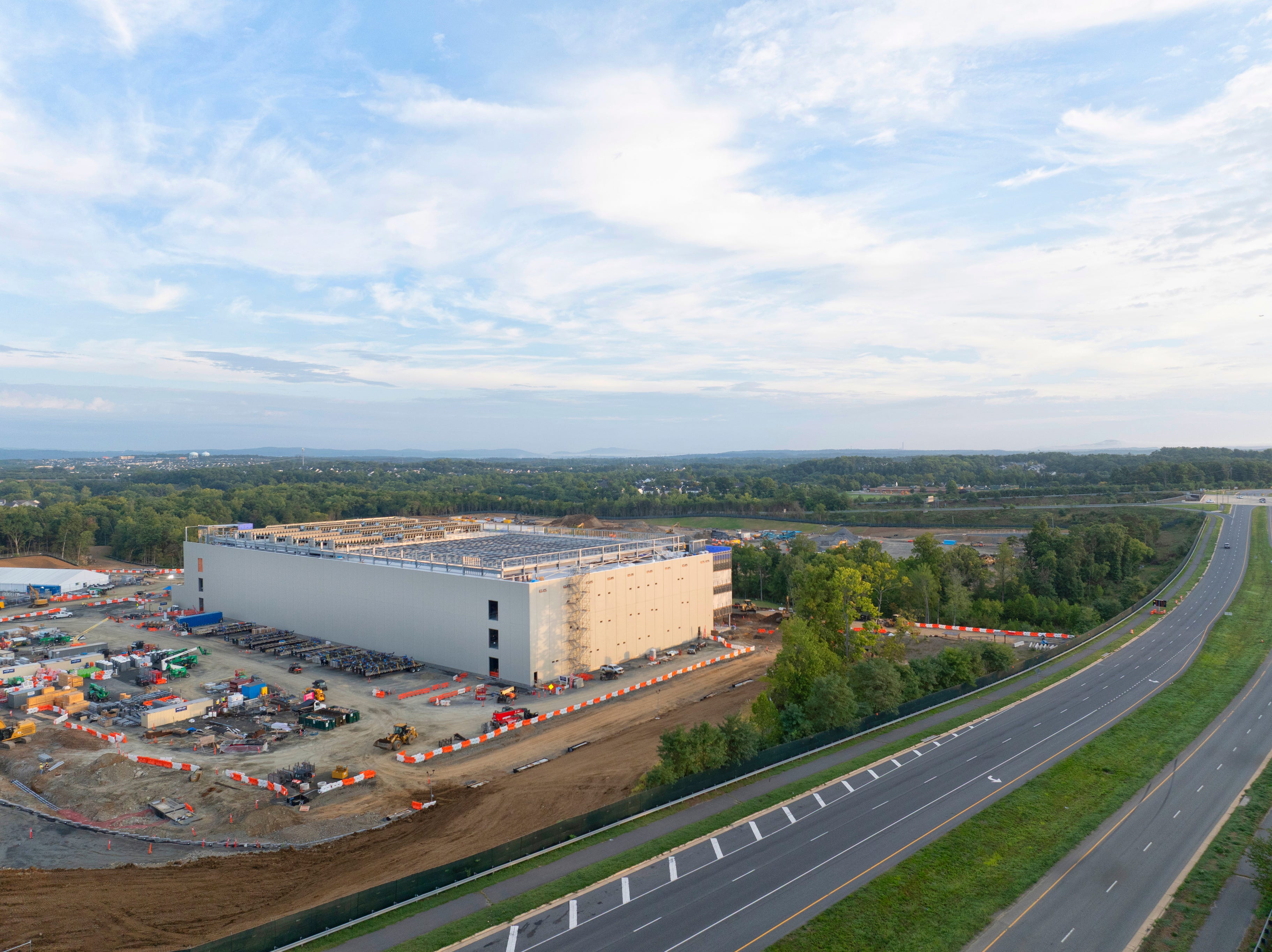
Only a few months ago, the political influence of AI companies, boosted by the avalanche of dark-money operatives, was successfully fueling a mad rush to build energy-hungry data centers across the country. But then a remarkable popular surge in opposition, a grassroots movement demonstrating the limits of third-party dark money and the power of genuine local political engagement, began to take hold.
Results from the latest Fox News poll should come as a three-alarm warning for tech bros and apologists for unregulated data center construction. “By a 40-point margin, voters oppose building data centers in their area to support artificial intelligence (30% favor, 70% oppose).” The go-slow approach has plainly taken hold: “Nearly 8 in 10 voters prefer slower data center construction to address environmental and community concerns, while 2 in 10 favor building them as quickly as possible to maintain a competitive advantage over China and other countries.”
Savvy Democratic politicians have stepped forward to support measures that impose local or state moratoriums on new projects. This month, New York Gov. Kathy Hochul issued “the nation’s first moratorium on new hyperscale data centers, establishing the strongest standards for data center development and creating a blueprint to support localities.” Her order will pause new permits for up to one year, “to build a nation-leading regulatory framework that protects ratepayers, the environment, the energy grid and communities across the state.” She is also pursuing legislation to end the sales tax giveaway/exemption for massive data centers. (A June poll showed New Yorkers by a large 46 percent to 21 percent margin backed a one-year data center moratorium.)
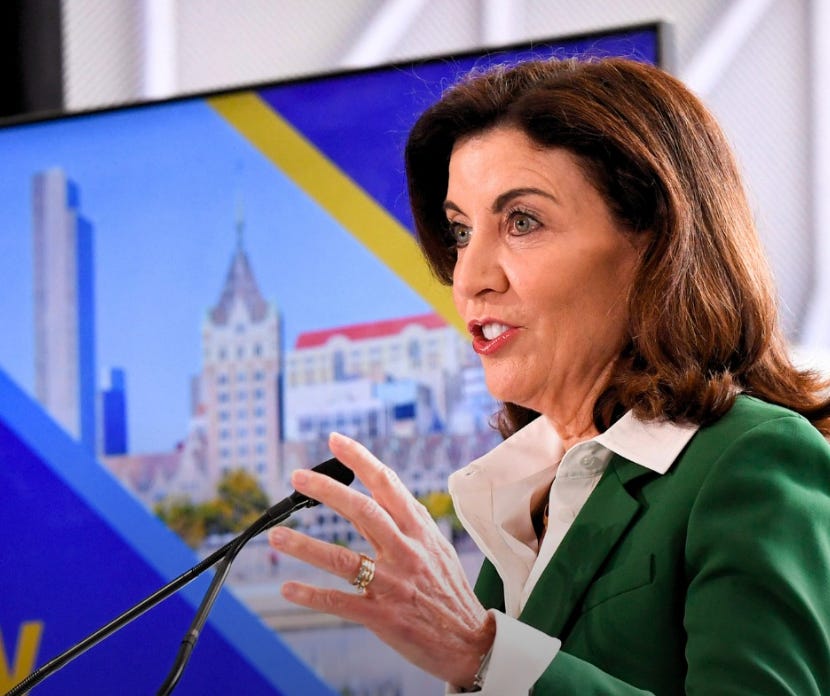
Unsurprisingly, AI lobbyists and corporate apologists went ballistic, but Hochul has garnered popular support for leadership in reining in AI companies. In an interview with NBC News, Hochul explained that she moved forward with her moratorium after hearing from local governments inundated with data center demands and corresponding popular pushback:
They’ve asked me for help, and at first, I thought this is more of a local decision, but then I realized they don’t have the negotiating ability, the clout, the wherewithal to be able to negotiate the best benefits or to make sure that these companies, as I said in my State of the State, are either bringing their own power or paying a premium into the grid to cover the cost.
She is betting that voters who have recoiled against runaway data center development will appreciate a more thoughtful approach. “You don’t have to have the data centers here to be successful, but that doesn’t mean we won’t welcome them at the right time and place under really different conditions than exist right now,” she said. “So we’re just being thoughtful about this. And people are happy we’re doing this.”
New Yorkers are not alone in their aversion to the data center boom. “Americans’ attitudes toward data centers have grown increasingly sour and politically polarized in the past six months, a trend that signals trouble for the artificial intelligence industry and leaders of both parties,” according to a recent Politico Public First poll. “While growing opposition to the sprawling, server-packed data hubs is coming from both sides of the political aisle, it’s especially evident among Democrats, whose opposition to the projects has grown much faster than antagonism from Republicans.”
Hochul is not the only Democratic governor at the forefront of the debate. “Illinois Gov. JB Pritzker this month moved to suspend data center tax incentives after lawmakers in his state failed to do so,” Politico reported. “Pennsylvania Gov. Josh Shapiro created a signature program setting standards for data center development. And Maryland Gov. Wes Moore has vocally expressed his conviction that the data center industry shouldn’t be allowed to determine its own rules.”
Meanwhile, data centers have become a major issue, for example, in Democratic Texas governor nominee Gina Hinojosa’s race. PBS reported recently that “with barely three months until November’s contest, the perceived threat to rural life, ranchland and dwindling water supplies could become a defining issue for her long-shot challenge to Republican Gov. Greg Abbott, dividing conservative rural areas that have traditionally served as a counterweight to Democrats’ urban strongholds.”
Other Democratic candidates, including Ohio Democratic candidate Sherrod Brown — who “aired a television advertisement attacking Republican U.S. Sen. John Husted as the ‘face of data centers in Ohio’ as people gather signatures for a statewide referendum to outright ban their construction” — have found a receptive audience. Dr. Amy Acton, the Democratic nominee for governor of Ohio, announced her support for a moratorium that would bar any new center if it “does not cover 100% of utility costs, is not exclusively built with union labor or operates without transparency through usage of NDAs [nondisclosure agreements].”
The speed and depth of the opposition to unregulated data center construction is remarkable. According to a Brookings Institution report, “The first three months of 2026 saw local data center opposition block or delay 75 projects worth $130 billion in planned construction… roughly the same number of projects affected as in all 12 months of 2025.”
At a time when populist anger against political elites and mega corporations is boiling over, the issue is not whether the U.S. should lead in cutting edge AI technology, but “whether that leadership will be accountable to democratic institutions or concentrated in the hands of a few private actors… [and] whether the infrastructure of the 21st century serves the public interest or the interests of the tech oligarchs and their investors.”
The ultimate balancing act between, on the one hand, technological ascendancy and growth, and, on the other, quality of life and shared prosperity, will not be resolved overnight. But Hochul, along with other Democratic governors and candidates, deserve credit for listening to voters who refuse to be bullied, cowed, and silenced by AI oligarchs.
Undaunted, unafraid, and unwilling to cede control of their communities to a narrow stratum of billionaires whose interests certainly do not include widely shared prosperity, ordinary Americans have gotten the attention of politicians. Whether they embrace a moratorium or other regulatory mechanism, Democrats would be wise to listen to voters who do not want to cede the future of our economy and the life of their communities to AI moguls.
“Illinois Gov. JB Pritzker this month moved to suspend data center tax incentives after lawmakers in his state failed to do so.”
Exactly. Why are taxpayers subsidizing data centers? Filthy rich tech companies should pay for their own infrastructure.
And how many of these data centers have already been built? And where? And under what conditions?
There seems to be a lot of secrecy as to how these centers will affect their local communities in terms of rising energy costs, possible water pollution, and only a handful of new jobs created.
We need far more transparency and community input into these structures than we are getting right now.
Living in Northern Virginia, the largest concentration of data centers in the planet, I see first hand what a blight data centers are on the suburban landscape and our natural environment. Given that data center developers knew from the start that they had to lie to residents about what they were doing and buy off politicians and homeowners tells you that they knew from the start that this development would be opposed. Now they are talking about putting installations in space, out of our reach, although you can find an article in the NYT today about all the space junk falling out of the sky and how it can be difficult to obtain accountability from the people who put this stuff up there. The issue of tech lords and other oligarchs thinking they can do whatever they want -- the faster they move the more they can get away with breaking -- is a bigger issue than data centers or AI. We need government that represents ordinary people, not the monied interests.