


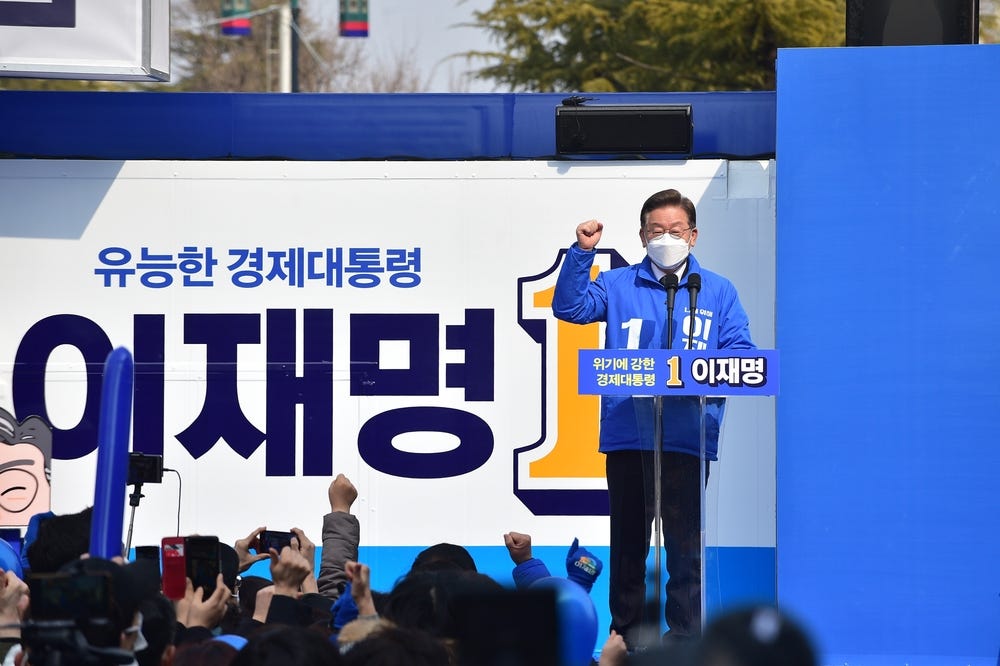
If it were a Hollywood script, it might have been rejected as too far-fetched: A man born in poverty, maimed in an industrial accident at age 13, got his law degree on scholarship, worked as a human rights lawyer, rose through the political ranks, and survived an assassination attempt. He seized the moment to rally democratic defenders when he dramatically scaled a fence to return to the legislature after the right-wing president declared martial law – and just won the presidency decisively. That’s the story of South Korea’s newly elected president, Lee Jae–Myung. His victory this week marked the end of a period of turmoil and violence that shook South Korea’s democracy.
In the wake of the declaration of martial law, impeachment and revolving interim leadership, South Koreans were looking to put an end to chaos. As the BBC recounted:
[Former president Yoon Suk Yeol’s] declaration of martial law on 3 December -- made in a self-proclaimed bid to eliminate "anti-state forces" and North Korea sympathizers -- served as the catalyst for Lee to emerge as a leading presidential candidate.
Within hours of the declaration, Lee appealed to the public via a livestream broadcast and urged them to assemble in protest outside the National Assembly building in central Seoul.
Thousands responded, clashing with police and blocking military units as opposition lawmakers rushed into the assembly building, clambering over fences and walls in a desperate attempt to block Yoon's order.
Lee was among them, climbing over the fence to enter the National Assembly and helping to pass the resolution to lift martial law.
Despite the heroics, Lee is no angel. His career has been marred by a drunk driving incident, allegations of corruption (he faces ongoing criminal trials, which might be suspended while he is in office), and a history of incendiary rhetoric. In a culturally conservative party, his fiery and aggressive style has irritated establishment politicians who have accused him of divisiveness.
However, when the stakes were highest, Lee defied conventional wisdom and pushed back against his party’s excessive caution. As a mayor during the covid epidemic, Lee “clashed with the central government due to his insistence on providing universal relief grants for all residents of the province.”
Last year, his willingness to block his predecessor’s initiatives helped precipitate the martial law crisis. (“Such constant stonewalling by the Democratic Party only exacerbated Yoon's leadership struggles -- which also included repeated impeachment attempts against administration officials and constant opposition to his budget.”)
Whatever his shortcomings, Lee waged a successful campaign fueled by a backlash against lawless authoritarianism. An extraordinary 80% turnout (the highest in nearly 30 years) and decisive 8% margin of victory stood as a stark rebuke of his predecessor.
Lee, a center-left candidate with a streak of pragmatism, now can claim a mandate to decrease international tensions and advocate “political and economic reforms, including more controls on a president’s ability to declare martial law, and revising the constitution to allow two four-year presidential terms instead of the current single five-year term,” CNN reported. “He also supports boosting small businesses and growing the AI industry.”
Lee will have his hands full navigating his own legal troubles, dealing with U.S. President Donald Trump’s frenetic tariff schemes, lifting the country out of an economic rut, coping with an aging population, and uniting the country after a period of extreme turmoil. In his prompt inauguration following the election, he pledged, “It is time to replace hatred and confrontation with coexistence, reconciliation, and solidarity – to open an era of national happiness, of dreams and hope.” He added, “I will answer the earnest call to build a completely new nation.”
Lee will have to walk a thin line when it comes to foreign policy. He advocates retaining a strong U.S. alliance but also wants to seek accommodation with China. Brookings expert Andrew Yeo explained, “China remains South Korea’s largest trade partner and is critical to the nation’s supply-chain ecosystem. Lee thus aims to take a more conciliatory approach to China.”
South Korea’s less confrontational stance toward China has already set off grumbling from the Trump team. “While South Korea had a free and fair election, the United States remains concerned and opposed to Chinese interference and influence in democracies around the world,” a White House official told Reuters. That bizarre statement seemed to suggest something was amiss in a smoothly run, democratic election. Even worse, one of Trump’s wackiest right-wing confidantes, Laura Loomer, went so far as to claim South Korea had been taken over by “communists.” (Perhaps she has confused North and South Korea.)
Lee’s personal life story of resilience, determination, and independence would be inspirational in and of itself. But his unrelenting opposition to authoritarianism, willingness to rock the boat in his own party, and determination to reclaim functional democracy set an example for other backsliding democracies, including the United States. His courage and undaunted efforts to defeat authoritarian bullies deserve our praise.
Where and when will we find our Lee Jae–Myung?
Mr Lee may be interesting but vets to the mall today.
The BIG NEWS yesterday is Musk called for Trump to be impeached after mocking his connections to the convicted sex offender Jeffrey Epstein, as the president threatened to cancel federal contracts and tax subsidies for Musk’s companies in an extraordinary social media feud on Thursday.
https://www.theguardian.com/us-news/2025/jun/05/trump-elon-musk-fallout
Musk has lost $152bn of Tesla's shares. Although Space X isn't publicly traded, shares in its rival space companies have risen as a result. Musk has retliated by threatening to decommission a spacecraft contracted to the government. Both of these fools would be acting in breach of contract and this would doubtless play out in the courts (with the 250 other lawsuits being defended by this hapless administration).
https://www.theguardian.com/commentisfree/2025/jun/05/trump-tariffs-republicans
Did Trump admit that Musk fixed Pennsylvania? A Pennsylvaninia grand jury should be on the case.
Elizabeth Warren (D-Mass.) released a new report entitled, “Special Interests over the Public Interest: Elon Musk's 130 Days in the Trump Administration.” https://www.warren.senate.gov/imo/media/doc/130_days_of_elon_musk_report.pdf
What about other liability exposure? The other day Bill Gates accused Musk of the killing of 300,000 Africans.
Trump again made a fool of himself re Ukraine.