


Thousands will gather today on the National Mall to commemorate the 63rd anniversary of March on Washington for Jobs and Freedom. It is critical to remember the full title of the 1963 event in which over 250,000 people assembled to hear, among others, the Rev. Dr. Martin Luther King Jr. and John Lewis. As King knew all too well, democracy and economic opportunity have always been inextricably linked for Black, Hispanic, and other minority communities.
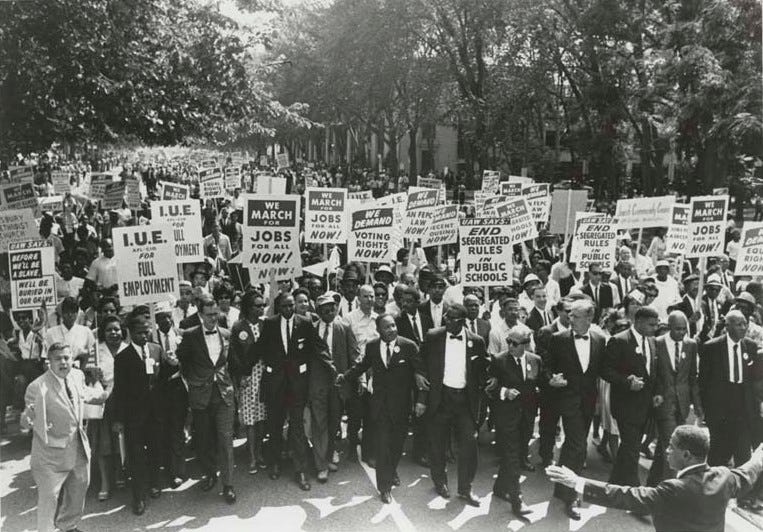
Hosted by the Rev. Al Sharpton’s National Action Network, the event today reiterates three goals:
We march to defend the vote, because voting rights are under attack, and the protections generations fought, bled, and died for are being weakened.
We march to defend civil rights, because attacks on diversity, equity, and inclusion are attempts to roll back access, opportunity, and representation.
We march for economic justice, because too many families are still fighting for fair wages, affordable housing, equal opportunity, and a fair chance to build wealth.
Thirteen years ago, President Barack Obama reminded us at the 50th commemoration that the very significance of political/legal victories achieved following the 1963 March may have “obscured” the march’s economic agenda. The original attendees, Obama recalled, “were not there in search of some abstract ideal. They were there seeking jobs as well as justice — not just the absence of oppression but the presence of economic opportunity.”
Obama told the crowd in 2013:
For what does it profit a man, Dr. King would ask, to sit at an integrated lunch counter if he can’t afford the meal? This idea — that one’s liberty is linked to one’s livelihood; that the pursuit of happiness requires the dignity of work, the skills to find work, decent pay, some measure of material security — this idea was not new. Lincoln himself understood the Declaration of Independence in such terms — as a promise that in due time, “the weights should be lifted from the shoulders of all men, and that all should have an equal chance.”
While acknowledging economic gains made by African Americans and Hispanics, Obama noted that “working Americans of all races have seen their wages and incomes stagnate, even as corporate profits soar, even as the pay of a fortunate few explodes.” He observed: “Inequality has steadily risen over the decades. Upward mobility has become harder. In too many communities across this country, in cities and suburbs and rural hamlets, the shadow of poverty casts a pall over our youth, their lives a fortress of substandard schools and diminished prospects, inadequate health care and perennial violence.”
Sadly, that portrait of economic stagnation and widening inequality is even more accurate today, and, hence, the need to pursue both pro-democracy objectives and shared economic prosperity has never been more acute.
The movement for civil rights and economic equality faces daunting new challenges from the most corrupt, cruel, and racist presidency in our lifetimes. As Donald Trump’s social media account and speeches shamelessly feature egregiously racist language and imagery (which, in turn, reverberate through the language and media accounts of Trump officials and cult followers), his regime wages daily assaults on the right to vote (aided and abetted by a MAGA Supreme Court majority eager to defer to blatantly illegal executive decrees), demonizes and even prosecutes venerated civil rights organizations such as the Southern Poverty Law Center, and corrupts the Justice Department (which originated in response to post-Civil War violence against Black people). Meanwhile, the Trump team has systematically savaged the livelihoods and blocked economic advancement for African Americans and other minority communities.
As the Center for American Progress recently recounted, the Trump regime has decimated the ranks of the federal civil service, a historic pathway for upward mobility for African Americans (personnel cuts “have affected Black women in particular, as they are disproportionately represented in agencies that have been hit the hardest”). It has promulgated anti-DEI orders that threaten legal action against government contractors and private employers and slashed programs that aid minority advancement (e.g., the Minority Business Development Agency, the Small Business Administration). Its blatantly racist threat of mass deportation aimed at Haitians and Somalians has already devastated those communities, forcing many to abandon their jobs.
Coupled with other policies, including freezing educational grants, cost hikes for student borrowers, lawsuits against higher education to stymie diversity outreach, rolling back enforcement of fair housing enforcement rules, and massive cuts to the social safety net, the Trump regime’s onslaught has inflicted economic pain disproportionately on African Americans. Black unemployment, for example, remains persistently high, widening the gap between Blacks and Whites.
The National Urban League’s annual “State of Black America” confirmed that “prospects for minorities in the U.S. are under threat during the second Trump administration,” as The Hill reported earlier this month. The report recapped the damage Trump and his MAGA crew have wrought:
When the Secretary of the Department of War blatantly refuses to promote Black military leaders, fires them discriminately, and goes as far as to refuse to have them photographed with the sitting President, there can be no other explanation than racism. Watching the Civil Rights division of the Department of Justice and the Equal Employment Opportunity Commission, which were created to combat racist practices in the federal government and the workforce, become bastardized and morphed into tools to favor white men, our government has sanctioned racism. And every case on the Supreme Court docket, from the SAVE Act and Louisiana v. Callais to Watson v. the Republican National Committee, is an assault on voting rights that disproportionately silences our community.
The Federal Reserve backed up that assessment in its May Survey of Household Economics and Decisionmaking, which documented the decline in the economic standing of African Americans: “In 2025, Black adults were most likely to report a decline in their financial standing. The share of Black adults ‘doing okay’ or ‘living comfortably’ declined by almost 5 percentage points last year to 60%.... This is the lowest figure the Survey of Household Economic and Decisionmaking survey has recorded since 2015.”
Despite this onslaught, we must not falter in fulfilling the march’s promise. Today, we should recognize not only the courage and sacrifices of the civil rights pioneers but also those of today’s heroic leaders who resist Trump’s racist agenda and assault on economic opportunity. Movement leaders in public office and organizations such as SPLC, Common Cause, Fair Fight Action, The Leadership Conference, LULAC, the Poor People’s Campaign, the ACLU, the National Council of Churches, the Urban Institute, Public Citizen, and Black Voters Matter — to name just a few — defend immigrants under siege, litigate in defense of voting rights, expose injustice and corruption, and work to expand economic opportunity for millions of Americans.
We salute the undaunted champions of civil rights and economic justice, past and present, who remain determined to move us closer to that “more perfect union” our Founders envisioned.
Yes. And while we're at it, let's not lose sight of the fact that this administration similarly discriminates against women, Jews, Muslims, gay, differently abled, and (apparently) well educated non-Republicans, as well as people of conscience across the board. Trump&Co may have replaced lynchings with ICE killings and deportations, and pogroms with digital hate campaigns, but they have continued to elevate the status and power of rich white Christian males by walking over the bones of the rest of us.
White America needs to be reminded that every black American who traveled from the south to march on Washington 63 years ago could not sit in the front of the bus, use the restroom on the bus or eat in the diners along the route because it was illegal because of Jim Crow laws that SCOTUS upheld as constitutional in Plessy v. Ferguson. Why was anyone surprised after the same Court decided Dred Scott as it did. SCOTUS has seldom been an honorable body.