


On Tuesday, Virginia voters ignored Republicans’ shameless disinformation campaign to pass a redistricting referendum creating four more Democratic-leaning congressional districts. As predicted, the race was close (3 points), but Democrats, independents, and disaffected Republicans made clear that they would not tolerate Donald Trump’s re-redistricting gambit, which he began last summer in Texas. (On Wednesday, a right-wing judge enjoined implementation of the map. Virginia’s attorney general immediately appealed. This judge had previously issued similar orders blocking redistricting; all were overturned.)
Democrats certainly have come a long way in the re-redistricting wars. Last August, when Texas Democratic state lawmakers returned home from their out-of-state venture to deny a quorum for the re-redistricting plan Trump had foisted on Republican Gov. Greg Abbott, Republicans seemed to have the upper hand in re-redistricting. With Trump driving the effort to rig the midterms, many political watchers expected Republicans to pick up batches of seats — not only in Texas, but in other red states.
Things did not turn out that way. And with the heavy shift in Hispanics’ voting preferences, Republicans may well come up short in the re-redistricted seats in Texas. Democrats believe that incumbent Dems will manage to save at least 2 of the 5 seats that Republicans intended to snatch.
Moreover, with Minority Leader Hakeem Jeffries raising tens of millions of dollars, rallying Democrats, and doing gobs of free media appearances, Democrats nationalized the fight. They struck back resoundingly with Prop. 50 in California, potentially adding another 5 seats to their tally. And with Virginians voting on Tuesday to redistrict their state, as many as four more districts may fall into Democrats’ laps.
Previously, Republicans picked up one seat in Missouri (still subject to a referendum and legal challenge) and two in Ohio (although Democrats may well defend all their seats). Utah (+1D) and North Carolina (+1 R) cancelled each other out. Indiana rebuffed Trump’s redistricting demand. Florida may try a belated re-redistricting. However, many Republicans are nervous that the scheme will backfire if Hispanics, as has been the case in primary voting, turn out heavily for Democrats, especially in the Miami area. In short, Republicans may well wind up losing ground (hence the recriminations).
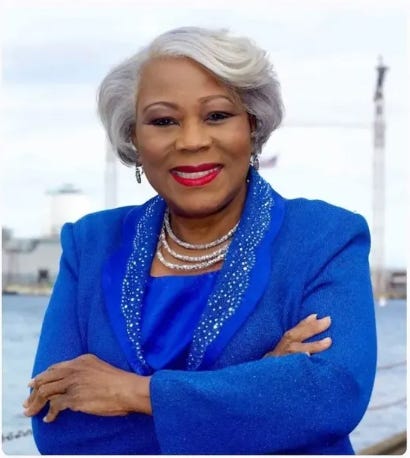
In addition to Jeffries, credit in Virginia goes to firebrand Democratic state Sen. Louise Lucas, who pushed for a redo of the map that would aim for 4 more Democratic seats. NPR reported:
About redistricting, she wrote to Republican U.S. Sen. Ted Cruz of Texas, “You all started it, and we f***ing finished it.”
“Donald Trump knows he’s going to lose the midterms. He knows it. That’s why he started this mess in the first place,” Lucas said in announcing the new map. “Today, we are leveling the playing field. These are not ordinary times, and Virginia will not sit on the sidelines while it happens.”
After the win, she took a victory lap: “I watched what was happening in Texas — Republican legislators backed by Donald Trump and MAGA extremists — try to rig the system before voters ever had a chance to speak,” said Lucas. “If they start this fight, Virginia is going to finish it … and in a special election — one question, no candidate, millions of dollars spent trying to confuse voters, Virginians still showed up.”
At a Wednesday press conference, Jeffries gleefully touted the multi-state strategy he spearheaded. “Donald Trump and Republicans launched this gerrymandering war,” Jeffries told reporters. “And we’ve made clear as Democrats that we’re going to finish it.” He brandished a slogan lifted from a MAGA operative: “Maximum warfare. Everywhere. All the time.” He may have finally shed his reputation for excessive caution.
The redistricting fight has accomplished more than simply adding seats to Democrats’ column. At the start of the battle last summer, Trump’s gambit woke up Democrats in Texas. After a dismal 2024 election, the redistricting fight energized local party officials and encouraged national Democrats to focus on and invest in the Lone Star State. Democrats found an opening to present themselves as the champions of Hispanic and Black voters who were losing voting power.
And perhaps most significantly, the Texas fight boosted the visibility of state senator James Talarico. He swiftly became a prominent figure in the Democratic resistance to Trump’s 2026 midterm-rigging. “My Democratic colleagues and I just left the state of Texas to break quorum and stop Trump’s redistricting power grab. Trump is trying to rig the midterm elections right before our eyes. But first he’ll have to come through us,” Talarico said at the time on Twitter. “It’s time to fight back.” It is questionable whether Talarico would have gone on to win the Democratic nomination for U.S. Senate had it not been for his role in fighting the Republican re-redistricting scheme. Talarico has put a critical Senate seat in play for Democrats and become an exemplar of a new generation of young, adept progressives with broad appeal.
Beyond Texas, the fight over Trump’s re-redistricting plot helped Democratic leaders address a key problem with their own voters, as well as independents: Voters think Democratic politicians are weak.
As pollster and analyst G. Elliott Morris has discussed, “Democrats’ weakness problem stands out as a particularly strong signal of intra-party dissatisfaction. . . Just 53% of Democrats call their party tough, compared to 80% of Republicans.” The same deficit has affected Democrats’ appeal to independents. “What is a Democratic problem is that 45% of independents say Democrats are weak,” Morris explained. That perception of weakness is a critical liability since “perceiving a party as strong is a stronger predictor of voting for that party than perceiving the other party as extreme.”
Arguably, the re-redistricting fight has helped change the image of Democrats nationally from a party playing by Marquess de Queensbury rules against street thugs to a party that recognizes it must brawl in defense of democracy. It also seemed to supercharge Democrats to take other bold moves, including holding firm on ICE funding, virulently opposing Trump’s war against Iran, demanding Cabinet members quit, pressing to release the Epstein-Trump pedophile files, and challenging Trump’s mental competency.
In that regard, the re-redistricting fight may turn out to be a crucial inflection point for the party, for 2028 aspirants who helped champion the effort (e.g., Illinois Gov. JB Pritzker, California Gov. Gavin Newsom), and for the man likely to be the next speaker, Hakeem Jeffries.
This week, credit goes to the voters of Virginia, and especially to Louise Lucas, who kept the momentum going throughout the re-redistricting fight. As Lucas put it in January, “I said in August of 2025 that the maps will be 10-1 and I’m sticking with that today.” She certainly did. She pulled Virginia Democrats, not known for partisan skirmishing, into the fray and scored another win against MAGA Republicans. She was an undaunted, unwavering, and unapologetic advocate of blocking Republicans’ power grab. Thanks to her and to Virginia voters, Democrats maintained their re-redistricting edge and, in the process, rediscovered their fighting spirit. We salute Lucas and her fellow Virginians for putting an exclamation point on a national fight to thwart Trump and his schemes.
We are grateful for Louise Lucas. She certainly kept the momentum going in the redistricting fight.
She appeared on Nicole Wallace’s “Deadline: White House” the other day, along with Virginia House of Delegates Speaker Don Scott. They were a hoot. “Turns out what started in Texas didn’t stay in Texas,” she reminded that state’s ultra-dumb Governor Abbott. Her colleague was a bit more direct. “When they go low, we gonna kick their motherfuckin’ ass.”
Evil spells have a funny way of backfiring, as Abbott and Trump may soon find out. Just ask Lord Voldemort.