


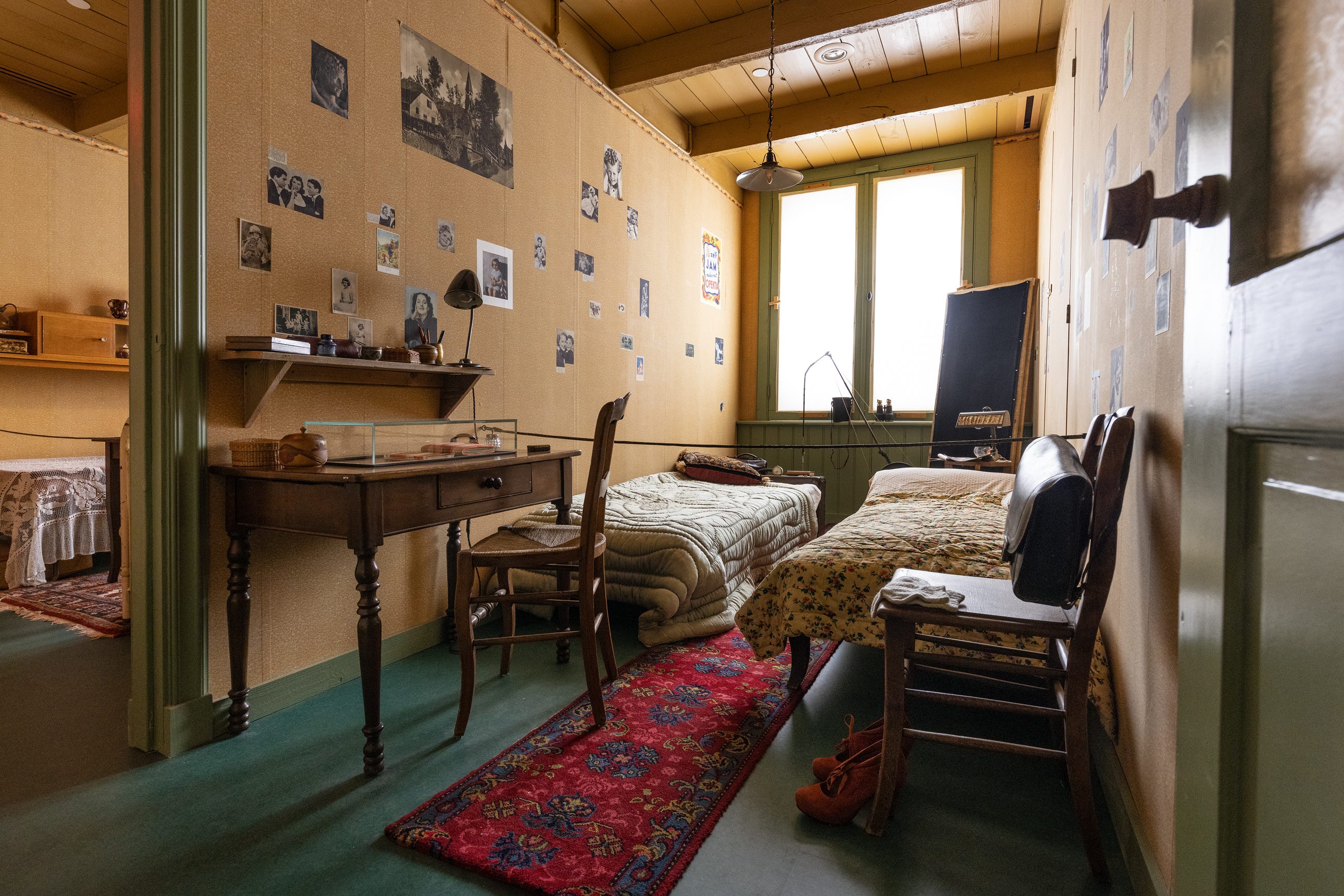
“I see the eight of us in the annex as if we were a patch of blue sky surrounded by menacing black clouds,” wrote Anne Frank on Nov. 8, 1943.
Nine months later, 15-year-old Anne was arrested by the Gestapo.
In total, Frank spent 751 days in that “patch of blue sky,” writing the diary that would become a literary classic and live on well after her death in February 1945.
In 1960, Anne’s father Otto Frank—the annex’s sole survivor—opened the space to the public. The Anne Frank house has since become one of the top tourist destinations in Amsterdam, drawing more than a million visitors a year.
But for the first time in history, Americans have the unique opportunity to tour the annex without booking a flight to Europe. A painstaking replica of the secret hideaway, furnished much as it would have been from 1942 to 1944, is on display at the Center for Jewish History in Manhattan.
But the full-scale recreation is just one part of Anne Frank The Exhibition, a sweeping yet intimate retrospective exploring Anne’s life and legacy. The show, which opened in January, tells the story of the Holocaust through a deeply personal lens. It has been extended multiple times due to high demand, and is scheduled to close Feb. 1.
“The comprehensive nature of the exhibition is something that had just never been done before. Really, at every level, this is a precedent-setting exhibition,” said Michael Glickman, who served as an advisor to the Anne Frank House on the New York exhibition. “Never before has there been a meticulous recreation of the annex where Anne and seven others hid. Never before has there been an exhibition that has presented the story of the family and those in hiding from the very beginning all the way through to their legacy.”
The 7500-square foot exhibition begins with an introduction to the Frank family (Anne, her older sister Margot, and their parents Otto and Edith) and tells their story in tandem with the rise of fascism in Germany. We learn that the Franks moved from Frankfurt to Amsterdam shortly after Hitler came to power in 1933. In the Netherlands, Otto ran a pectin company and the family lived in relative comfort until the Nazi occupation in 1940.
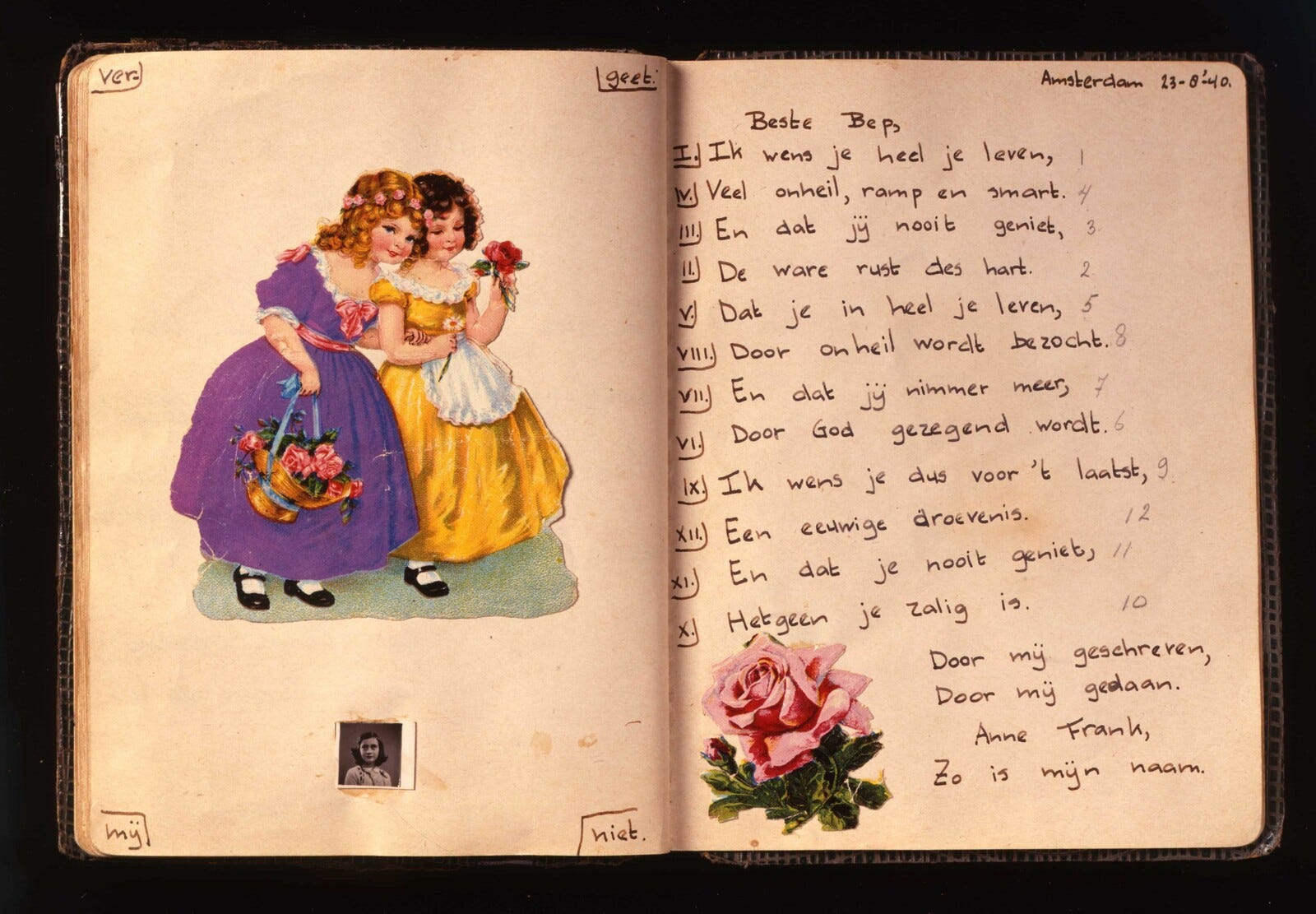
We get a strong sense of the peril they faced, along with their distinctive personalities: Edith is cripplingly shy; Otto more outgoing; Margot studious and quiet; Anne a bright and mischievous dreamer obsessed with Hollywood movie stars. The exhibition details the family’s unsuccessful attempts to obtain American visas, and recounts the antisemitic discrimination and genocidal violence that ultimately led the Franks to go into hiding in July 1942.
“It’s impossible to do an exhibition without giving people the perspective of what was happening around them,” Glickman said, continuing:
It wasn’t just that they left Frankfurt. Why did they leave? It wasn’t just that they went into hiding. What led up to that moment? it wasn't just that they were arrested. What happened to 6 million Jews, including 1.5 million Jewish children who were murdered. That context was really important for us.
The exhibition comes to life through more than 100 artifacts, including Frank family mementos, such as a beautiful toy gramophone given to Anne as a baby, and a travel trunk Otto used in 1909 when he sailed across the Atlantic for an internship at Macy’s.
“That is one of those pieces that stands out as miraculous that it survived,” Glickman said. It’s a single item of luggage that “makes the journey feel more real and more understandable.”
There are also objects that do not have a direct personal connection to the Franks but which nevertheless deepen the historical perspective, like a German election ballot that only lists one option, and a dagger inscribed with the message: “Everything for Germany.”
Without clobbering visitors over the head, the parallels to our current nightmare are hard to ignore, from the scapegoating of a marginalized group for a wide array of social and economic ills, to the alarming speed with which a democracy can become a dictatorship.
“It was all about understanding this story because we have to continue to learn from history,” Glickman said.
After the introductory galleries, visitors walk through the five cramped rooms of the annex, absorbing a palpable sense of what it was like for the Franks, the van Pels family, and Fritz Pfeffer to live in constant fear of discovery for two long years.
The Anne Frank House in Amsterdam remains virtually empty, as it was when Otto Frank returned home in 1945. (After the occupants of the annex were arrested in 1944, a Dutch company sent most of their belongings to Nazi families, which was “standard practice,” according to Glickman.) The lack of adornment enhances the sense that visitors are treading on hallowed ground.
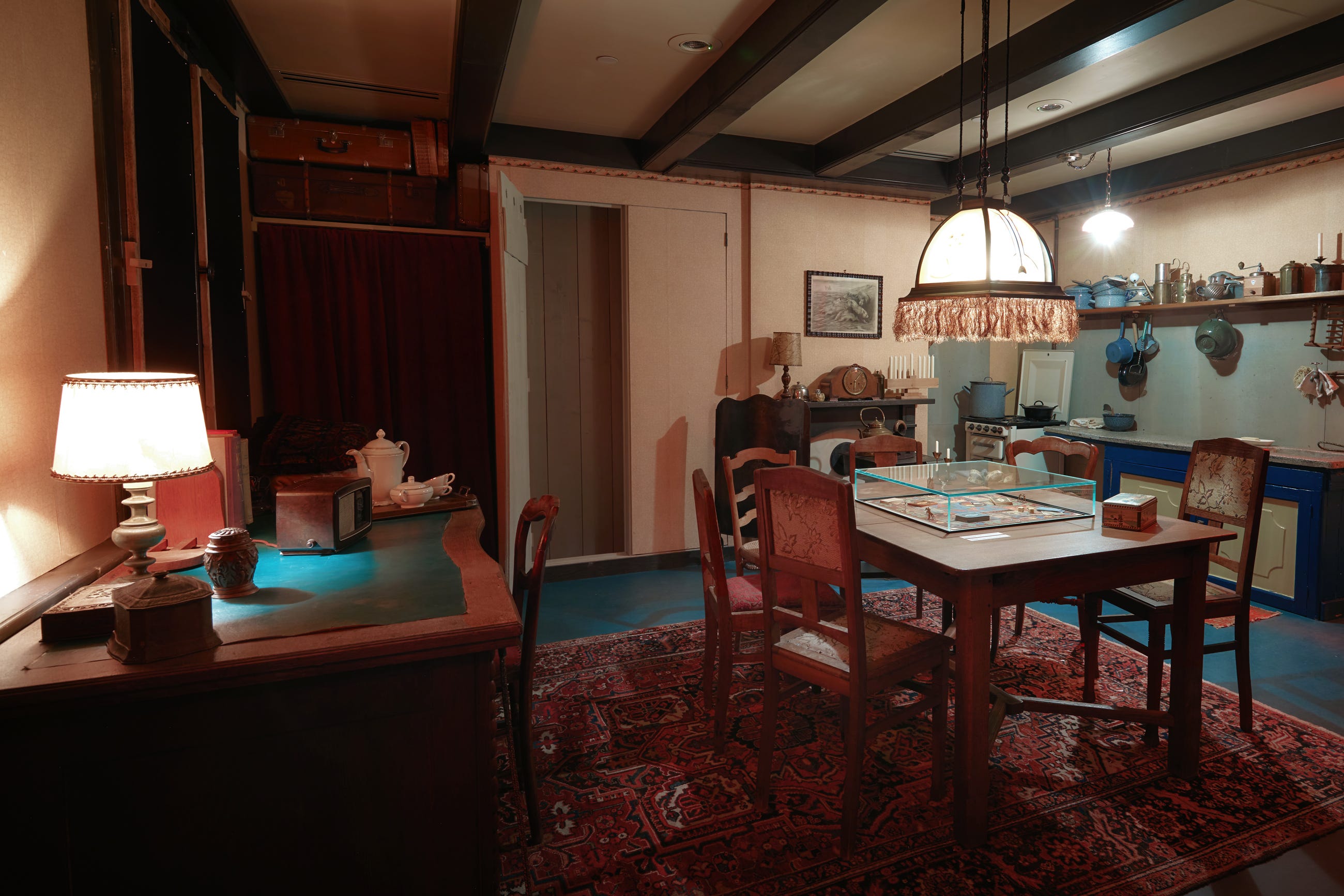
In contrast, the New York annex is fully furnished with items authentic to the time period and even a handful of objects that were recovered from the original space, such as a board game given to Peter van Pels for his 16th birthday.
“It was really important for us to be able to offer this distinction,” Glickman said of the replica, which was based on detailed scale models Otto Frank commissioned in 1961 to document how the families used the rooms. “It was important to us in building this experience that we not just create empty space.”
After the annex rooms, visitors learn about the Nazi’s Final Solution and follow the annex residents as they’re transported to concentration camps across Europe. Anne and Margot went to Auschwitz, then Bergen-Belsen, where they died two months before the camp was liberated. Perhaps the most haunting image of the entire exhibition is a photograph highlighted to show how 10 out of 15 Jewish children in Anne’s kindergarten class were killed in the Holocaust.
Speaking of children: the exhibition is suggested for kids 10 and older, but it is relatively light on graphic Holocaust imagery. There is also a specially designed audio tour for kids that explains the history in a straightforward but age-appropriate manner. After visiting on my own to make sure it wouldn’t be too disturbing, I returned with my daughters, 10 and 7, who were riveted.
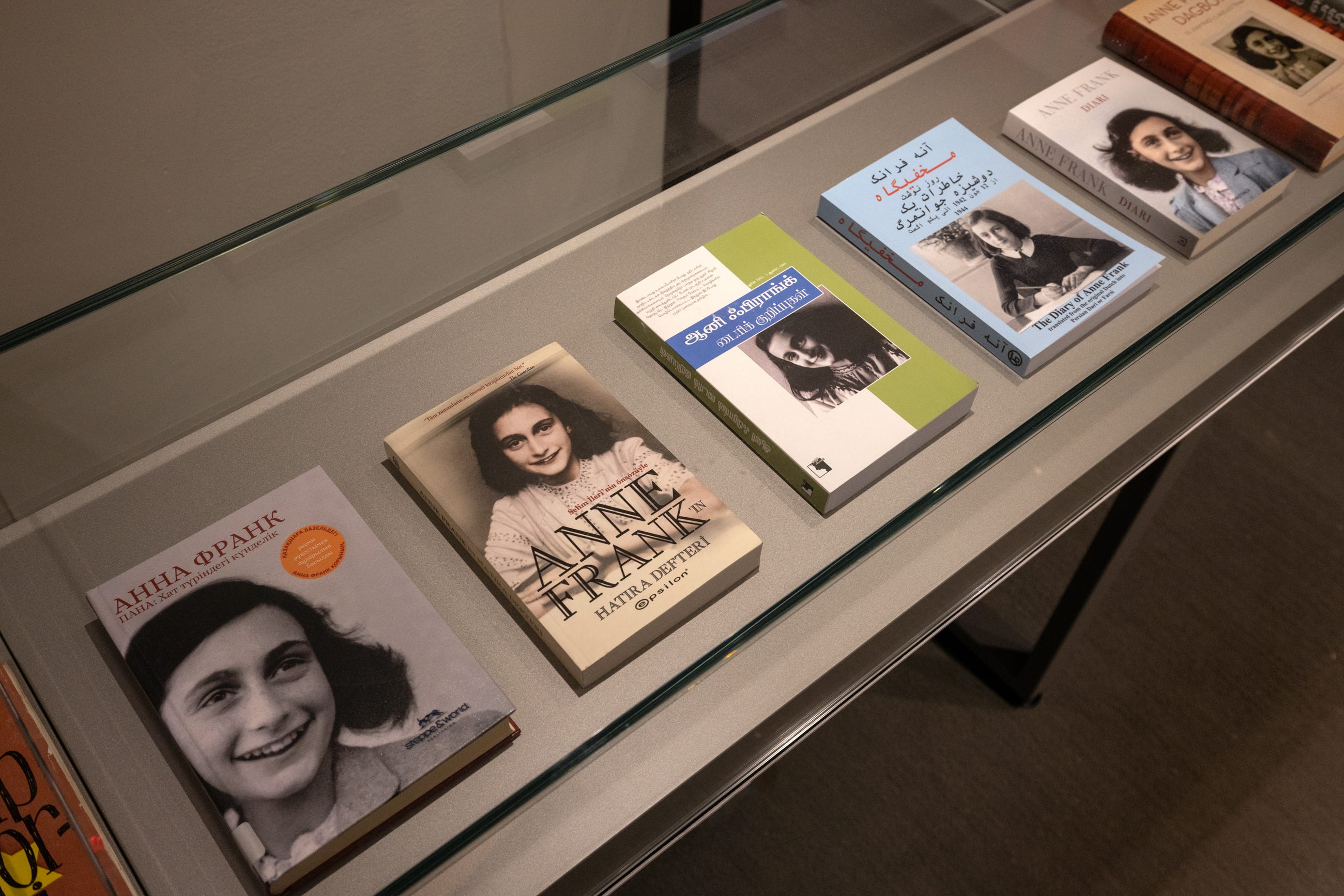
The final portion of the exhibition details Otto Frank’s arduous journey home from Auschwitz (the display includes the tiny, soiled cotton bag he used to carry his personal belongings), the publication of Anne’s diary, and its continued impact on readers.
“This exhibition is a living testament to how the legacy continues in the present day,” Glickman said. “And every single person walking through this exhibition is part of the story of carrying Anne’s words forward.”
Meredith Blake is the culture columnist for The Contrarian
"I see the world gradually being turned into a wilderness, I hear the ever approaching thunder, which will destroy us too, I can feel the sufferings of millions and yet, if I look up into the heavens, I think that it will all come right, that this cruelty too will end, and that peace and tranquility will return again." *** "It's really a wonder that I haven't dropped all my ideals, because they seem so absurd and impossible to carry out. Yet I keep them, because in spite of everything I still believe that people are really good at heart".
I wish I shared her optimism. I did when I was her age...
Ah, the innocence of youth. And the kicked-in-the-teeth-once-too-many jaded skepticism of almost 7 decades of life in this unreal-seeming version of America.
[P.S. I have a personal connection to Anne Frank and her diary. A theatrical story for another day.]
I don't remember who noted that Anne Frank may not have thought that "in spite of everything, I still believe that people are really good at heart" after she was sent to death camp. But the slaughter of 6 million people because they were Jewish is quite simply a warning that anyone, anywhere, for any reason can be singled out as an enemy to be destroyed.