


With all the threats facing our national security, the last thing the United States needs is for the head of the FBI to be “missing in action.” But according to a recent report, that’s the case.
“The FBI Director Is MIA,” The Atlantic said. “Kash Patel has alarmed colleagues with episodes of excessive drinking and unexplained absences.” Patel denied the complaints and filed a $250 million lawsuit against the news site. (The 19-page suit also made news for misspellings and typos.)
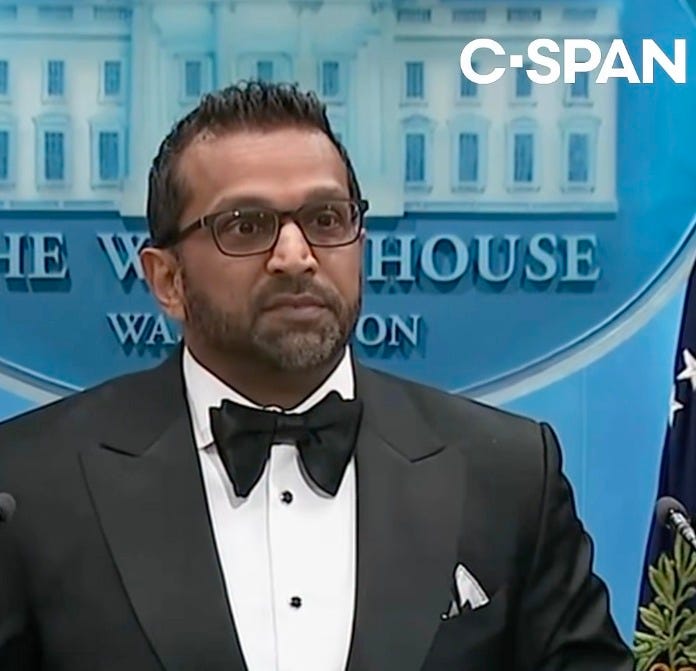
Other news agencies rushed to cover the questions about Patel’s fitness for the job. But news giants are ignoring another crucial part of this story: Because they’ve lost faith in the media, many Americans are unlikely to believe the claims.
In 1976, 72% of Americans trusted the media to report the news fully, accurately, and fairly either a “great deal” or a “fair amount.” Now, that figure is at an all-time low of 28%, according to Gallup.
Legacy news outlets like to blame right-wing attack machines for sowing distrust. But the legacy media has done this to itself. It gets things wrong all the time, and rarely takes responsibility.
I saw this happen during my 20 years working inside major news agencies. Now, in my podcast and newsletter, They Stand Corrected, I fact check the news. Listeners and readers constantly send me examples of media failures.
In this case, Americans are likely to be even more wary than usual because The Atlantic’s report is based entirely on anonymous sources. The “more than two dozen” people interviewed include “current and former FBI officials, staff at law-enforcement and intelligence agencies, hospitality-industry workers, members of Congress, political operatives, lobbyists, and former advisers.”
In a 2020 survey, more than two-thirds of Americans said anonymous sourcing influenced whether they find a story credible. I haven’t found a more recent survey on anonymity, but because overall trust has gone down, it’s likely that wariness of anonymity has gone up even further.
Sometimes, keeping sources a secret is essential. Watergate’s “Deep Throat” is the most famous example. But news agencies’ penchant for anonymous storytelling has also left a trail of destruction.
There are famous cases, like Rolling Stone’s piece about a gang rape at the University of Virginia which, it turned out, never happened. There are many other less well-known cases. In 2014, Reuters columnist Jack Shafer wrote that twice within two weeks, “New York Times reporters got taken for long rides by anonymous sources who ultimately dropped them off at the corner of Mortified and Peeved.” He asked, “How did anonymous sourcing become the rule rather than the exception in American journalism?”
I was at CNN when the network cited anonymous sources saying an arrest had been made in the Boston Marathon bombings. In reality, the two bombers were still at large. Anyone in the area breathing a sigh of relief instead should have been on guard.
None of this means The Atlantic’s story is wrong. The writer, Sarah Fitzpatrick, says since publication she has been “inundated by additional sourcing going up to the highest levels of the government” who have provided “additional corroborating information.” It’s also worth noting that Clint Brown, who worked as Patel’s “sherpa” through his transition to the FBI role, says he never saw any signs of these kinds of behaviors at the time. (He told me The Atlantic has not contacted him.)
The Atlantic is not responsible for other media’s failings. But it has faced problems of its own. In 2020, it retracted a story that had included anonymously sourced information. And I have reported on how The Atlantic passed along another news site’s anonymous claims that former NBC host Matt Lauer had a door-locking button at his desk. There turned out to be no door-locking button, according to Lauer and NBC itself (the button closed the door, but did not lock it, an important distinction). The Atlantic story was never updated.

To be clear, Patel has credibility issues of his own. I’ve reported on his false claim about vetting of immigrants. A state court judge once wrote that he was “not a credible witness” in a case involving January 6, 2021.
Americans are stuck between a presidential administration known to lie shamelessly and a media establishment that fails to ensure it’s delivering the truth. Of course people don’t know what to believe.
Even the coverage of Patel’s response to The Atlantic offers a powerful reminder of how often the media fails to fact check. At a news conference, he nonsensically claimed that he “has been on the job twice as many days as every director before me. What that means is I’ve taken half as many days off as those before me. What that means is I’ve taken a third less vacation than those before me.”
Huh? None of those things means the same thing. I heard about these remarks when listeners sent me links to reports carrying part or all of them. Unlike much of the media apparently, I asked the FBI to explain; I have not heard back.
Americans desperately need the media to serve as trustworthy sources of truth. Fact check everything. Until then, asking people to believe an anonymously sourced piece is going to be a very tough sell.
Josh Levs is host of They Stand Corrected, the podcast and newsletter fact-checking the media. Find him at joshlevs.com.
Thanks for running this column with my latest episode, The Contrarian. The legacy media has lost America's trust for good reason. To earn it back, the media should fight for truth always. Folks - share thoughts, questions, and links you want me to fact check over at: https://theystandcorrected.substack.com/
Kash Patel and Pete Kegsbreath get a free pass for being drunks.