

By Tianna Mays and Diamond Brown
“This is not time to engage in the luxury of cooling off.”
The Rev. Dr. Martin Luther King Jr. delivered those words in his “I Have a Dream” speech at the March on Washington 63 years ago today, as a quarter-million people descended on Washington to confront a democracy that was failing them.
They came by bus and train, by car and plane, from Black churches and union halls, from segregated towns and cities across the country. They gathered at the Lincoln Memorial to ask America to honor its ideals and demand liberation from a system built to deny Black Americans political power, economic opportunity, and full citizenship.
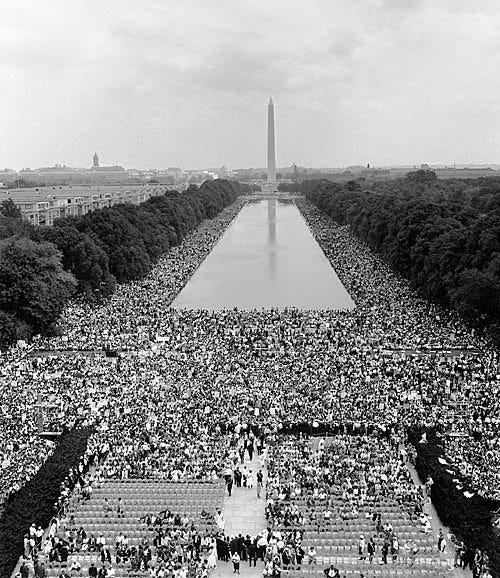
Today, we are back marching on Washington for those same demands, with a renewed urgency: defending the vote. That we must march today to defend that right should make us uncomfortable. Sixty-three years after Americans filled the National Mall to demand full citizenship, we are still confronting the same struggle over who can exercise political power and whose voice counts in our democracy.
The America of 2026 is profoundly different from the America Dr. King confronted in 1963, precisely because the Black freedom movement forced it to change. The Civil Rights Act of 1964 and Voting Rights Act of 1965 dismantled legal infrastructures deliberately designed to exclude Black Americans from political and economic power. But those victories were never self-executing or irreversible. And as the country changed, so too did the methods used to put political power further out of reach.
The old machinery of voter disenfranchisement that civil rights activists fought against was brutally explicit: literacy tests, poll taxes, all-white primaries, intimidation, and violence. Today’s voting restrictions rarely announce themselves so plainly. Instead, we hear fancy words like: “election integrity,” “verification,” “list maintenance,” “documentary proof,” and “districting.” The language and the laws are more polished, but the tactics are painfully familiar.
A voter does not have to be formally barred from the ballot to be effectively excluded. A polling place can be moved and made inaccessible. An early-voting site can disappear. A registration can be challenged or purged. A mail ballot can be rejected over a trivial technical error. An identification requirement can demand documents that are difficult or expensive to produce. Newly drawn district lines can dilute the political power of entire communities. No single rule has to explicitly spell out, “You cannot vote.” Stack enough barriers together, and the result can be the same.
The scale of recent changes to voting laws and regulations should command our attention. Since the 2020 presidential election, at least 30 states have enacted 123 laws that make it harder for eligible Americans to vote. In 2025 alone, 17 states enacted 32 restrictive voting laws, tying the highest annual total since this legislation began being tracked in 2011. And the pace is accelerating: States enacted 44 restrictive laws between January 2025 and April 2026, setting a new record for a two-year federal election cycle. Through May, lawmakers in at least 41 states had considered more than 300 additional bills containing restrictive voting provisions.
And they are arriving precisely as longstanding federal protections against discrimination at the ballot box are being weakened. The Voting Rights Act of 1965 was one of the crowning achievements of the civil rights movement. For decades, its preclearance provision required jurisdictions with histories of discrimination to obtain federal approval before changing election rules. The Supreme Court gutted that safeguard in Shelby County v. Holder in 2013. Earlier this year, in Louisiana v. Callais, the court dramatically narrowed one of the most critical avenues for challenging racially discriminatory maps in federal court. By raising the burden on plaintiffs seeking relief under Section 2, the decision gives states ample room to defend maps that disadvantage voters of color as products of partisan politics rather than racial discrimination.
And just this week, with another consequential election mere weeks away, the Supreme Court has allowed portions of the Trump administration’s executive order imposing new rules on mail voting to move forward while litigation continues. That fight extends well beyond mail voting.
Consider the persistent battle over documentary proof of citizenship. Citizenship is already required to vote in federal elections. Yet Congress has repeatedly considered legislation like the SAVE Act that would require Americans to provide documentary proof of citizenship when registering. On paper, that may sound simple. In real life, millions of Americans do not have passports sitting in a drawer, and birth certificates are easily lost and expensive to replace.
Those burdens are not distributed evenly. Racial Black disenfranchisement is not incidental to American democracy; for generations, it was written into law and enforced through state power, economic retaliation, intimidation, and violence. But the burdens created by restrictive voting policies today extend beyond any one community. They fall especially hard on people who already have fewer resources or have historically faced greater obstacles to political participation.
That is why the lesson of 1963 remains so urgent. The March on Washington was a call for jobs and freedom because its organizers understood that political freedom and economic freedom are inseparable. And the ballot determines who writes labor laws, funds schools, sets wages, draws districts, appoints judges, and protects civil rights. Voting is the mechanism through which Americans can make change.
Those who marched on Washington in 1963 understood that democracy cannot maintain itself. They were confronting a political system that had spent generations telling Black Americans to wait: wait for attitudes to change, wait for courts to act, wait for Congress to move, wait for the country to become ready. Waiting without political action changes nothing.
That’s why they organized, marched, litigated, registered voters, and demanded federal action. Two years later came the Voting Rights Act.
And that is why we will march again. Voting should not require extraordinary persistence from ordinary citizens. We march because no American should need more money, more free time, better transportation, more paperwork, or more luck than their neighbor to exercise the same fundamental right.
Sixty-three years later, we know that progress can be reversed, rights can be stripped away, and democracy can be weakened. The marchers of 1963 did not wait for a more convenient moment to demand their freedom. And neither will we.
Tianna Mays is the legal director at Democracy Defenders Fund. Diamond Brown is a senior counsel for policy at Democracy Defenders Fund.
This march is not only about political and economic freedom, it is also about dignity, self determination and self preservation. It is about defending the basic tenets of democracy by instituting inclusive practices from all minority communities to benefit the collective interests of everyone.
Just shameful that the U.S. has allowed such racism to roar back in a country of peoples from many backgrounds and races. With voting as a main Democratic right and act it looks like our legislators and judges need to go back to school for a basic U.S. government class.