

By Richard Painter, Virginia Canter, and Norm Eisen
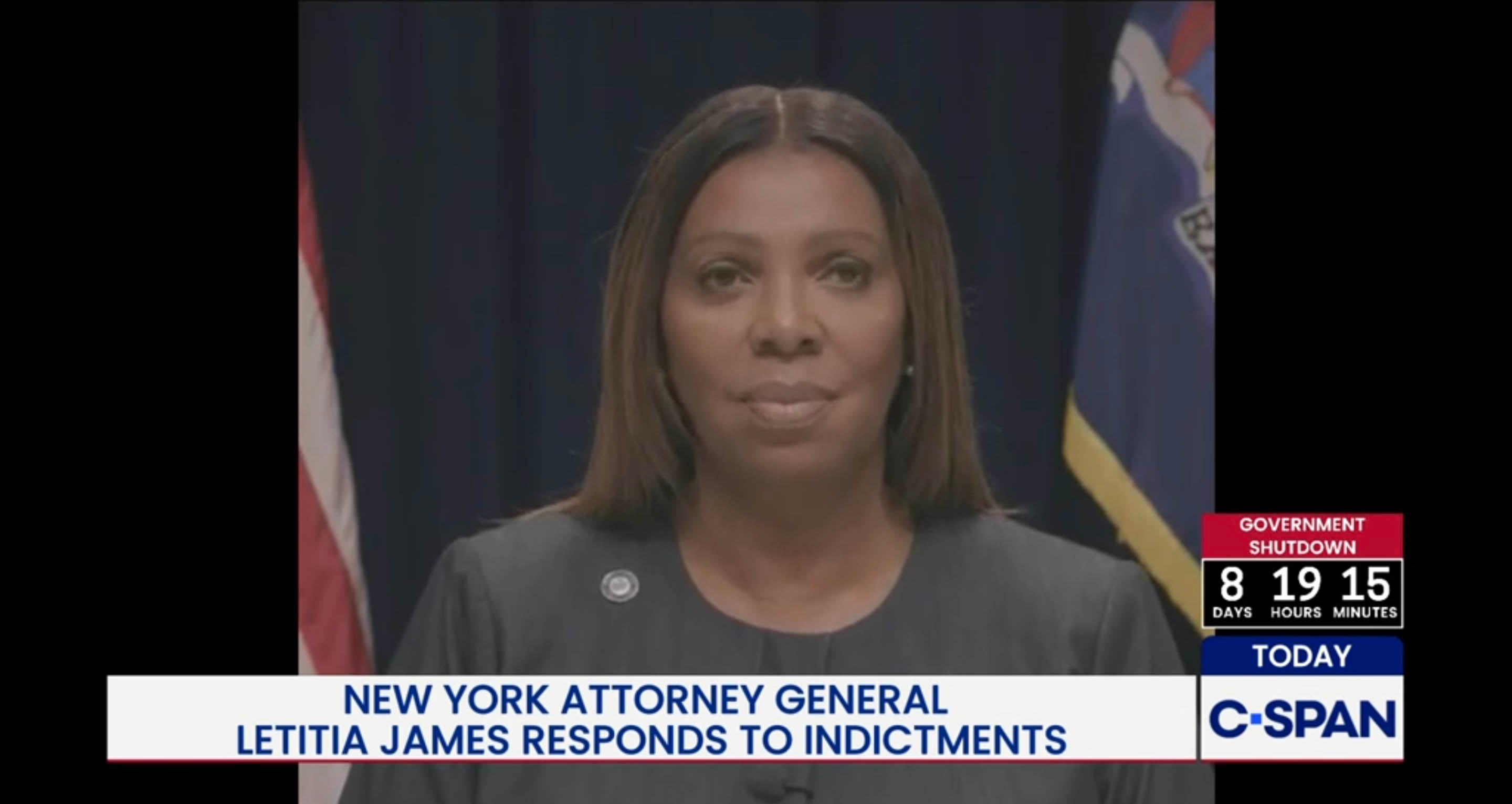
A head of state can transform a democracy into a dictatorship easily if voters don’t care. Of all the executive departments, two are essential to impose such a plan: the military and the justice department. By deploying military forces inside the country for whatever purpose and prosecuting political enemies, a president can make himself a dictator in short order. Donald Trump is well on his way with the deployment or attempted deployment of the National Guard in cities like Los Angeles, Washington, D.C., Portland, and Chicago, and the recent indictments of former Federal Bureau of Investigation Director James Comey and current New York Attorney General Letitia James. Fortunately for democracy, there has been significant court and public pushback on the deployments, and we expect the same on the indictments.
Domestic deployments of federal troops have been common throughout the world. It has happened many times in South America and Asia. It happened in the summer of 1932 in Germany, a constitutional republic, when the Supreme Court of the Weimar Republic, in Prussia v. Reich, allowed President Paul von Hindenburg to declare Prussian protest an “emergency” and deploy troops over the objections of the Prussian government. American courts should not embark on that slippery slope of allowing the president’s domestic deployment of the military, a process that can begin with one city or state but all too easily spread to the entire country.
The other side of this dictatorial equation is the justice department. A head of state who can order his government to prosecute political enemies makes political dissent among the most serious crimes against the state. With the justice system diverted to such ends, democracy dies. Vladimir Putin has done this in Russia for two decades. We cannot allow it here in the United States unless we want a dictatorship.
Comey was recently indicted for the crime of offending the president. He offended the president by supervising the FBI investigation of the president’s campaign eight years ago, and he got fired for that. Comey’s firing led to Special Counsel Robert Mueller’s investigation of Russian interference in the 2016 election and then to a protracted effort since then by the president and his supporters to get back at Comey. It took until 2025, when the president began his second term, for the Comey indictment to happen, but it did.
Of course, the indictment did not literally charge Comey with offending the president. The indictment is built around a flimsy “false statement” charge concerning testimony Comey gave to Congress in 2020, based on testimony he had provided in 2017. Professional prosecutors have been examining Comey’s testimony since 2017, and none concluded that criminal charges were warranted. A prosecutor appointed by Trump reportedly raised concerns about charging Comey and refused to bring charges against James. He was promptly removed and replaced. The new prosecutor’s two-page indictment of Comey, one of the flimsiest we have ever seen filed in federal court, is a political prosecution. Nothing more and nothing less.
Now, that same new prosecutor is bringing charges against James, who prosecuted the Trump Organization for civil fraud and won. The charges against James consist of what appear to be baseless allegations of “bank fraud.” And the press reports that more prosecutions might be on the way.
Attorney General Pam Bondi, in congressional testimony this week, denied that the Justice Department is engaging in political prosecutions. But when Sen. Amy Klobuchar (D-Minn.) asked Bondi if she received any advice or instruction from the president or anyone else at the White House, Bondi replied, “I’m not going to discuss any conversations.” If the answer was “no,” Bondi should have said so. Indeed, communications from the president or anyone else at the White House to the Justice Department about specific prosecutions are highly unusual and, absent extenuating circumstances, such as prosecution after a major terrorist attack, have been against White House policy for decades. Until now. The attorney general’s refusal to talk about it is not a denial, and, indeed, the president himself has openly talked on his social media platform about prosecuting his enemies.
Notwithstanding Trump’s apparent efforts to weaponize the Justice Department, the federal courts are holding firm to uphold the rule of law. Indeed, three different federal courts just granted relief in Chicago. In one case, a federal judge extended a 2022 consent decree to further limit the ability of Immigration and Customs Enforcement to arrest people without warrants or probable cause. Another federal judge issued a temporary restraining order from the bench to bar “federalization and deployment” of the National Guard within Illinois for at least 14 days, concluding that there is “no credible evidence that there is a danger of rebellion in the state of Illinois” and the Trump administration’s “perception of events” around Chicago “are simply unreliable.” Finally, a federal judge issued a temporary restraining order to block federal agencies from “arresting, threatening to arrest, or using physical force against journalists unless there is probable cause to believe that the individual has committed a crime.” It also prohibits them from “issuing crowd dispersal orders, without exigent circumstances,” and from using various riot control weapons such as tear gas.
Now is the time for all of us—Democrats, Republicans, independents, and everyone else—to decide what kind of country we want to live in. If we want a democracy, we must not tolerate two things: the deployment of the military for domestic law enforcement under the command of the president or political prosecutions by the Justice Department. Congress must demand that the president govern according to the laws and Constitution of the United States and tell him that he must obey the law or leave office. If Congress won’t perform this vitally important Constitutional duty, it will be our duty as voters next year to replace Congress.
Richard Painter is a legal scholar who frequently writes on topics including the U.S. Department of Justice. Virginia Canter and Norm Eisen are attorneys at the Democracy Defenders Fund, which represents municipalities in cases relating to National Guard and ICE deployments.
"Congress must demand that the president govern according to the laws and Constitution of the United States and tell him that he must obey the law or leave office. If Congress won’t perform this vitally important Constitutional duty, it will be our duty as voters next year to replace Congress."
It's pretty darn clear that Congress (the Republican majority) has no intention of telling Trump or any of his cronies that they must obey the law (although Susan Collins is quite concerned /s).
Whether we actually have until next year to replace Congress is uncertain (I lead an elections group in my local Indivisible). So that leaves massive protests, boycotts and other means of citizen's engagement. We must all do our part to get Democrats elected on both the state and federal levels. That means doing nuts and bolts activism. Phone banks, texting and knocking on doors. At least in my area far too few people have volunteered for these kinds of activities. It's past due for people to get actively engaged.
I am not interested in going back to the same kind of country we had prior to 2016, when president 47 rose to power. Our founding fathers, despite their flaws and imperfections, did include some ideals in our constitution that have yet to be realized by large groups of American citizens. Whether the founders really intended for them to be realized or not is irrelevant.
When introducing the Bill of Rights to Congress, James Madison spoke in terms of “the peoples’ rights,” not what Congress would not do to abridge those rights. Read the first amendment. It says “Congress shall make no laws….” Madison’s rights were rewritten by…Congress. Fortunately, the judiciary has interpreted, through the application of the 5th and 14th amendments, that these are rights. In practice, they are liberties, not rights, through the eyes of the executive branch. And there are no constitutional restraints on the executive branch in abridging those liberties. They are not constrained by the constitution, nor by any other secular writ.
Any form of government that follows the Trump reign of terror, must have a constitution that clearly and unequivocally spells out the rights of *every person* who is a citizen of this country. Nothing less! In addition, these rights must be protected by the full power of the executive branch. Any organization or person attempting to abridge these rights should be prosecuted. Corporate personhood should be overturned and stricken down.
That is a start from yours truly, Wry Banter, agent provocateur and defender of the written word.