


Donald Trump has overthrown the president of Venezuela and intends for the United States to “run” the country—to extract its oil wealth.
This isn’t a case where one needs to speculate or unpack ulterior motives. The president of the United States told the world, directly in a press conference Saturday, that oil was at the heart of his decision to topple Nicolás Maduro from power.
There was some throat clearing about secondary motives, of course: the narco-trafficking charges Maduro will face in New York, the supposed threat to American citizens by Venezuelan gangs, and the fuzzy allegation that Venezuela could be “potentially in league with the cartels operating along our border.”
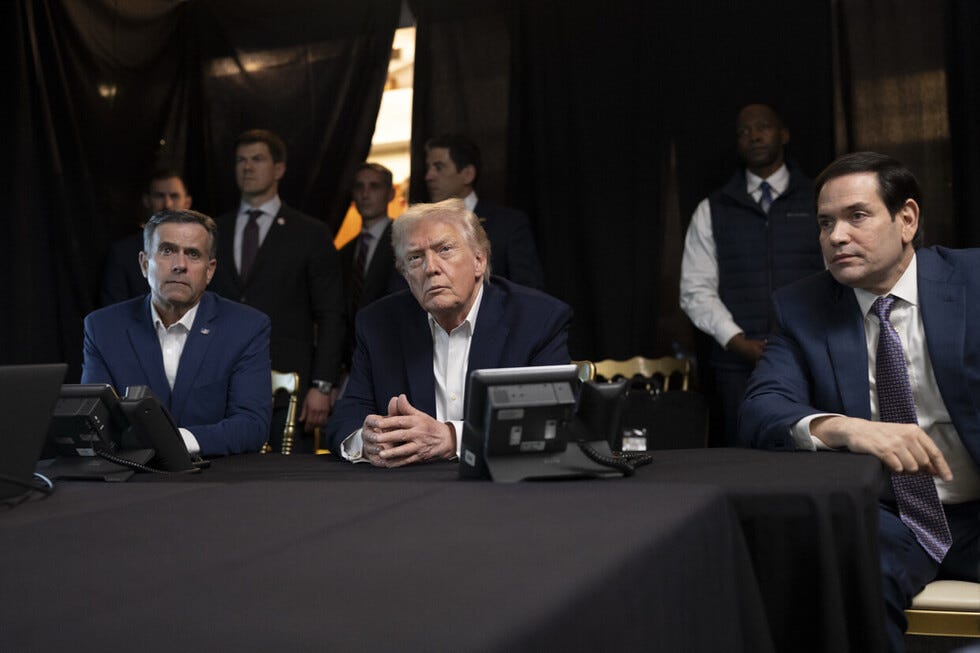
But the casus belli for regime change in the South American nation was crude: “They stole our oil,” Trump said. Venezuela has some of the largest oil reserves on the planet, but American Big OIl producers have been locked out of the country since a wave of nationalization in the early aughts. Trump insisted that overthrowing Maduro was an effort to reverse “one of the largest thefts of American property” in the nation’s history. “We’re late,” he added. “But we did something about it.”
Maduro was captured in a predawn Saturday raid in the capital, Caracas, that Trump characterized as a “spectacular assault” and “one of the most precise attacks on sovereignty [ever],” constituting “an attack for justice.” The deposed Venezuelan president is now in U.S. custody and due to be processed on a new indictment for alleged drug-trafficking and “narco-terrorism” conspiracies, as well as weapons charges.
Congress had no notice of the regime-change strike, Secretary of State Marco Rubio revealed at the press conference. The mission was apparently accomplished without a loss of American life; the toll on Venezuela has not been revealed. In his turn at the mic, Secretary of “War” Pete Hegseth buttressed the logic for the strike, insisting Trump was “deadly serious about getting back the oil that was stolen from us.”
For his part, Trump made clear that the United States intends to impose its will on the South American nation of 30 million people indefinitely. “We’re going to stay,” he said, “We’re going to run it.”
How any of this is supposed to work in practical terms—in particular for the citizens of Venezuela—is wildly up in the air. Is the United States actually in control of the country? What kind of U.S. military presence will be required to achieve or maintain control? Trump described the operation to topple Maduro as a “pinpoint” strike, but he added that the United States is prepared for “a second and much larger attack if we need to do so.” He added, ominously: “We’re not afraid of boots on the ground.”
On the planned structure of governance going forward, Trump was fuzzy: “We’re going to be running it with a group,” he said, “And we’re going to make sure it’s run properly.”
America has learned the hard way that though toppling a government is relatively easy, the aftermath of regime change is where the true challenges lie. (See: Afghanistan, Iraq, Libya.) And it turns out the United States ran war-game scenarios in which it ousted Maduro—and they didn’t end well. “The idea that you’re going to be able to slot in a government and everything else will just fall into place, I think is just fantasy,” an expert in Caracas recently told the New York Times.
There was only one subject on which Trump appeared to have a clear concept for What happens next. That is the future of Venezuela’s oil industry, which Trump described as a quasi-U.S. asset. In fact, Trump characterized his decision to take over Venezuela as reversing a theft by “the socialist regime.” (Venezuela’s oil industry was nationalized in waves, beginning in the late 1970s and culminating under then-president Hugo Chavez in 2007.) “Venezuela unilaterally seized and sold American oil, American assets and American platforms, costing us billions and billions of dollars,” Trump said, underscoring the loss as a national humiliation: “Massive oil infrastructure was taken like we were babies.”
As Trump envisions it, Big Oil will now have a field day—returning to tap Venezuela’s massive reserves. “We’re going to have our very large United States oil companies go in, spend billions of dollars, [and] fix the badly broken infrastructure,” Trump said.
This capture of Venezuela’s oil industry, Trump alleged, will pay for itself—after some upfront spending by Big Oil firms. “They will be reimbursed for what they’re doing. But … we’re going to get the oil flowing the way it should.” In Trump’s exploitative pitch, this gusher of petro wealth will also pay the costs of U.S. intervention and occupation: “It won’t cost us anything, because the money coming out of the ground is very substantial.”
Trump—who has built his political career as a contrast to neocon interventionists—seemed oblivious to the fact that he was echoing George W. Bush deputy Paul Wolfowitz and his infamous promises that Iraq would “finance its own reconstruction.”
In fact, Trump even one-upped Wolfowitz. He presented a daydream scenario in which limitless petro-cash could also provide U.S. interests with “reimbursement for the damages caused us by that country.” In a sop to the citizens of the nation whose leader he just captured, Trump also extended vague pledges to use the oil wealth to “make sure the people of Venezuela are taken care of.”
How long will American rule last? Trump indicated that the expected horizon is at least 12 months: “What’s going to happen with Venezuela I think over the next period of a year,” he said, “is going to be a great thing—and the people of Venezuela will be the biggest beneficiaries.” Trump added that there would ultimately be “a safe, proper, and judicious transition” back to Venezuelan rule.
Americans have seen this movie before, and many are aghast at what the 47th president has unleashed. “Trump’s shocking claim that the United States will occupy Venezuela, run the country and exploit the nation’s oil resources echoes the imperial arrogance of the United States after the invasion of Iraq,” said Public Citizen Co-President Robert Weissman, “and may well foretell a comparable disaster.”
Trump did not offer any legal justification for toppling the leader of a sovereign South American nation—a move that threatens the stability of the global order at a moment when Russia is at war with Ukraine and China is eyeing Taiwan. Instead, Trump invoked the Monroe Doctrine—an American posture dating from the 1820s that declared U.S. preeminence in the Western Hemisphere.
“The Monroe doctrine is a big deal, but we’ve superseded it by a lot,” Trump said. “They now call it the Don-roe Doctrine.”
Even as Trump reasserted the United States’ supposed authority to impose its will on “our own hemisphere,” the president made clear that the Don-roe Doctrine is fueled by oil. “We want to surround ourselves with good neighbors. We want to surround ourselves with stability,” he said. “We want to surround ourselves with energy.”
Speaking of Venezuela, specifically, Trump spoke of its reserves as now belonging to the U.S.: “We have tremendous energy in that country…. We need that for ourselves. We need that for the world,” he said. “And we want to make sure we can protect it.”
For members of Congress—the co-equal branch that was not consulted on the president’s act of war—there’s no justification for what Trump has set in motion.
“Trump has no right to take us to war with Venezuela. This is reckless and illegal. Congress should vote immediately on a War Powers Resolution to stop him,” said Rep. Greg Casar, a Democrat from Texas who chairs the Congressional Progressive Caucus. “My entire life, politicians have been sending other people’s kids to die in reckless regime change wars. Enough. No new wars.”
Tim Dickinson is the senior political writer for The Contrarian.
So............... the US oil companies are going to pay billions to our fascist dictator personally for this gift of the oil "belonging to us." That sounds an awful lot like the"2020 election was stolen from us." "US" being himself, of course.
Re Venezuela, Donald Higgins commented in Robert Reich’s 1/4 post “Sunday thought: Even worse”….
“Trump and his gang… conduct(ed) a covert action where kidnapping was the end goal of their efforts, what is stopping (others) from doing the same thing to Trump for the crimes he has committed(?).”
This statement to which I applied slight edits for clarity, warrants serious consideration. The reality is it would be difficult (but not impossible) for anyone not on the inside to get to Trump while he’s in office - much easier to grab his family members, his cabinet members and top advisers, their family including CEOs that are backing Trump and their families. Some of those most at risk have young children (a particularly chilling scenario). Our short-sighted foolish president has just increased the personal risks and dangers facing everyone around him! And they don’t seem to get it.
Consider how close we are to a major escalation from a regional act of aggression into a much larger and vastly more deadly global war if any such attempt was made and Trump blamed it on a foreign power. It would not be the first time such a tragic self-inflicted tragedy unleashed hell on earth.
We have made a grave error in electing Trump to the highest office in America! His actions make it more likely that China will soon invade Taiwan AND that Russia will now throw everything it has left into the utter destruction of Ukraine.
We are closer to chaos than ever before. Some will criticize me for such statements but in truth I am afraid and I ‘see’ what’s coming. It’s not a dream. It’s a real possibility and we must put an end to the madness Trump, the Supreme Court, the GOP, the Christian Nationalists, MAGA cultists and all of Trump’s coat-tail riders have wrought.
Note to all law enforcement: I am not advocating violence. I support non-violent peaceful resistance protected under the law.