

By Megan Armstrong
In January, Brendan Sorsby committed to Texas Tech as the best quarterback in the NCAA transfer portal (a database that facilitates college sports’ version of free agency). The Texas Tech Red Raiders won their first Big 12 championship in program history last season, and Sorsby was anointed as the one to lead the team to the promised land of a national championship next season. He was reportedly set to bank approximately $5 million just for showing up, and he had a shot at being the face of college football in 2026.
But before his first snap, he became the newest face of sports gambling instead.
On April 27, Texas Tech announced that Sorsby had voluntarily checked himself into a residential treatment program for a gambling addiction. ESPN’s Pete Thamel reported that Sorsby’s decision “came in the wake of the discovery of Sorsby making thousands of online bets on a variety of sports via a gambling app,” dating back to betting on the Indiana Hoosiers to win games he did not play in as a redshirt true freshman on the team. He is not believed to have tried to influence game outcomes; his pattern was described to Thamel as “a steady flurry of small bets over a period of time.”
Sorsby now faces an active NCAA investigation, as the NCAA “forbids athletes from betting on both college and pro sports.” He has retained Jeffrey Kessler as his lawyer to fight to regain his college eligibility, per ESPN’s Adam Schefter, and he can apply to the NFL’s supplemental draft if it’s determined he’s banned from college football.
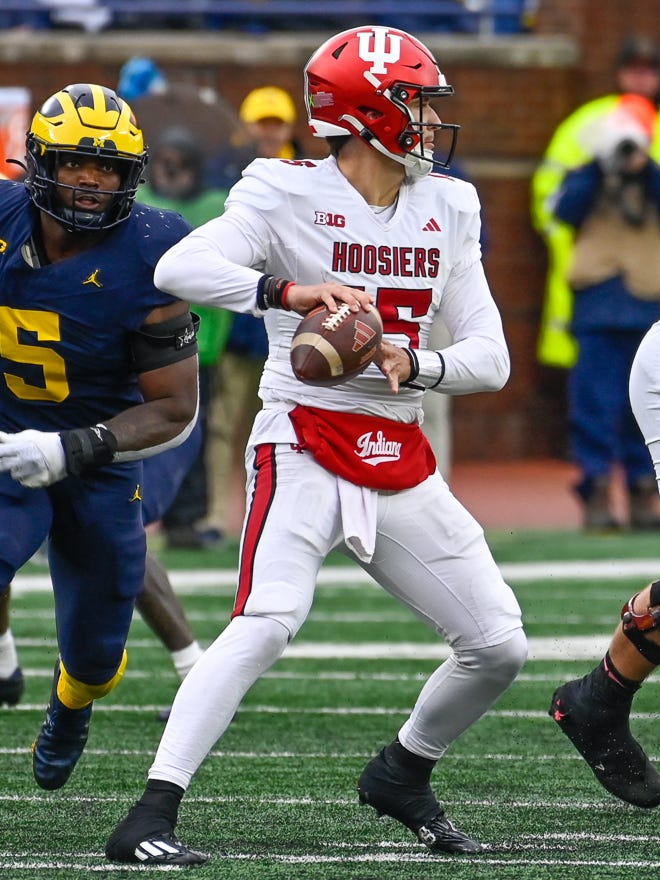
Even if he isn’t banned, the “sports gambling addiction” label will follow Sorsby in football circles, at least in the short term. The NFL has a recent track record of being surprisingly hard on gambling.
The highest-profile instance came in March 2022, when the NFL suspended star wide receiver Calvin Ridley, then with the Atlanta Falcons, for one full year after Ridley gambled for five days in November 2021 while away from the Falcons to “focus on my mental well-being.” After the NFL reinstated him in March 2023, Ridley told his story in The Players’ Tribune. He wrote, in part, “I was still just so depressed and angry, and the days were so long. I was looking for anything to take my mind off of things and make the day go by faster. One day, I saw a TV commercial for a betting app, and for whatever reason, I downloaded it on my phone. I deposited like $1,500 total, literally just for something to do.”
Sorsby is 22 years old. For him to go from hot NFL prospect to pariah would be a shame, not least because his relatively innocuous actions didn’t hurt anyone. He didn’t rig games, and the NFL forgives far worse all the time. It remains to be seen whether the NFL will discipline Falcons linebacker James Pearce Jr., who recently agreed to a six-month intervention program seeking to have three felony charges dismissed. (To say nothing of the crimes of the most powerful people in our country, who commit infinitely more troubling offenses on a loop and get off scot-free.)
It’s also a shame because Brendan Sorsby is not the real face of sports gambling.
America is.
Turn on any sports show, and you’ll be greeted by a scroll of live odds and betting ads, if not an outright sponsorship by DraftKings or FanDuel.
CBS Sports published an article about Sorsby’s gambling addiction and couldn’t help but dedicate a paragraph to Texas Tech’s updated Big 12 championship odds on FanDuel.
Several star athletes are active investors in the controversial and sharply escalating prediction-market site Kalshi, per Front Office Sports, and the Trump administration is actively suing three states in a garish attempt to override state gambling laws and keep the prediction market industry flourishing.
The American Gaming Association announced in February that the sports betting industry raked in a record $16.96 billion in revenue last year, with $166.94 billion placed in legal American sports bets.
This Pew Research Center survey from last October underscores the rampant cognitive dissonance allowing gambling to infiltrate sports and daily lives nationwide. It’s a billion-dollar industry that a substantial number of people feel bad about participating in, yet can’t stop — similar to doom-scrolling or any other normalized addiction. As of last summer, 43% of American adults believe sports betting is bad for society, while 40% believe it’s bad for sports. Only 7% and 17% responded that it’s a good thing for society and sports, respectively.
Sorsby has not publicly commented on the nature or roots of his sports gambling addiction, so it would be irresponsible to speculate on the specifics of his story. But three universal truths apply. Addiction has never cared how much someone has to lose; it only cares about taking as much as it can. Addiction never develops in a vacuum, and the plot lines of this very American story hold up with any one of us as the main character.
Would it ever cross your mind that you were putting your future in jeopardy with every tap of your finger if you grew up in an environment where gambling apps lived in your pocket, and placing a sports bet was as naturally ingrained a daily habit as brushing your teeth?
How are you supposed to recognize you have an addiction when you’re innocently mimicking wholly normalized behavior around you?
Maybe none of this sways you. Maybe you don’t view Sorsby as a sympathetic figure because he’s a star quarterback. Football is king, and quarterbacks are the crowned princes, always expected to be the exception to the rule. He should have known he couldn’t be just one of the boys placing bets in the group chat; he had NCAA eligibility and a bright NFL future to protect.
Heavy is the head that wears the crown, or whatever. But under that helmet resides a human, and neither a helmet nor pads has ever protected against human fallibility.
Sorsby has been the exception to the rule on the football field for his entire life — defying typical physical capabilities to throw better, run faster, and win more than mere mortals. He is now an even more profound exception off the field by seeking help for the vice that quietly rules those around him in plain sight.
Megan Armstrong is a freelance journalist, podcast producer, and perpetual content consumer. Her work has appeared in Billboard, Boardroom, Esquire, GQ, GRAMMY.com, NYLON, Teen Vogue, The Kansas City Star, The Hollywood Reporter, UPROXX, and elsewhere.
This used to be a personal addiction. Now it's an international disease, one that meshes in with prediction markets and insider trading.
Great article, but the betting addiction is not only present in the US. It has become a billion dollar industry worldwide, especially in soccer.