


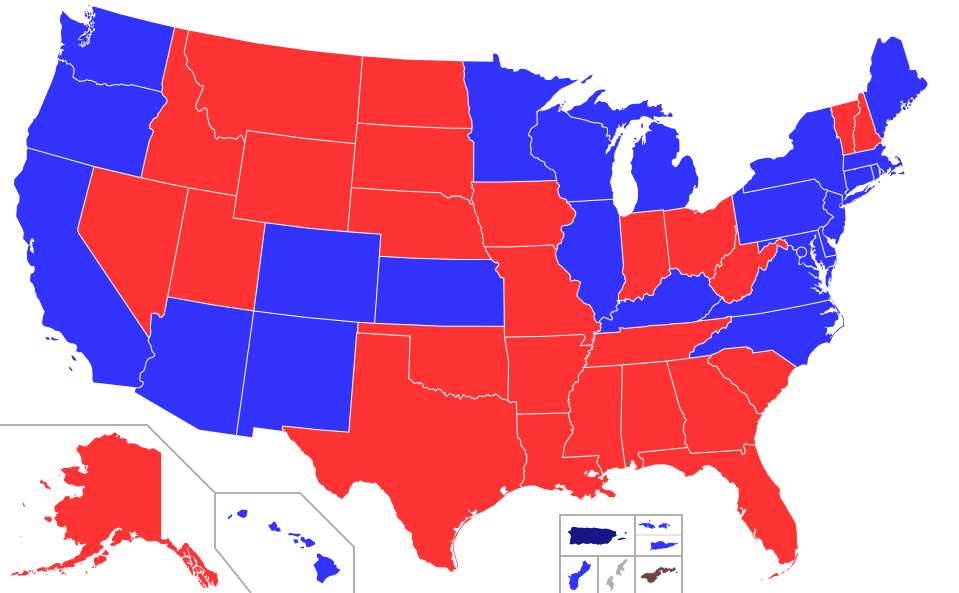
Democrats are well positioned to flip a slew of governorships from red to blue, including in Iowa, Georgia, Alaska, Ohio, Nevada, Texas, and Florida. They also have the chance to break through in state legislative races, building majorities or, at the very least, breaking up Republican supermajorities. That will give them critical power to ensure the 2028 presidential election is conducted lawfully and, in the interim, to demonstrate what responsible, progressive governance looks like.
When the White House and federal agencies remain in Donald Trump’s hands and the MAGA majority on the U.S. Supreme Court peels aways decades of protections from Americans on everything from voting rights to abortion access, state governments can provide critical protection for fundamental services, ranging from healthcare to housing to food assistance. Maintaining state vaccine requirements, instituting moratoriums or strict regulations on data centers, and backstopping schools and food banks hit by federal cuts can insulate residents from rotten federal policy choices.
States can also act as essential bulwarks to shield residents from federal government abuse. In its September 2026 report, the ACLU listed critical policy arenas — including immigration, free speech/data collection, and voting and civil rights — in which states can play a critical part in preventing grave constitutional abuses.
On the immigration front (as we have seen in states such as Illinois), state and local authorities can opt out of the “Trump’s deportation machine by minimizing local entanglements with abusive and discriminatory immigration enforcement programs,” refusing to contract with ICE to provide detention space (where we have seen rampant abuses), and/or refusing to allow their law enforcement personnel to be dragooned into assisting abusive ICE actions.
In addition, as is happening in Minnesota, state and local officials can investigate excessive use of force and pursue prosecution of federal officials who violate state law. They can likewise gather information, hold public hearings, and create a complete public record that can be used by federal officials in a future administration.

Governors also can refuse to turn over to the Trump regime their national guard troops to patrol other states and, as California, Oregon, and Illinois did, go to court to block federal invasion of troops to conduct rogue, violent immigration raids in their own states.
In California, for example, Gov. Gavin Newsom recently signed a bill that “prohibits military personnel from another state, territory, or the District of Columbia from entering California to perform military duty or law-enforcement functions without the permission of the Governor” while preserving the exception for “forces lawfully called into active federal service under Title 10 and acting under the authority of the President or Secretary of Defense.” Every state can pass such protection.
When it comes to privacy protection, we have already seen more than two dozen states successfully sue to prevent the feds from collecting unredacted voting roll data containing sensitive personal information on millions of Americans. Likewise, though the Supreme Court has authorized the SAVE database, a massive federal data collection bank replete with errors that has sucked up Social Security information, states can decline to access it, ban dissemination of such material in their jurisdictions, and reaffirm state privacy protections for residents.
We have witnessed an all-out assault on voting rights from the Trump regime on multiple fronts (e.g. attempting to wreck mail-in voting, re-redistricting, threatening state and local officials who do not purge voting rolls, cutting funding for election administration). In addition to litigating against federal abuses, states can expand and protect voting rights by adequately funding election operations, passing stiff laws against voter intimidation, providing ample time for early voting (and cure periods for ballot errors), redistricting to level the playing field (e.g., New York, Virginia, Maryland), using state referenda to defend fair maps (e.g., Missouri) to counter Republican gerrymandering, and insulating vote-counting and certification from partisan shenanigans.
Finally, though the U.S. Constitution should prove that broad equal protection and due process rights apply to all Americans, when the MAGA hacks on the Supreme Court strip away those protections, state governors, legislatures, and courts can fill in the gap. That entails protections for reproductive rights (including protection for medical providers whom MAGA state officials may attempt to sue or even prosecute), nondiscrimination guarantees for LGBTQ+ residents, and defense of state higher education institutions from attempts to impair diversity efforts.
In this area, Just Security recommends that states “follow the example of former Republican California Governor George Deukmejian, who 40 years ago signed into law a broad right for any individual to sue anyone who interferes with, or attempts to interfere with, their constitutional or statutory rights through threats, intimidation, or coercion,” with enforcement powers afforded to the state attorney general. These entities can provide protection against private, local, state, or federal actors who violate civil rights. States may need not only new laws but also new agencies/entities to “with explicit authority to enforce — including through litigation and other legal means — the constitutional and statutory rights of state residents as against any entity that violates those rights.”
Some states have already pioneered models for civil rights enforcement, but it takes will and leadership for them to be effective. (“For example, in fiscal year 2023, the state of Iowa operated a civil rights commission with seven part-time commissioners to hear cases, four attorneys, and 15 civil rights specialists. That body held 13 meetings, one hearing, and issued zero reports. In contrast, California employed 315 positions in its Civil Rights Department and launched 5,765 investigations, secured 788 settlements regarding discrimination in housing, employment, and public accommodations, and secured some $154 million in monetary relief for complainants.”)
A patchwork system of civil right enforcement is not ideal, but it is preferable to civil rights deserts. Given that “the federal government is not reliably fulfilling its responsibilities and that it is itself now an affirmative perpetrator of harm against residents,” as Just Security said, Democratic governors and legislatures can take up the task of creating systems to ensure that “all people, every day, have access to the country’s guarantees of equality.”
In sum, elections for governors, other statewide offices, and state legislatures will be critical to the everyday lives of millions of Americans. The “laboratories” of democracy envisioned in the Constitution can maintain vital services and provide urgently needed protections when it comes to immigration, privacy/data collection, and voting and civil rights. Flipping states from red to blue will ensure that millions of Americans find protection from the privations inflicted by the president in a downward spiral of cruelty, incompetence, and vengeance.
Jennifer
Thank you for reminding everyone that our Federalist system of government provides many, many safeguards when our Federal government goes off the rails.
Nov 3, We the People are beginning to take our government back, "deep state" and all.
You single-handedly counter Project 2025. BRAVA!!