


With the abrupt conclusion of the Musk v. Altman trial earlier this week, AI watchers may finally turn towards a question more important than a clash of billionaire egos: who will govern this world-altering technology going forward?
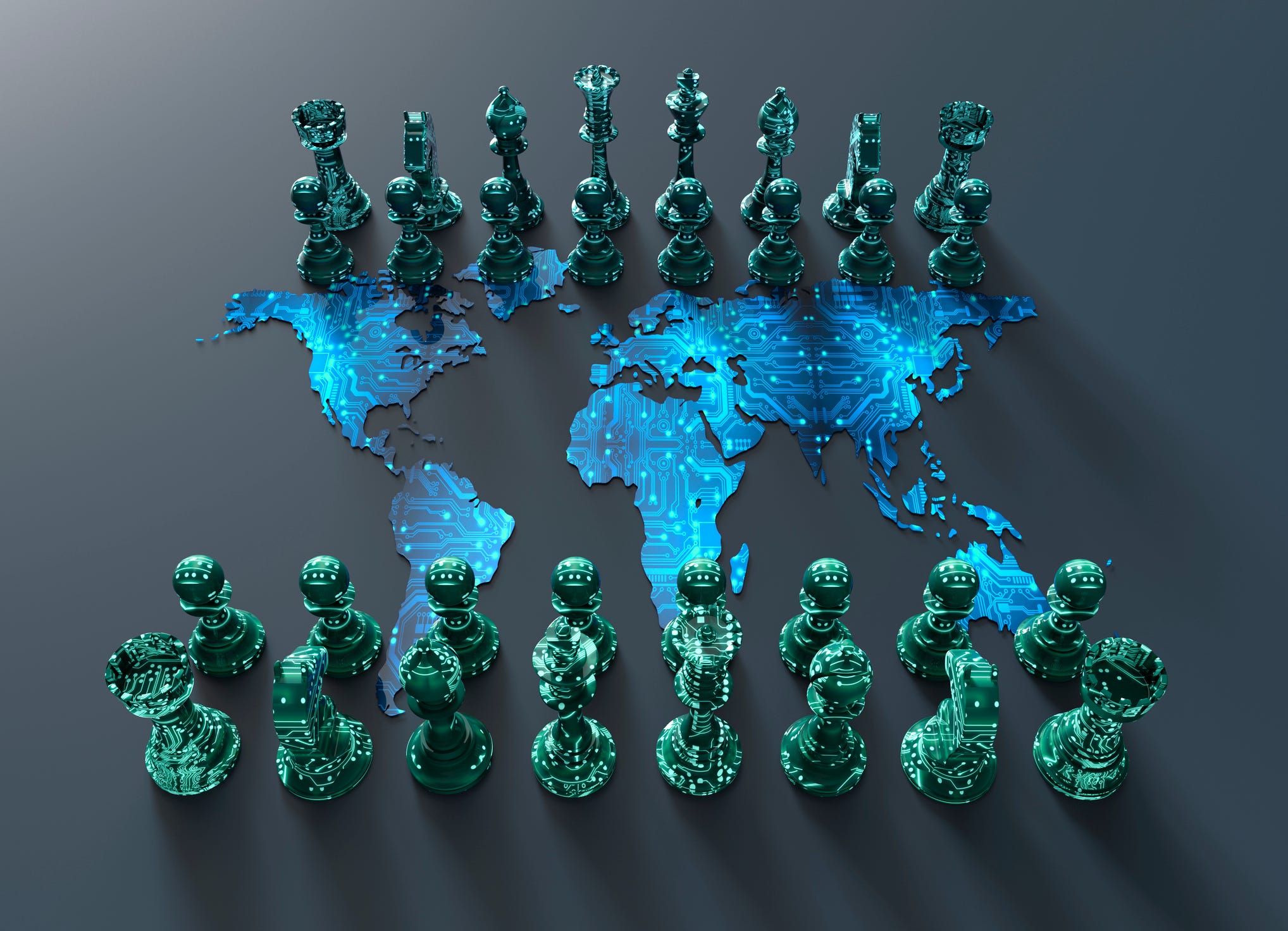
Sovereign AI is the effort by nations to pull the production of AI chips, datacenters, models, and decisions inside their borders. It’s a substantial market already at $80B for 2026 and one with seismic geopolitical implications. Yet the American press has barely noticed, perhaps because those implications have not sunk in yet.
Sovereign ownership of infrastructure like roads, railways, air-traffic control and weaponry is commonplace; in the US, 13% of infrastructure is federally owned. But telecommunications and AI are different. The Internet has always run on shared plumbing: the Internet Corporation for Assigned Names and Numbers, or ICANN, matches website addresses to host computers around the world and returns the same data from Moscow to Botswana. But the ideal of a global Internet commons, out of which this protocol was created, has been fracturing for two decades. China blocked foreign access in a policy called the Great Firewall. Russia similarly gave itself the right to unplug from the global Internet while the European Union enacted restrictive General Data Protection Regulation (GDPR).
Some of these enclosures happened by fiat, while others were sold to citizens as protection. Each produced a more parochial Internet. AI is now traveling the same arc, faster and with sky-high stakes.
Sovereign AI opens new doors for wealthy, highly-populated nations to secure strategic advantages at scale. AI’s power comes from the design of its model, its data, and the scale and power of the infrastructure on which it runs. Once AI is categorized as a national asset, countries with existing capital, the right resources, and large populations on whose data models can be trained are already far ahead in the race to build more powerful models. A generation ago, very different countries could still build comparable infrastructure; despite its smaller population, Kenyan telecommunications system resembled India’s. Now countries of different wealth and populations will have wildly divergent AI.
Superpowers are flexing first. The United States has restricted NVIDIA’s most advanced chips from China. In response, China has raced to build alternatives, and DeepSeek has nearly closed the gap. The UAE has poured tens of billions into its home-grown AI company G42 and declared itself an “AI nation.” France funds Europe’s leading model, Mistral and India is debating a sovereign foundation model for its 1.4B citizens. Saudi Arabia, with more money than population, is building its own.
Sovereign AI is driven by two opposing forces: fear and greed. The fear takes the form of protectionism, as in China and Russia, where fear of leaking secrets and malign outside information has led to government restrictions on which models citizens can use, which weights leave the country, and which datasets get scraped. Protectionism melds national identity with censorship.
The second force, greed, appears as opportunism. Computing power has become a strategic resource on par with oil, and the country with the cheapest power, loosest zoning, and most permissive data rules will have an outsized advantage. It is a nineteenth-century resource race with twenty-first-century stakes.
Taiwan Semiconductor Manufacturing Corporation (TSMC) is the world’s most egregious monopoly, fabricating nine of every ten advanced semiconductors on Earth, and every chip below seven nanometers—which means every chip frontier AI depends upon. A Chinese move on Taiwan would shock the world economy more severely than any modern oil embargo, and sovereign-AI strategies without domestic fabrication capacity would collapse overnight. Below TSMC, the chokepoints are equally narrow: ASML’s lithography in the Netherlands, Japanese chemicals, and a few undersea cables. Examine the supply chain and “sovereign AI” looks like a cluster of single points of failure no country has fixed.
If AI hype so far has been centered around technological miracles, sovereignty is about politics. Private companies are remaking products around national rules: NVIDIA has redesigned its top GPUs multiple times for the Chinese market; Washington took a ten-percent stake in Intel under the CHIPS Act last year, the first major federal equity position in a US chipmaker in half a century. Hyperscalers now run jurisdiction-specific “sovereign cloud” regions to satisfy data localization laws.
For citizens, the AI on offer already differs by passport. ChatGPT remains unavailable in China, Russia, and Iran; Italian regulators briefly blocked it in 2023 under GDPR; the EU AI Act now grants Europeans formal avenues for appealing AI decisions. In international relations, infrastructure has become a primary axis of diplomacy: a US-Netherlands-Japan agreement controls lithography exports; the G42-Microsoft alignment in 2024 required the UAE to strip Huawei equipment from its operations; Gulf compute commitments worth tens of billions now run through American partnerships.
The Oakland verdict has arrived; it had nothing to say about the map of the AI future. That verdict is being decided in Hangzhou, Brussels, and Bangalore. It is a map being drawn by ministers and sovereign wealth funds rather than citizens.
Reuben Steiger is a writer and entrepreneur based in Princeton, NJ. Over a 25-year career he has helped start companies including Second Life and has led global innovation for companies including Interpublic and Omnicom. His current focus is the scaling and adoption of AI technologies. He collects books about the future.
