


As a president second to none in blasphemous self-depiction and besotted by venomous white Christian nationalism, Donald Trump and his MAGA authoritarian enablers have attempted to supplant separation of church and state with an authoritarian-imposed neo-Confederacy — a theoretically mandated rigid hierarchy in which white males hold the power. During his 250th Independence Day celebrations, we once again saw how dramatically that anti-constitutional, anti-American vision conflicts with our authentic democratic values expressed in our foundational documents and consistent with our deepest faith traditions.
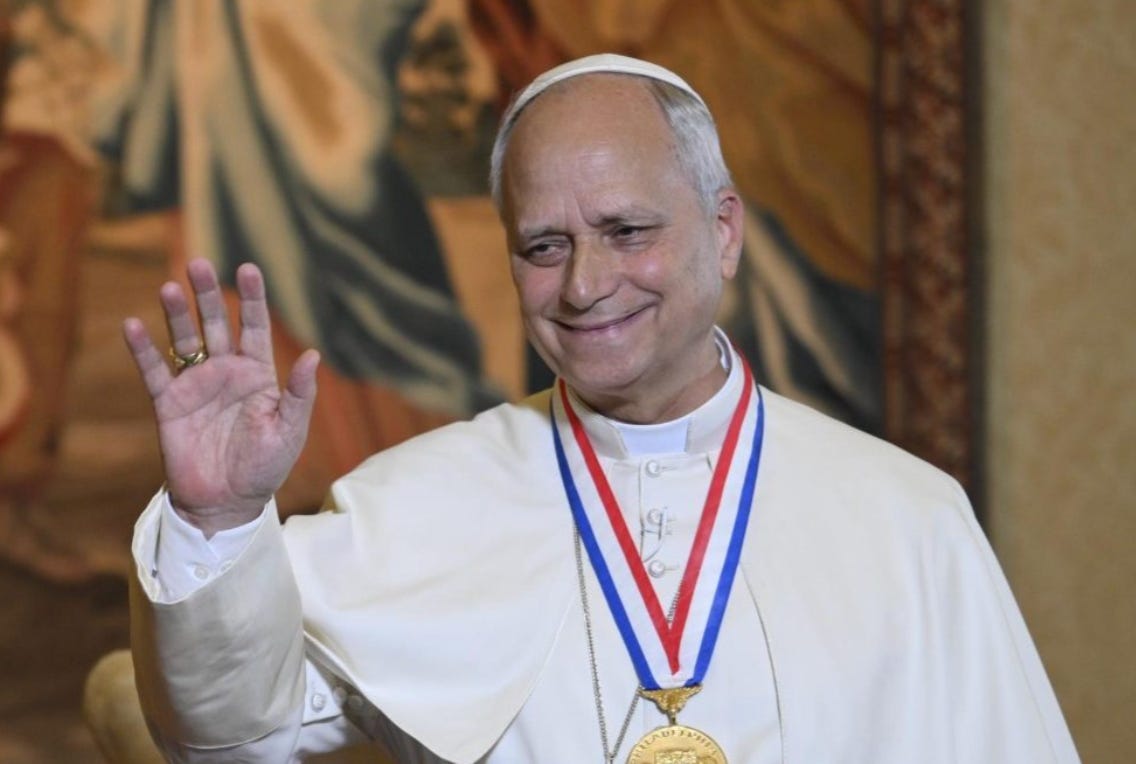
Unexpectedly, Pope Leo was among those articulating the most historically genuine expression of America. Again, the leading voice to express to the world our constitutional traditions comes from the Vatican — by way of Chicago — not from the band at the White House, which remains temporarily occupied by constitutional ignoramuses and moral buffoons.
In his letter marking America’s Semiquincentennial, Pope Leo emphasized the creedal foundation of our nation: “that defining moment in the history of the United States of America, July 4, 1776, that gave enduring voice to the ideals of liberty, equality, the pursuit of happiness, justice and democratic self-government.” He explained that “among the principles that have guided the development of this country is the God-given dignity of every human life, each person being endowed with an inherent worth that calls for reverence, protection and care.”
One cannot imagine Trump grasping that concept, let alone expressing it to Americans, whom he treats as suckers and pawns in his game of self-enrichment.
Leo connected his guidance on America’s founding creed, as he has done throughout his papacy, to the defense of immigrants faced with Trump’s onslaught of abuse, violence, and dehumanization. Presumably by no coincidence, on July 4th, Leo visited the Sicilian island of Lampedusa, “the epicenter of Europe’s migration debate to honor the tens of thousands of people who have died trying to reach Europe to find freedom and prosperity,” the Associated Press reported. His seminal point addressed the willful disregard of immigration exclusionists: that America’s founding principle relies on the inherent value of all individuals, which obligates us to treat immigrants humanely and to continue incorporating them into our democratic experiment.
Pope Leo’s letter to America reiterated:
Defending human life also includes welcoming, protecting and assisting immigrants, whose hopes, sacrifices and contribution have formed part of the history of this country from its very beginning. In every generation, those who have arrived seeking freedom, opportunity and a place to belong have helped to shape the nation’s character. To receive them with compassion and generosity is not only an act of charity, but also a recognition of the dignity that belongs to every human person.
This is a complete and effective repudiation of the mean, racist, anti-historic, ungodly vision of America that Trump and his ilk advance. MAGA’s freakout in the wake of the Supreme Court’s ruling on birthright citizenship — threatening to bar pregnant women from entering America (!) — speaks to the moral insanity that has gripped its already warped ideology.
In addition to Leo’s contribution to the 250th anniversary of America’s independence, Leo appeared remotely on July 3 to accept the Liberty Medal from the National Constitution Center. Again, the Pope’s deeper appreciation and understanding of the Constitution than the current Oval Office occupant speaks volumes about the latter’s utter unfitness for even temporary residence in the White House. With personal emotion that is entirely absent in the MAGA power elites, Leo spoke about his own connection to the Declaration:
From our youth, most of us have admired the eloquence of those words, with their resounding appeal to the law of nature and to nature’s God as the basis of their assertion that all men and women are created equal and endowed by their Creator with certain inalienable rights, including the right to life, liberty and the pursuit of happiness. While couched in the language of the Enlightenment, that claim is ultimately grounded in an understanding of the human person inspired by the great biblical vision of man and woman being created in the divine image. It is indeed here that we discover the basis of human dignity; dignity which precedes the establishment of any State, and whose custody constitutes its very purpose.
Without the arrogant denial of our nation’s imperfections or the harsh vitriol America’s critics use to skewer its imperfections — let alone rants against Communists or dehumanized migrants — Leo acknowledged that “the path to building a society that would embody those high ideals of liberty and justice for all was not always easy and, in many respects, is still a work in progress.” In calling for us to take up “anew in each generation and in the face of ever new challenges” of perfecting America, he speaks with humility about our obligations to one another, a sentiment that used to be entirely uncontroversial — until it was savaged by those who espouse a hateful, anti-democratic vision of exclusion and domination.
Leo paid a moving tribute to the message of E pluribus unum — another concept entirely beyond MAGA’s grasp and hence absent from Trump’s public discourse. “In order for a nation to flourish, it must be truly united; united not by goals bound to momentary endeavors, but by ideals that do not fade with the passing of time,” Leo explained. It’s those values, “a shared human dignity, equality and the rights laid out in the Declaration of Independence,” that Leo recognizes as the glue to bind Americans together. He understands that the American experience must be centered on values, not on power or wealth; in ideals, not personality; and in purpose, not in chest-thumping spectacle.
The core of the MAGA movement is utterly divorced from, indeed is hostile to, the uplifting, humanistic, and democratic vision that has been at the heart of the American experiment for 250 years. At the very least, many will find it karmically satisfying that an American Pope adept at public communication would come along at precisely the right time to demolish the bogus vision of a president entirely lacking in decency, humanity, or redeeming characteristics, yet who claims God spared him for the job.
On one hand, it is easy to be depressed by Americans’ folly in entrusting our precious democracy to Trump and his pack of moral, political, and intellectual dullards. On the other hand, the Pope’s ability to connect anew with millions of Americans on a plane that transcends politics (and utterly confounds Trump) gives one hope that we might find our way out of the thicket of hatred, corruption, and nonstop lies — and might one day move forward to a shared, treasured, and authentic understanding of America.
A line as few others could write it: "constitutional ignoramuses and moral buffoons." Jen was talking about the goons in the WH, but she just as easily could have thrown in at least two and possibly more members of the Supreme Court, whose partisan rulings in this century have helped lead us down this perilous path. But the good guys will win, as long as the Pope and others are willing and able to call out injustice, hypocrisy, and ignorance wherever they see it.
Jennifer,
What stayed with me wasn’t only your critique of MAGA, but Pope Leo’s reminder of what America is at its best.
His vision is neither triumphalist nor cynical. It is rooted in the conviction that every person possesses an inherent dignity that precedes the state, and that our constitutional experiment is measured not by the power we wield but by the principles we uphold. That’s a moral vocabulary we’ve been missing.
As someone who has spent much of the past year thinking and writing about liberal democracy, Jewish identity, and the obligations we owe one another, I found his words both moving and hopeful.
Thank you for continuing to make the constitutional and moral case. Pope Leo’s message was a timely reminder that the enduring strength of the American experiment lies not in personalities or power, but in the ideals that call each generation to become something better than the last.