


As we approach the 250th anniversary of the signing of the Declaration of Independence, American flags are going up in town squares across the country. Celebrations are planned, parades scheduled, and a state fair on the National Mall. The bunting is out.
And yet, for many Americans, this moment feels complicated. We are a deeply divided country. The White House has spent months prosecuting a war of choice overseas that most Americans oppose, cruelly rounding up members of our communities and tearing apart families, gleefully dismantling civil rights protections, and engaging in the kind of corrupt self-dealing that would have been unthinkable a generation ago. Amid those decisions, and so many more, it can be hard to know what to do with our flag.

Loving our country doesn’t require us to paper over what is wrong. In fact, it requires the opposite: the courage to speak out when we fall short of our values and to challenge America to live up to its promise. James Baldwin may have said it best when he wrote that he loved America more than more than any other country and “precisely for this reason, I insist on the right to criticize her perpetually.”
Like many Americans, I am an immigrant. I came to this country after a childhood that took me through Pakistan, Bangladesh, Iran, and the United Kingdom — through revolution, war, military rule, and race riots. I have seen what it looks like when democracies fracture. I did not come to America for its monuments or its military might. I came because I believed in something more specific: the ideas America was built on, the organizing principles at its core.
I’m not alone: People around the world are drawn to what America represents. Even in Iran, where I was a child in 1976 at the time of the U.S. bicentennial, I vividly remember the festivity as Iranians celebrated America’s big birthday.
That’s because a nation defined by shared values is historically rare — and was unheard of when our founders signed the Declaration of Independence and ratified the Constitution. Most nations are held together by shared ancestry, common religion, or centuries of accumulated history. America’s founding proposition was different: that a people could be unified not by who they were but by a set of natural laws, of beliefs. That all people are created equal. That liberty and justice are not privileges to be earned but rights to be guaranteed. That a government’s legitimacy comes from the consent of the governed. Over the years, our leaders have doubled down on these ideas, for example, passing the 14th Amendment, providing citizenship, equal protection, and due process for all Americans — enshrining what the founders meant about equality.
Those ideas have never once found their full expression. Yet that is the story of America: a nation perpetually falling short of its own stated values and perpetually being pulled back toward them by people who refused to let the gap stand. The abolitionists. The suffragists. The civil rights marchers. The generations of immigrants and organizers and ordinary citizens who looked at what America claimed to be and decided to hold it to account, determined to fulfill America’s promise.
That is a tradition worth honoring this July. Not a sanitized celebration of what is but an embrace of America’s greatest institution: our shared commitment to what should be.
Patriotism lives in our actions toward bettering our country and supporting one another: in the neighborliness we extend across lines of difference embodied by millions of Americans who volunteer in national service programs to support communities that look far different than their own; in the grace we offer to those who are struggling by showing up for victims of disasters and tragedies; and in our daily decisions to treat people around us as human and deserving of dignity beautifully modeled by Americans who support their neighbors — whether that means dropping off a meal to support the family of a deployed service member or escorting the child of an immigrant to and from school because their parents fear detention.
It lives in our embrace of truth, even when the truth is inconvenient. One of the things I love most about this country, and one of the things I fear losing most, is its tradition of honest self-examination; the insistence that facts matter and justice is worth pursuing — even when it is hard.
And it lives in our refusal to give up. Through two and a half centuries, Americans by birth and by choice have believed that this country could achieve its promise — not because they were optimistic or naïve but because they were committed to doing the work that would make it so. Generations of Americans have shown that commitment by doing our own small part in a larger story of progress that none of us will live to see completed.
That’s what America’s founding was about: not an end but a beginning. Not a celebration of what is or an homage to whomever lives in the White House but a determination to build what should be. The Declaration of Independence itself is less a proclamation of achievement than a statement of intention and a promise made to the future. Two hundred and fifty years later, that promise is still outstanding. The work of fulfilling it belongs to us.
So, as we celebrate this anniversary, with all its complexity and contradiction, let’s put that idea at the center of it. For two and a half centuries, Americans have been committed to a better country and a brighter future — and determined to do the work that makes both real. That is what patriotism has always looked like at its best. That is worth celebrating — and worth fighting for.
Laleh Ispahani is the Managing Director for Programs in the U.S. at the Open Society Foundations.
Limited Edition Screen Prints!
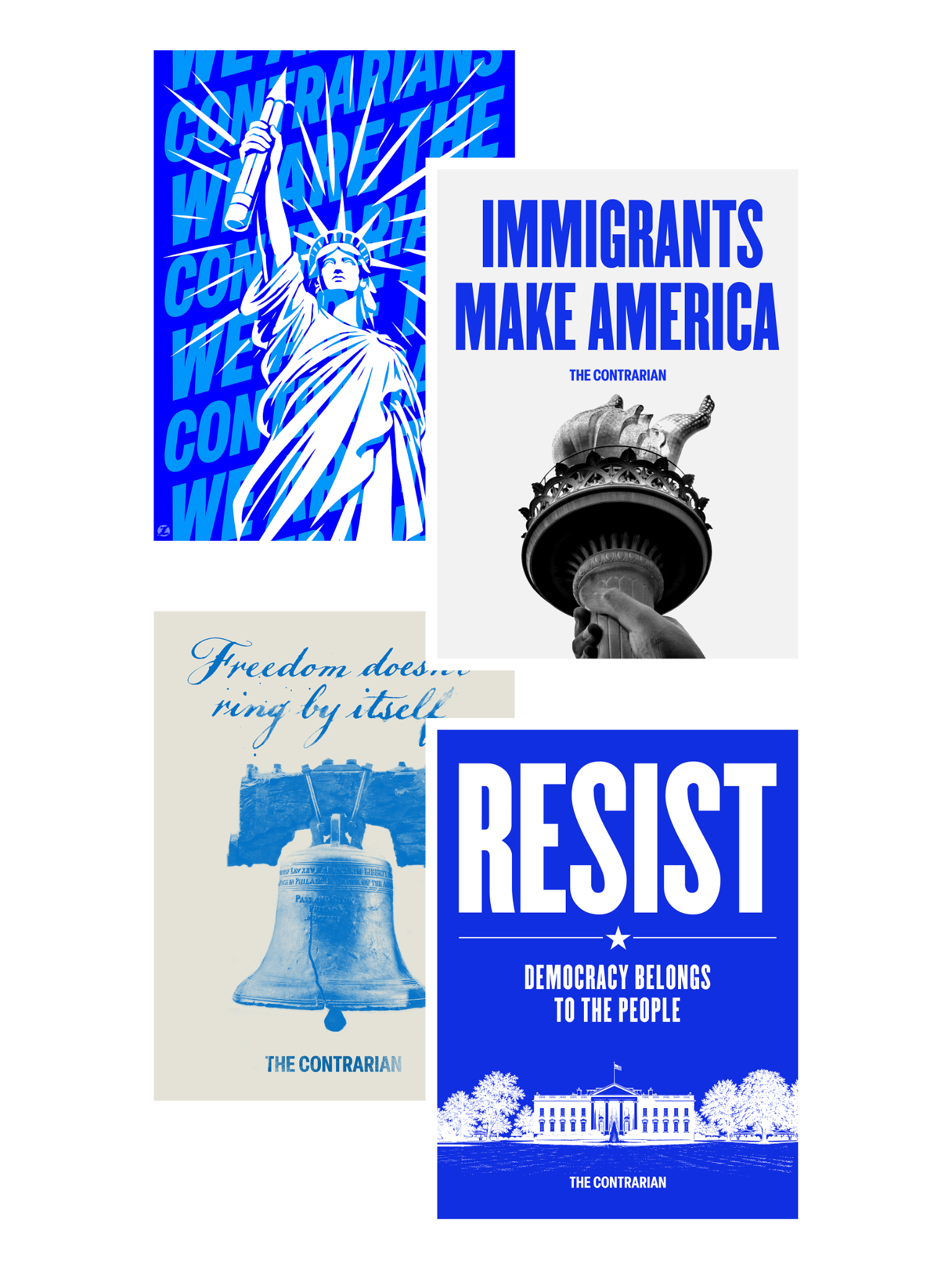
Celebrate America 250 with The Art of Resistance
This limited-edition collection of screen prints is created to honor the American tradition of leveraging creative expression to inspire change.

Excellent!!
Lovely. You are what all Americans should be like.