


No foreign adversary needed to penetrate American networks, sabotage critical infrastructure, or launch a sophisticated cyberattack to bring U.S. commercial aviation to a halt on Friday. A botched equipment upgrade at a remote Federal Aviation Administration facility accomplished that on its own.
The resulting nationwide ground stop exposed a troubling reality: A failure at a single point in America’s aviation infrastructure could produce consequences on a national scale. The disruption also revealed weaknesses in the government’s ability to manage a crisis, communicate what it knew, and protect sensitive information while explaining what went wrong.
Federal officials insist the incident was not an attack. That distinction matters in determining what happened, but it does little to diminish the national security implications. America’s adversaries now have another publicly documented example of how an ordinary technical failure can disrupt a system central to the country’s economy and national security.
Five takeaways from Friday’s shutdown deserve attention.
The administration’s response mistakes funding for a modernization strategy.
The Trump administration, like its predecessors, has made modernizing the nation’s aging aviation infrastructure a priority, and for good reason. But Friday exposed a problem that additional funding and replacing obsolete equipment alone will not solve. The FAA must integrate new technology without compromising the reliability of the existing network, a challenge that has plagued previous modernization efforts.
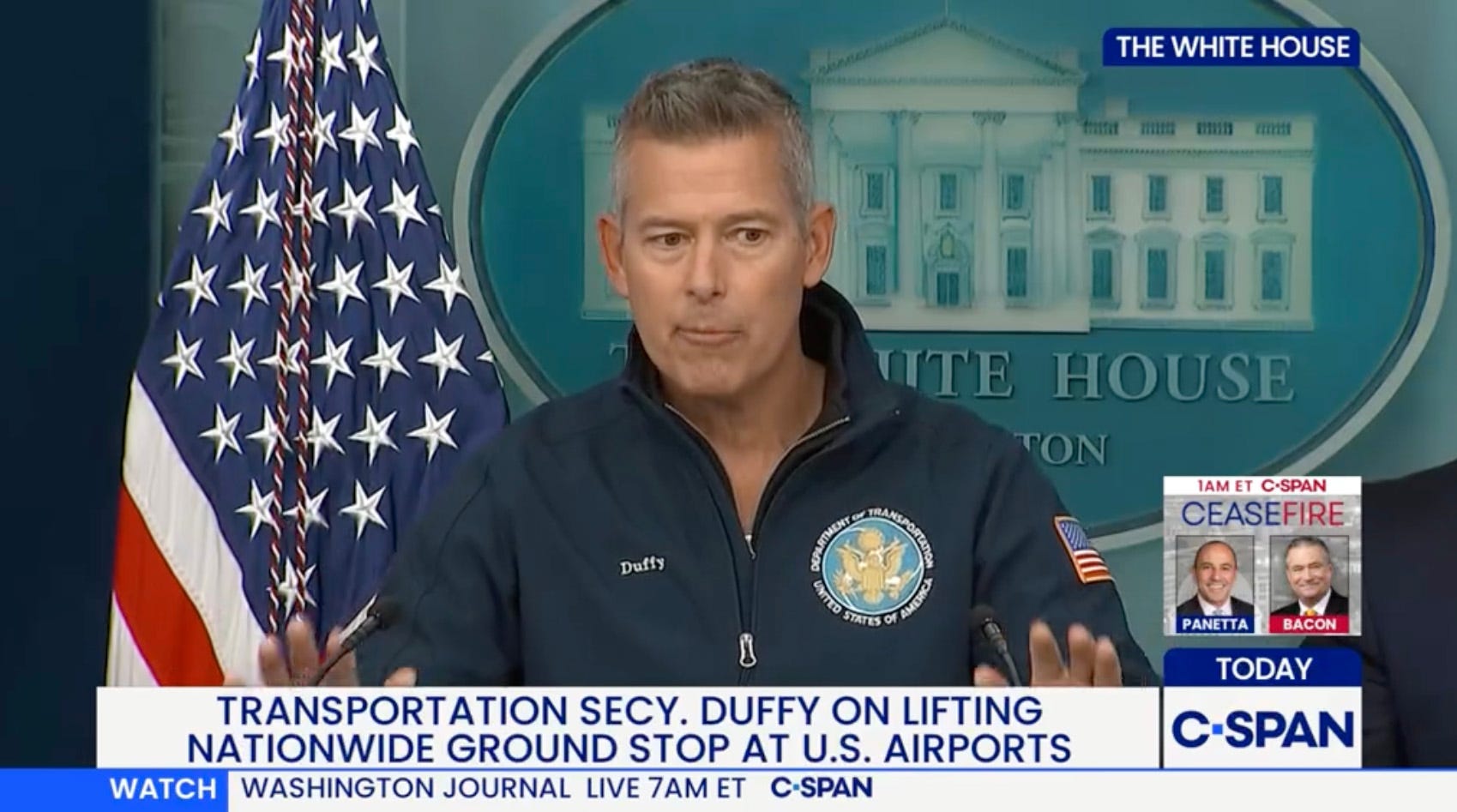
Secretary of Transportation Sean Duffy’s immediate demand for billions more from Congress sidestepped that problem; his Sunday morning interviews offered no substantive change in that position. The administration needs to demonstrate that the FAA can test upgrades, contain failures, and maintain national operations throughout the transition. Without those safeguards, additional spending risks reproducing the vulnerabilities that modernization is supposed to eliminate.
The shutdown confirmed to adversaries that a nationwide disruption can occur without a sophisticated attack.
Federal officials have ruled out sabotage, including a cyberattack, as the cause. Still, Friday’s disruption provided foreign intelligence services and non-state actors with useful information about American infrastructure. They need not replicate Friday’s malfunction to exploit what it revealed. Similar weaknesses in electrical grids, telecommunications, and other critical infrastructure could allow adversaries to cause widespread disruption with relatively limited resources.
Rapid advancements in and accessibility to artificial intelligence tools is lowering the technical and financial barriers that once restricted sophisticated operations largely to governments and well-resourced organizations. Cyberattacks against more than 30 Minnesota water systems in July, including one that temporarily shut down a town’s water treatment plant, and recent bomb threats disrupting European aviation demonstrate that relatively limited actions can interfere with essential services.
Although those incidents have not been established as AI-enabled, the technology is expanding the range of actors capable of planning and executing disruptive operations. The threat increasingly comes not just from hostile governments but from smaller groups and individuals with access to capabilities that were once beyond their reach.The FAA’s emergency procedures worked, but its ability to sustain operations during a crisis remains inadequate.
The FAA’s decision to halt departures nationwide was correct. Faced with unreliable communications and incomplete information, controllers followed established emergency procedures and brought thousands of aircraft safely to the ground.
The shortcomings were hardly unforeseen. A 2017 Transportation Department audit identified significant deficiencies in the FAA’s ability to maintain operations during major system disruptions. Seven years later, the Government Accountability Office found that more than three-quarters of the FAA’s air traffic control systems were unsustainable or potentially unsustainable, including dozens critical to national operations.
Procedures that prevent accidents do not necessarily ensure essential services will be maintained during a failure. A nationwide grounding could compound a national emergency involving military mobilization, mass evacuation, or disaster response, particularly if the disruption coincided with attacks against other critical infrastructure.The White House’s crisis communication remains poorly coordinated and excessively focused on praising Trump.
As Americans watched television coverage of grounded aircraft and stranded passengers, commentators speculated about technical failures, cyberattacks, and sabotage. At 4:16 p.m., Duffy issued a brief public statement, but the administration provided few details. When Homeland Security Secretary Markwayne Mullin appeared outside the White House at 5:01 p.m., he offered useful reassurance, acknowledged that the cause remained unknown, and declined to speculate.
The absence of a coordinated White House communications response grew more conspicuous. Rather than a designated spokesperson providing regular updates, two Cabinet secretaries eventually delivered a lengthy briefing at 8:31 p.m. that mixed operational information with arguments for infrastructure spending and repeated praise of Trump. Mullin credited the president’s leadership, and Duffy emphasized his involvement and praised White House Chief of Staff Stephen Miller’s coordination of the response.
The Centers for Disease Control and Prevention’s Crisis and Emergency Risk Communication guidance begins with three instructions: Be first, be right, and be credible. The Trump administration has added a fourth: Be flattering. From COVID-19 to Defense Secretary Pete Hegseth’s briefings during the Iran war, praise for the president has become a recurring obligation, woven into official briefings even during national crises.When a national crisis strikes, Trump lets his Cabinet be cannon fodder.
President Trump was notably absent from Friday’s public response. Asked why, Mullin insisted the president was directing the government’s response and trusted his Cabinet to inform Americans about the actions underway.
Presidents do not need to personally manage every national emergency. On September 11, 2001, George W. Bush relied on his national security team to manage the immediate response, but he also addressed Americans that morning, spoke again while returning to Washington, and delivered a formal address from the Oval Office that evening. The circumstances were vastly different, but the responsibility to communicate presidential leadership was the same.
Trump did not comment about the incident until Sunday. And not through a formal briefing to reporters, but through posts on Truth Social. Not surprisingly, he blamed the Biden administration for the FAA’s problems. Trump rarely hesitates to stand before cameras to claim credit for his administration’s achievements. But presidential accountability also requires answering for failures, even those inherited from predecessors. Friday presented that opportunity, and Trump chose — again — not to take it.
Friday’s shutdown ended without loss of life, but its effects are likely to linger into the approaching Thanksgiving travel period, if not the December holiday season. The safe resolution should not obscure the larger national security lesson. America’s ability to respond safely to a disruption is not the same as its ability to withstand one. Until the administration treats those as equally essential responsibilities, the country will remain more vulnerable than it needs to be.
Brian O’Neill, a retired senior executive from the CIA and National Counterterrorism Center, is an instructor on strategic intelligence at Georgia Tech. His Safehouse Briefing Substack looks at what’s ahead in global security, geopolitics, and national strategy.

Stop the presses! Trump blames the air travel shutdown on Joe Biden. And he wants money.
Cue the no-bid contracts to "fix" this.
"The resulting nationwide ground stop exposed a troubling reality: A failure at a single point in America’s aviation infrastructure could produce consequences on a national scale."
I'm not sure I accept this explanation because I do not trust this regime to honestly convey or even find out what actually happened. In fact, I doubt that there was just one cause. When the president just blames his predecessor instead of offering evidence, I don't buy it. In fact, I just put it in my "probably false" pile of untested information that will have to wait until we have an administration with some integrity.