


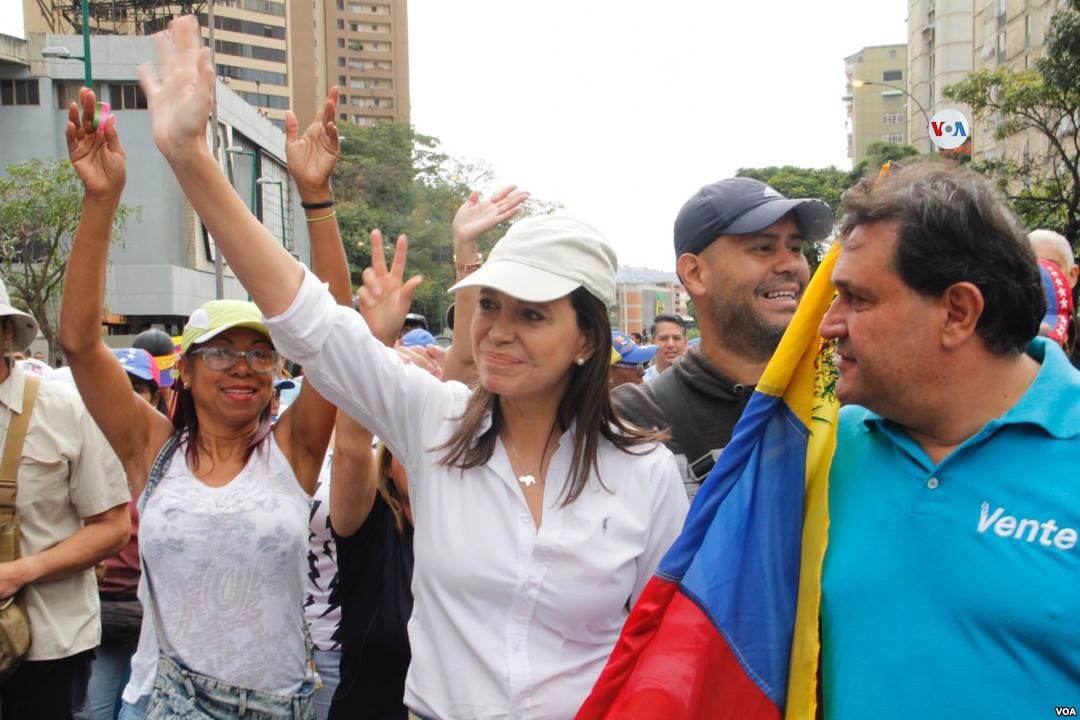
When the Nobel committee awarded Venezuela’s opposition leader María Corina Machado the Peace Prize on Oct. 10, the choice was framed as a vindication of non-violent resistance. The citation praised her “struggle to achieve a just and peaceful transition from dictatorship to democracy.” Yet, within days of the announcement, Machado publicly aligned with the Trump administration’s militarized campaign in the Caribbean, voicing support for his “decisive support” against Nicolás Maduro’s government.
It was a jarring pivot. The laureate of peace echoing, at least rhetorically, a campaign of coercion that has killed dozens of civilians at sea—operations for which the Trump administration has provided no public evidence of the alleged narco-terrorist links and that U.N. human-rights experts warn are constitute extrajudicial executions. Machado has not questioned those strikes, their justification, or the government’s claims, nor has she raised concerns about Trump officials’ suggestions that “land targets” could follow.
Machado’s rhetoric was more than gratitude. It reframed the U.S. military campaign as liberation and placed the language of peace within the vocabulary of armed enforcement. The irony is difficult to miss: the Nobel’s newest laureate celebrating a use of force condemned by Mexico, Brazil, Colombia, and many Caribbean states as unlawful and destabilizing.
In the White House, Machado’s praise will be marketed as validation—a ready answer to dissent if and when the campaign pushes inland.
Machado’s award was, on its surface, an attempt to rescue democratic aspiration from fatigue. Her movement endured years of surveillance, arrests, and exile. She became the moral center of a cause that had lost momentum after successive waves of repression. The Nobel committee’s message was that courage still matters, even when institutions collapse. In that sense, the decision fit a familiar pattern: an aspirational prize meant to sustain fragile reformers, not a reward for a completed peace.
That context matters because Venezuela’s situation is far from resolved. Maduro’s contested re-election last year deepened the nation’s economic crisis and accelerated migration. Close to 8 million Venezuelans now live abroad, though, ironically, Trump has relied on xenophobic rhetoric when referencing those in the United States. Against that backdrop, the Nobel committee’s language about “peaceful transition” sounded less like triumph than encouragement—a signal to keep faith in process rather than force.
The Nobel committee has been here before—many times. In 2019, Ethiopia’s Prime Minister Abiy Ahmed received the same award for ending a decades-long border war with Eritrea. Slightly more than a year later, he launched a devastating campaign in Tigray that left hundreds of thousands of people dead. The committee later issued a rare public rebuke, acknowledging that its hopes for peace had not been realized. If Venezuela’s transition, whenever it comes, is defined by foreign strikes, armed militias, and institutional collapse, the Nobel committee will again find its moral arithmetic inverted.
A “kinetic” toppling of the Maduro government would be neither simple nor swift. Venezuela is a nation of about 30 million people, similar in population to Iraq before the 2003 invasion but twice Iraq’s land area—and far more defensible in its terrain, without an equivalent, fully committed neighboring base of operations for U.S. forces. Security services are cohesive; civilian militias number in the millions. Its airspace is not permissive. State institutions remain intact enough to mobilize.
Even if external force induces regime fracture, the aftermath would likely be violent and protracted. Border regions already host Colombian guerrillas and criminal groups that thrive on disorder. A foreign-assisted collapse would turn Venezuela’s humanitarian crisis into a regional one.
And, most important, most Venezuelans desire a democratic, negotiated transition; barely 3% support foreign military intervention.
Trump’s fascination with the Nobel Peace Prize is well documented. Yet, if the Venezuelan campaign expands, Trump’s prospects for viable Nobel consideration would vanish—that is, if the Nobel committee were to realize that its principles had been tarnished and a correction was needed to return legitimacy to the award. The Nobel is not awarded for toppling dictators; it is awarded for reducing violence and building durable peace. Even a successful regime change achieved through bombardment and covert action would read, to the committee, as a replay of the Abiy Ahmed cautionary tale: an apparent breakthrough that births a deeper war.
None of this denies Machado’s personal bravery or the justice of Venezuelans’ grievances. But courage and consequence are not the same. Her embrace of Trump’s militarized approach transforms a moral narrative into a strategic gamble. The Nobel committee’s intent was to honor non-violent perseverance. What the world now sees is a laureate newly aligned with an ally openly weighing land strikes and covert operations.
If that trajectory continues—if Maduro’s fall comes through violence rather than negotiation—the aftermath will be defined by displacement, militia rule, and economic collapse that dwarf the current crisis. The laureate of peace would preside over a transition written in the language of force.
For the committee, this is an institutional test of memory. After Abiy, it vowed caution—fewer awards for potential, more for proof. Yet Machado’s selection suggests a relapse into aspiration. If the outcome mirrors Ethiopia’s descent, the Nobel risks hollowing its own authority. It would appear to reward the symbolism of democracy while ignoring the mechanisms that sustain it.
The Nobel Peace Prize has always existed in tension between hope and hindsight. When it chooses hope, it must trust the recipient to uphold its meaning. Machado’s words since Oslo’s recognition suggest that trust might already be strained.
Brian O’Neill, a retired senior executive from the CIA and National Counterterrorism Center, is an instructor on strategic intelligence at Georgia Tech. His Safehouse Briefing Substack looks at what’s ahead in global security, geopolitics, and national strategy.

When is the international criminal court, along with the UN, going to start investigating the orange felon's and his military's illegal blowing up of boats in international waters, without furnishing proof they were indeed drug smugglers?
I know the US refuses to be a signatory to the ICC, but that should not be an excuse to do nothing at all.
Thank you for publishing this. I feel like I've been screaming into the void saying the same thing and I'm glad to see a, let me just say, much more qualified voice saying the same thing out loud here where hopefully it will get a little visibility.