


We sat in an emergency room for over eight hours. I clutched the pale hand of my friend as she underwent multiple tests to determine why her lower stomach was seized in so much pain that she had temporarily lost the ability to walk and see straight. While we waited for the doctor, her phone buzzed with a text that had ungracefully landed in my phone earlier: leadership confirmed our office is getting DOGE’d by the end of the month. We worked at the same agency. Both of our offices focused on global humanitarian work, so we were clear targets of the Trump administration.
The timing could not be worse. A few hours later, the doctor revealed that she had a cyst slowly bleeding into her pelvis, for which imminent surgery was required to save her internal organs from permanent damage. Recovery post-surgery was eight weeks, minimum.
DOGE favored firing federal employees via blindside. Federal healthcare plans carried a 31-day grace period post-termination. My friend and I did the math: if fired, she would lose her healthcare right after her surgery. Recovery would be either a debt-inducing nightmare or, if she chose to go without proper medical supervision, a life-threatening roll of the dice.
The haphazard DOGE cuts risked the lives of millions of people across the globe. I learned first-hand that this threat extended to American workers.
After the “DOGE” text, anxiety spread like wildfire at my agency. Our floor worried that our own mail staff had been assigned to monitor us; where they used to come by once daily with the mail, they now perused every cubicle aisle with paper and pencil twice a day, making marks on a sheet and wordlessly departing. No explanation. I observed that a mail staffer only noted if a cubicle was empty. Was DOGE tracking only our absences, or would our trips to the restroom and our lunch breaks be flagged, too?
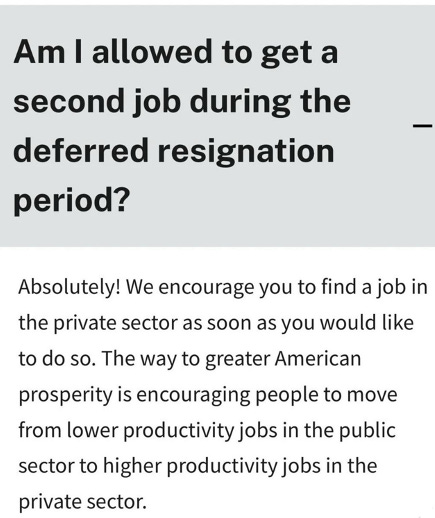
I braced myself when I opened my email box each day, anticipating a new barely-veiled insult from a DOGE spam email address (such as: hr@opm.gov, hr1@opm.gov, hr15@opm.gov, etc). One of the “Fork in the Road” emails—we had received two—condescendingly stated that federal jobs were “lower productivity” and “encouraged” feds to move into “higher productivity jobs in the private sector.” Musk bombarded us with “Five Bullet Points” emails and threatened that “failure to respond will be taken as a resignation.” Apparently, proving that we “had a pulse” and read our emails overrode delivering life-saving medicine to HIV positive communities.
For months, even prior to the election, Elon Musk, Russ Vought, and other members of the Trump administration demeaned, threatened, and (metaphorically) handcuffed federal workers. In addition to the prison surveillance atmosphere, our day-to-day work was hampered by DEI scrub demands from the White House and State Department, which quickly superseded our actual programming.
Instead of executing on global health initiatives, we spent weeks scouring every resource, website, document, and media source for the verboten DEI words. Instead of strengthening HIV medicine supply chains or training rural nurses, we removed “woke” Powerpoint icons (bye bye smiley face with rainbow background). “Genderbased violence” became “interpersonal violence.” “Climate change” was diluted to “extreme weather impacts.” “Inclusion” became “integration.” “Diversity”...no longer existed. Oh, and they urged us to report one another for DEI violations.
Things escalated. When the administration removed the “T” in LGBT, I received guidance to no longer acknowledge trans identity, even in reference to a volunteer’s service journey. Violations risked revocation of funding and program elimination. As my office’s communications contact, it was on me to brief the team. Inside a conference room decorated with photos of our diverse (sorry, varied?) global health specialists and their communities, I shared the new guidance during our weekly strategy meeting. Based on the tight restrictions, I said, “we can’t really highlight our trans volunteers anymore.” We discussed how we could “conceal” their identity. We could not identify a solution beyond “post and pray” or “don’t post at all.”


The crackdowns prompted another worry: that our LGBTQ+ employees would be targeted for displaying pictures of their partners, pride flag pins, or other identity paraphernalia. Our general council swore it was a violation of the law to forbid this, but with USAID shuttered, people were being illegally fired left and right. In the strategy meeting I admitted I had “no confidence” that such open expressions of queer identity were safe.
The room sat in uncomfortable, eye contact–avoiding silence. Our maternal health specialist glanced my way and muttered “I am at a loss. I don’t know how you were able to get the words out.”
Truthfully, I cognitively dissociated. Like many federal employees, after months of fighting to maintain my job I had switched to survival mode. Every new directive stole an hour from my sleep, so I tried to concentrate on what I could control. I had pivoted to program preservation thinking we could placate the president and sweet-talk our way into safety. Playing the “game” distracted from the fight. When the actual words left my mouth and my coworker’s disbelief captured them, it hit me—we can’t play a rigged game, but the administration wanted us to.
It was a cold wake up call.
Meanwhile, the State Department strangled our operations abroad. The foreign aid pause froze our core mission activities for HIV prevention. The humanitarian aid waiver did not cover services such as cervical cancer screening, PrEP (for anyone besides pregnant women), and resources for orphans and vulnerable children. We cancelled family planning sessions. We stopped our pandemic preparedness monitoring for the Marburg virus and mpox outbreaks. After four months under this barrage, agency leadership announced that DOGE had ordered us to downsize into a “bare bones” agency. Any remaining light at the end of the tunnel flickered. Removing over half of the existing staff would destroy our agency’s capabilities.
After the downsize decision had already been issued, a DOGE staffer learned about the stable return on investment and internationally recognized standing of our health programs and commented to a colleague: “Oh wow! I wish we knew this beforehand and had asked other agencies for this information.” So…what were they looking at when they signed our fate? What data had they requested? Had Marco Rubio simply handed down a cost figure and said “make it happen?” I’m so glad we paid them special six figure salaries for their ingenuity.
Across the government we had witnessed workers locked out of systems, files, and buildings without notice. Friends inconsolable after losing their family’s healthcare plan, ability to pay their mortgage, and their life’s work. Now it was our turn. Every day, someone in a managerial position popped over to my team with some iteration of “your office will be absorbed into another and we will likely only retain 2 of your twenty person team.”
Non-federal workers gave me unsolicited advice that “this is life, and life isn’t fair” and “this happens in the private sector!” Well, first of all, it shouldn’t. Second of all, this is the public sector. You do not want your institutions to be so easily dismantled, corrupted, and emptied. Our government is filled with dedicated civil servants who proudly took an oath to serve our country and constitution. We did not deserve to be treated as an enemy. Certainly not by the President of the United States.
It sounds dramatic, and maybe it is, but a sudden goodbye to your passion and life’s work, preceded by intentional distress and deterioration, comes with grief. Losing money, housing, and healthcare compounds this grief.
Thank you to those that stood with federal employees this year. Even words of kindness did immeasurable good.
Ciera Stone is the editorial associate at The Contrarian. She received a master of arts at the University of Notre Dame with a specialization in international peace, global affairs, and justice.
We the people are totally and horribly complacent with keeping him in office. There are MANY way he could be removed. The longer he remains, the worse the the consequences get.
Remove and impeach him now!
That the Dem 8 in the Senate allowed the government shutdown to end without extracting any concessions made federal workers' pain for naught. Letting the regime's "work" fester and sputter out as we held firm would have been the beginning of the end for government shutdowns. WE NEEDED THEM TO END.
We have spent more than a decade in perpetual stress, looking ahead to the next potential shutdown, putting off purchases and repairs and upgrades to our own safety nets, along with the diminished morale of working for an entity that would use its employees this way. The stress has damaged our physical and mental health, and we are all one health crisis away, like the author and friend, from destitution. How could any employer--let alone a government meant to increase public cohesion and function--operate like this?