


Graham Platner’s sudden exit from the Maine Senate race — following an accusation of a past sexual assault (he denies the allegation) — has scrambled one of the most important contests in the 2026 election cycle.
The question at top of mind: Who will step up to challenge Maine Republican incumbent Sen. Susan Collins — the faux “centrist” whose persistent, tragicomic pose of “concern” vis-à-vis Trump’s worst behavior hasn’t stopped her from enabling Trump’s reactionary Supreme Court or ICE’s brutality.
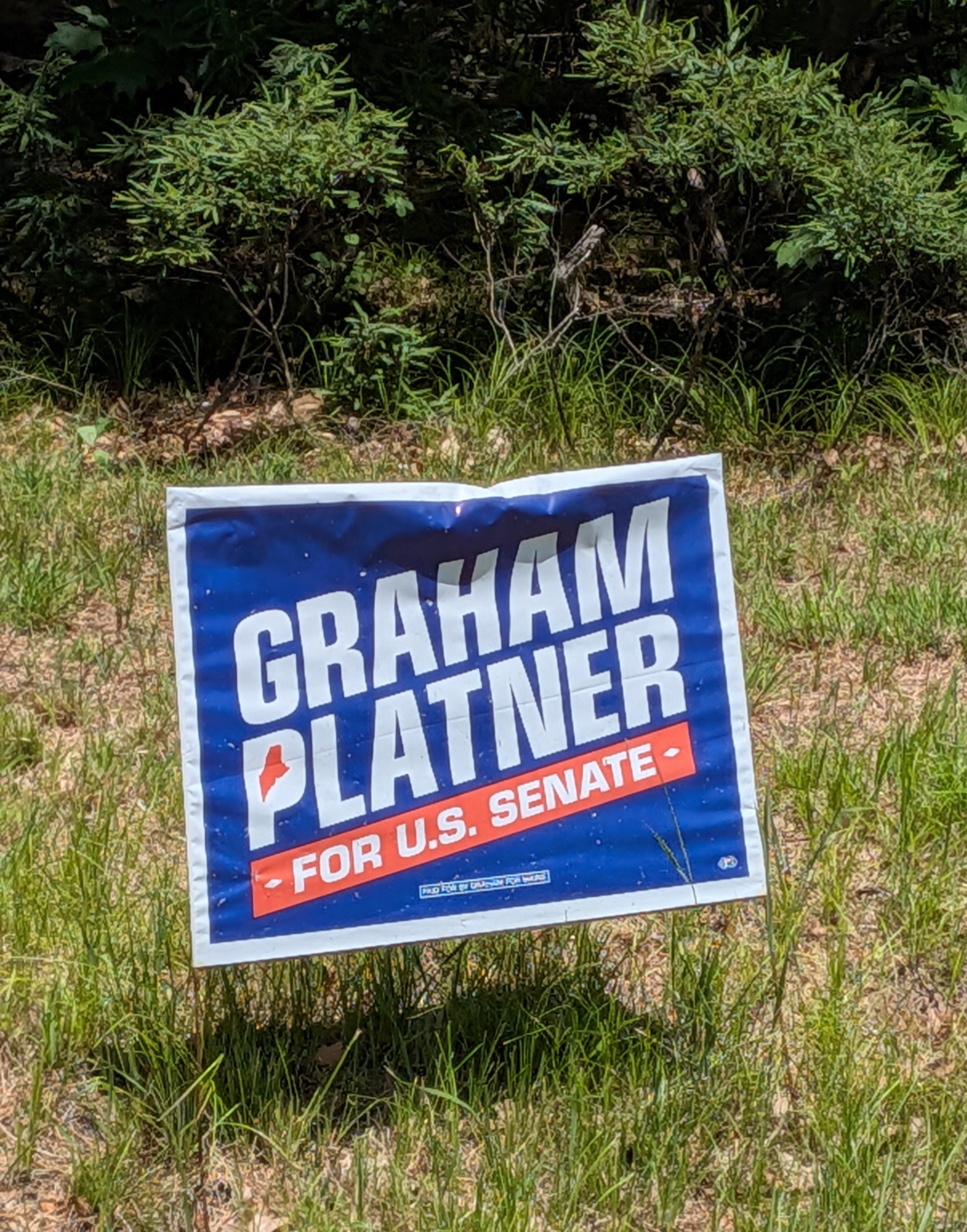
Platner’s Rise and Fall
The collapse of the Platner campaign comes after a meteoric political rise for the gruff populist — boosted by a noxious determination from prominent supporters (including progressive Senators Bernie Sanders, Elizabeth Warren, Chris Murphy, and others) to ignore a flurry of red flags about Platner’s suitability for public office.
Platner, a forty-one--year-old oyster farmer with a prickly beard and a Marine Corps combat record, was plucked from obscurity by Daniel Moraff, a progressive consultant who previously helped elevate Dan Osborn, a union machinist, for a surprisingly competitive Senate run in Nebraska.
For a party determined to reconnect with the white working class, Platner looked like he’d stumbled out of central casting. He proved to be a gifted communicator and organizer. And his coding — as an avatar of the blue collar male the party has been hemorrhaging for decades — led supporters to turn a blind eye to scandals that would have tanked any normal campaign. (His vetting, at the hands of the callow Moraff, was laughable.)
The list of loutish behavior included:
A Reddit comment history rife with bigoted, racist, and misogynistic sentiments, including writing that sexual assault victims should “take some responsibility.”
A chest tattoo of a Nazi skull and crossbones — a totenkopf — which Platner hastily covered up in October after its existence became public. Platner denied knowing the symbol’s meaning, saying he’d gotten it while inebriated with military buddies abroad. But a former girlfriend recalled him teaching her its significance years ago, and referring to it as “my totenkopf.”
The Platner campaign’s narrative was that he’d gone through a “very dark period,” reeling from untreated PTSD and alcohol abuse, and that he’d since evolved as a person. But what was always missing from this redemption arc was the pivot — some moment where Platner expressed real contrition or took responsibility for the past harms he’d caused. Instead, as each new scandal materialized, Platner seemed mostly peeved to be called to account.
Chuck Schumer had a backhand role in enabling Platner’s rise. The Senate minority leader from New York cleared the mainstream Democratic field for outgoing Gov. Janet Mills to seek the nomination. The normie Mills, seventy-eight, didn’t have the stamina to last even until the primary.
Platner’s top progressive political backers stuck with him through his (landslide) primary victory, and beyond. They excused not only the Nazi tattoo, but also reports of alleged mistreatment of past female partners, and a more recent sexting scandal, involving multiple women who were not his wife. With each revelation, they shrugged as if to say: With MAGA coding comes MAGA morality; whatcha gonna do?
Then the final bombshell dropped: A rape allegation that Platner drunkenly entered a former romantic partner’s bedroom and forced himself on her despite her insistence that he stop. (Platner called the allegation “categorically untrue.”)
At last, normal Democratic mores snapped into place. Warren, Murphy, and finally Sanders called on Platner to drop out of the race. The Democratic Senate Campaign Committee declared Platner would receive no further support from the party. When Platner did ultimately withdraw, he once again, blamed outside forces rather than take personal accountability for a reckless run for office that could have fouled Democratic hopes of capturing the Senate.
What’s Comes Next?
Platner’s exit has created a sudden scramble to determine who should succeed him. Will it be another working-class progressive? Or a politician more in line with the establishment priorities of Schumer & Co.?
The good news for Maine voters is that Platner dropped out prior to the end of a safe harbor period — meaning that the state party can qualify a replacement for the November ballot. There is not enough time for a proper primary contest or popular vote. So the nominee will be chosen via delegates to a party convention, with the final selection expected by the evening of July 25.
The rush is now on for candidates to formally declare for the contest, and for Maine’s counties to select the delegates who will name the new nominee. No surprise: The process is a bit convoluted. Democrats from across the state’s 16 counties will meet this weekend to select 500 delegates. In conjunction with 101 previously elected members of Maine’s Democratic State Committee, these will be the actual voters at the state’s nominating convention on the 25th.
Who are the leading candidates?
Troy Jackson, 58
A former president of the state senate, Jackson is fresh off a run for the party’s gubernatorial nomination, where he occupied the populist lane, endorsed by both Platner and Bernie Sanders. (He finished third in a closely fought contest.) Jackson is significantly older than Platner, but the longtime logger and union leader would slot in fairly seamlessly as a new frontman for the progressive electorate that gave Platner the Senate nod. Jackson has already been endorsed for Senate by the Sanders-allied activist group, Our Revolution.
Shenna Bellows, 51
Bellows is Maine’s secretary of state, who previously won election to a state senate district won by Donald Trump. The first woman to serve in her statewide post, Bellows is campaigning on her hardscrabble upbringing and her past work directing the ACLU of Maine, where she championed marriage equality and same-day voter registration.
Dan Kleban, 49
Kleban is the founder of Maine Brewing Company, a popular beermaker in the state. He briefly entered the Senate fray in the original primary, before backing out to endorse the establishment candidate, Mills. In a Substack post declaring his renewed candidacy, Kleban struck a more populist tone, denouncing a “system that’s been rigged by corporate interests” as well as the influence of “meddling” out-of-state consultants.
Nirav Shah, 49
An economist and epidemiologist, Shah previously directed the state’s Center for Disease Control and Prevention. (Before that, he directed Illinois’ Department of Public Health.) Shah was also a candidate in the recent gubernatorial primary, finishing second. Shah is a technocrat by orientation, with a platform largely focused on health care cost and accessibility.
Jordan Wood, 36
Wood is a former congressional staffer who also briefly ran for Senate in the primary before seeking a House nomination to fill the seat being vacated by Democrat Jared Golden. Wood took third in that primary contest. Along with Shah, Bellows, and Jackson, he earned a slot in a Thursday Senate candidate debate.
Can Any of These Folks Win?
The Republican incumbent, Susan Collins, is now seventy-three, has served five terms, and has worn out her welcome with many Maine voters.
Collins was a pivotal vote to place Brett Kavanaugh on the High Court — where he soon after voted to overturn Roe, and with it a constitutional right to abortion. (Nominally pro-choice, Collins recently declared she does not “regret” supporting Kavanaugh.) Just months ago, Collins offered a key vote enabling the superfunding of ICE through Trump’s term. This week, ICE agents gunned down one of her constituents.
In a wave election, any solid, generic Democrat could probably send her packing. And a poll this week shows Jackson, Shah, and Bellows would each start out roughly even with Collins.
The exit of Platner may bring less national heat to the race, but his late replacement also risks putting forward another poorly vetted candidate who may carry baggage and skeletons of their own.
Two things are increasingly clear. Democrats dodged a major bullet in Platner. And as Maine goes — so goes the Senate in 2026.
Hopefully, a lot of vetting can be done in the 8 days left. It is absolutely necessary to unseat Collins.
Collins will of course vote to confirm Todd Blanche as Attorney General, and that vote should be featured prominently in the election campaign.