


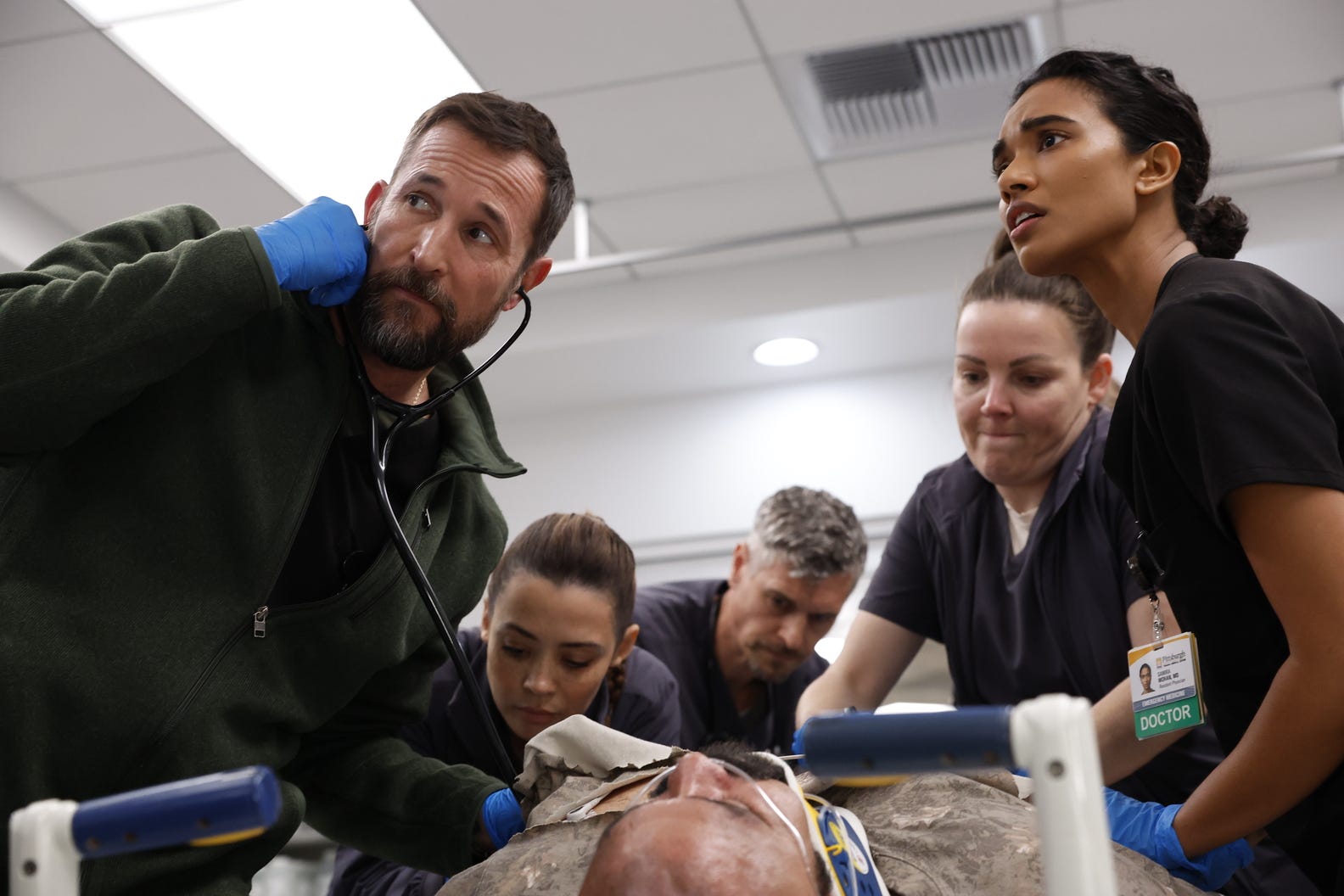
As soon as Noah Wyle won an Emmy for his role playing Dr. Robby on “The Pitt,” I found myself unexpectedly sobbing. By the time the show won the Emmy for best drama, I had advanced to an ugly cry. I cried because this represented something bigger: a rare, honest attempt to bring public health into our shared cultural bloodstream.
Showrunner R. Scott Gemmill dedicated the award to healthcare workers: “Respect them, protect them, trust them.”
“The Pitt” is not just another TV show. It's a platform that uses storytelling to shine a light on urgent public health issues as our nation's health infrastructure crumbles.
The urgency of this moment cannot be overstated. This Wednesday, Susan Monarez, the former head of the Centers for Disease Control and Prevention, will testify to Congress following her abrupt dismissal last month after clashing with Health and Human Services Secretary Robert F. Kennedy Jr. over vaccine policy.
Dr. Monarez, who served as CDC director for barely a month, was supposedly fired after she refused to “rubber-stamp unscientific, reckless directives and fire dedicated health experts.” This wasn't a quiet resignation over policy differences. This was a public health professional choosing science over politics and paying for it with her career.
The fallout was immediate and devastating. Debra Houry, the CDC’s chief medical officer and fellow emergency medicine physician, resigned the same day, “We reached our tipping point,” she told reporters. “America's public health is significantly in danger.” Others followed, leaving America's premier public health agency leaderless at a time when measles outbreaks are rising, gun violence continues to ravage communities, and the federal budget is set up to remove millions of Americans from their health care coverage.
This is why “The Pitt” matters and why its Emmy victory felt like more than just an awards-show moment. While our real-world public health infrastructure decays, this drama set in a Pittsburgh emergency room is holding up a mirror to America’s health crisis and refusing to look away.
The show doesn't sugarcoat the realities that healthcare workers face. In one devastating episode, viewers watch as a child arrives deathly ill from measles, a vaccine-preventable disease he contracted because his parents were convinced vaccines were not safe. The episode shows the human cost of our collective failure to trust science. Viewers see the fear in parents' eyes when they realize their “personal choice” has consequences extending far beyond their own family.
When “The Pitt” flashed back to COVID, it showed, in gut-wrenching detail, what we went through and the scars we still carry. The show captured the moral injury that healthcare workers bore with the knowledge that we could have done better if the systems around us had functioned properly. As an emergency physician in New York City who worked through COVID-19's darkest days, I remember watching patients die alone, jerry-rigging ventilators so two patients could share one machine, and cooling trucks outside our Emergency Departments because our morgues were overrun.
But the show does more than validate healthcare workers’ experiences. It reminds us that storytelling is one of the most powerful tools for bridging the gap between policy and human experience. And that’s why Monarez’s testimony Wednesday is important. In her own words, Americans can hear what they have lost with the politicization of the nation’s public health infrastructure.
When Monarez was fired, it wasn’t just one person losing a job. It was a signal that science-based public health policy is no longer the priority at CDC.
What does this mean for ordinary Americans? Vaccine recommendations might be based on political considerations rather than scientific evidence. Disease surveillance might be compromised by ideological concerns. During the next public health emergency, Americans might not be able to trust information from their own government.
So yes, I wept when “The Pitt” won the Emmy for best drama. For once, the best drama wasn’t about dynasties or royal families. It was about us: our kids, our bodies, our safety, our country.
Watch “The Pitt.” Not because the Television Academy said it was good but because it is the most important thing on television at this moment of national crisis.
More important, pay attention to Wednesday’s hearing. Ask your representatives what they’re doing to protect the CDC’s independence. Demand that public health policy be based on science, not politics. Remember that in a democracy, public health requires us to stay engaged, informed, and committed to protecting the institutions that protect us.
The next time we face a public health emergency, we need to know that the CDC will be there, functioning as it should, guided by science and committed to protecting every American life. Our children’s health, our communities’ safety, and our nation’s future depend on it.
Dara Kass is an emergency physician and the founder of FemInEM, an organization dedicated to the advancement of women in emergency medicine and addressing reproductive healthcare issues in our emergency departments.

Your concluding paragraph is absolutely essential. mRNA technology has actually been around for a while but banning it altogether is absolutely foolish. mRNA vaccines are used in cancer research and have the potential to augment some cancer treatments. Sometimes unexpected results leads to new treatments and therapeutics not just in cancer treatments or treating pathogenic communicable diseases but other pathologies as well such as autoimmune diseases.
Perfect column. Thank you so much. No medical doctors in our immediate family, but my Dad was a physicist and engineer who worked with Physicians in Denmark in the 80's on cures for cancer. Our daughter-in-law is an Epidemiologist who work on controlled testing for some of the original COVID 19 vaccines. After two episodes of cancer, my amazing daughter is alive and well thanks to the continuing efforts of Physicians and researchers to produce new treatments at an amazing rate, including the stunning abilities of robotic surgery. And I have had Rheumatoid Arthritis for 37 years. Most of that time suffering crippling damage to my larger joints, but given 11 years now of miraculous relief by the ever growing numbers of biologic drugs available.
None of us can know when we may need the intervention of modern medicine to save our lives or repair what is broken and sickened. Our family is very grateful to all of the wonderful, incredibly educated and experienced medical staff in hospitals, clinics, research laboratories and every doctor's office and pharmacy. And we have relied heavily on our Public Health Agencies throughout the country for advice and planning. Yet from the President's first term and the onset of COVID these public health agencies have been ridiculed, torn apart and devastated. This is incredibly sad and very dangerous We need to run this around now. And if you haven't see The Pitt, please watch. Shocking, sad, wonderful and very informative.
Thank you Dr. Kass for speaking up.