



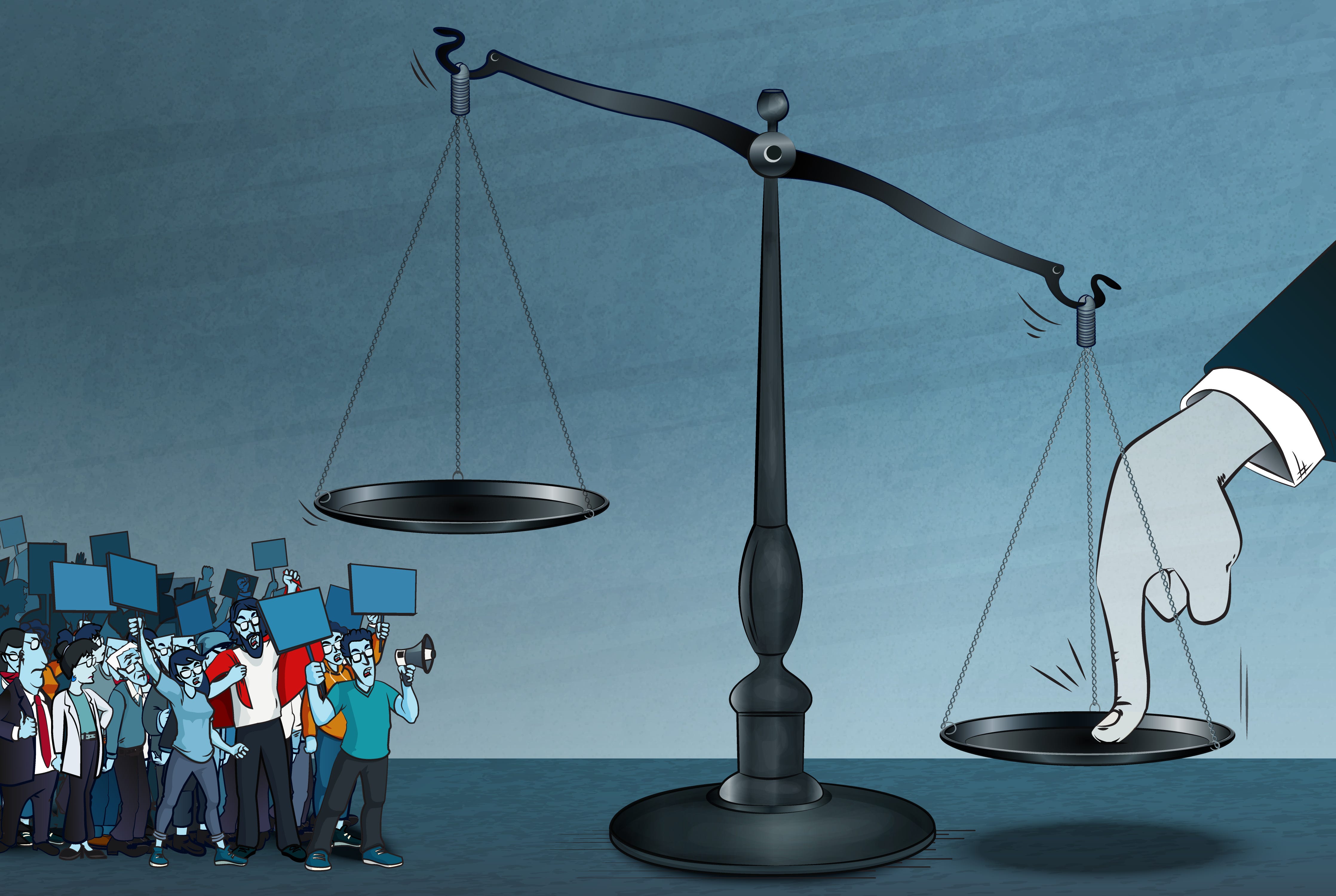
No president in American history has used–and abused–the constitutional clemency power quite like Donald Trump. It’s not just that he’s used his authority to pardon people who probably shouldn’t be pardoned; other presidents have done that, although in smaller quantities. What’s unique about Trump’s abuses is the sheer number–and how brazenly self-interested they’ve been. Thus far in his second term, he’s used the constitutional pardon prerogative in support of his larger vision of a government that’s set up to help him make money, reward loyalty, and undermine his perceived political enemies.
For our final Top 10 Worst of 2025, we detail the most egregious of Trump’s abuses of the pardon and other clemency powers. They are atrocious–so much so that we cannot rule out even worse pardons ahead, such as of Jeffrey Epstein’s co-conspirator Ghislaine Maxwell. Neither does Trump rule it out; when asked after the Supreme Court rejected her final appeal in October whether he would consider a pardon for her, Trump dodged the question by stating “I’d have to take a look at it.”
As the country reviews the Justice Department’s most recent Epstein files document release, more light might be shed upon the matter. Or not, if as it so far appears, material has been overwithheld. Thanks to you, we won’t have to take the DOJ’s word for it; your paid subscriptions support our democracy litigation and related work, including our pending case to force the release of all the Epstein files. With your support, we stand ready to go to court as needed to ensure full transparency.
In the meantime, let’s have a look back at Trump’s 10 worst pardons of 2025, followed by our usual round up of all the Contrarian coverage of the week.
Capitol Clemency Catastrophe
We begin our putrid pardon-palooza on Day One of Trump, when he granted clemency to over 1,500 insurrectionists who stormed the capitol in his name on Jan. 6, 2021. Among those pardoned for their crimes on the “day of love,” as he puts it, were 608 people who were charged with violent crimes and approximately 174 who were “charged with using a deadly or dangerous weapon or causing serious bodily injury to an officer.” Trump defended the pardons on the grounds that “these people have already served a long period of time” and that many sentences were “ridiculous and excessive.” Tell that to the cops who were targeted.
Juan Orlando Hernández
Despite all his bluster about fighting drug trafficking in Central and South America, Trump pardoned former Honduran president Juan Orlando Hernández, who was serving a 45-year sentence for pumping poison on a “cocaine superhighway” into our communities. Press Secretary Karoline Leavitt said the prosecution was the result of a “weaponized” Justice Department, which brought the case because Hernández was “opposed to the values of the previous administration.” But the case was pushed by then-prosecutor Emil Bove, later Trump’s defense lawyer, senior DOJ official, and now Third Circuit judge!
Ross Ulbricht
More drug hypocrisy: Ross Ulbricht, who operated the Silk Road, a notorious underground online market used by drug dealers, landed one of the first pardons Trump signed. Ulbricht was sentenced to life in prison for his role in facilitating the flow of heroin and other illicit drugs into our communities. Trump defended the pardon because Ulbricht was put in jail by “the same lunatics who were involved in the modern day weaponization of the government against me.” Yet Trump just declared that illicit fentanyl is a “weapon of mass destruction.”
Changpen “CZ” Zhao
As we discussed last week, CZ is one of Trump’s crypto cronies. That includes CZ’s crypto exchange Binance using a Trump-supported tablecoin, USD1, to finance a $2 billion transaction (potentially generating huge revenue for the Trumps). CZ, who spent nearly four months in jail for money laundering issues at Binance, scored clemency a few months after the USD1 deal. Binance announced that it would launch trading of the USD1 stablecoin and another Trump-linked crypto product on its exchange a week after Trump signed CZ’s pardon. When asked about the pardon, Trump said, “I have no idea who he is. I was told that he was a victim, just like I was and just like many other people, of a vicious, horrible group of people in the Biden administration.” Sure.
Giuliani, Meadows, and the Election Co-Conspirators
Trump’s decision to issue pardons for 77 people involved in the scheme to overturn the 2020 election results and keep Trump in power was no surprise. His pardon attorney, Ed Martin, revealed the clemencies by replying to his own May post on X in which he said, “No MAGA Left Behind.” The only real shock here is that it took so long for Trump to protect Rudy Giuliani, John Eastman, Mark Meadows, Sidney Powell, and company from future accountability (none is facing federal charges). Just like the Jan. 6 mass pardons, this grant of clemency was yet another attempt to re-write the history of the attempted coup–and convey to future would-be plotters that they will not face consequences if they try again.
Rep. Henry Cuellar
Trump suggested that his decision to pardon Rep. Henry Cuellar (D-TX) and his wife for allegedly engaging in a bribery scheme was mostly about politics: namely, hoping the congressman would switch parties or retire. But when Rep. Cuellar refused to jump ship, Trump exploded in a Truth Social rant, accusing Cuellar of “a lack of LOYALTY, something that Texas Voters, and Henry’s daughters, will not like.” For his part, Cuellar clapped back by paraphrasing the words of his fellow Texan and former president Lyndon B. Johnson, with Cuellar saying, “I’m an American, I’m a Texan, and I’m a Democrat, in that order … and I think anybody that puts party before their country is doing a disservice to their country.”
Todd and Julie Chrisley
It is possible that Trump saw some of himself in Todd and Julie Chrisley, former millionaire stars of the reality show Chrisley Knows Best, who received pardons after being convicted of fraud by an Atlanta jury in federal court in 2022? The pardon follows lobbying from the Chrisleys’ daughter Savannah, including a prime-time appearance at the 2024 Republican National Convention, where she argued that her parents were the victims of (you guessed it) political persecution. Trump’s pardon also fully relieved the Chrisleys of the more than $22 million they owed to victims of their tax fraud and tax evasion scheme. Not a bad deal– except for the victims.
BitMEX Co-Founders–and BitMEX
Trump appears to have made history in March when he used the pardon power to grant clemency to a corporation: crypto exchange BitMEX. The exchange pleaded guilty to “wilfully” failing to “establish, implement, and maintain an adequate anti-money laundering” program; Trump’s pardon coincided with a surge of activity on the exchange. The grant also extended to the exchange’s founders, Benjamin Delo, Arthur Hayes, and Samuel Reed, and employee Gregory Dwyer for their participation in similar schemes to flout U.S. laws. For its part, the company celebrated the pardon, thanking the president and boosting itself as “the safest, most trusted, financially-stable, and professionally operated crypto derivatives exchange.”
Scott Jenkins
Trump’s decision to pardon Scott Jenkins, an ardent MAGA supporter who was convicted of bribery and honest services fraud for running a “cash for badges” scheme, is one of the best examples of Trump’s putrid pardon philosophy. If you’re a MAGA official convicted of corruption offenses, you’re pardon eligible. Jenkins “displayed a shocking disregard for his ethical and legal responsibilities,” according to prosecutor Zachary T. Lee (who was then Trump’s acting U.S. Attorney before resigning in October). No matter. The day before the pardon was announced, Martin dropped his infamous “No MAGA left behind” post on X. Trump, as usual, defended the pardon because Jenkins “is a victim of an overzealous Biden Department of Justice”--even though it was his DOJ that secured Jenkins’ 10-year sentence.
Trevor Milton
Trevor Milton, convicted of defrauding investors in his electric car startup in 2022, received a pardon in March. Trump labeled Milton, who was represented at his trial by Attorney General Pam Bondi’s brother, Brad Bondi, as yet another victim of persecution: “the thing that he did wrong was he was one of the first people that supported a gentleman named Donald Trump for a president.” He certainly did support Trump and his agenda–to the tune of at least $930,000 to the Trump campaign or Trump-aligned PACs and $750,000 to the MAHA Alliance, a PAC designed to convince Robert F. Kennedy Jr. supporters to vote for Trump in 2024. Milton bombastically declared that the pardon is really about “every American who has been railroaded by the government.”
Dishonorable mention: George Santos
Trump loves those who have made their support for him clear. And few people have been better at that than George Santos, the disgraced former congressman and conman whose sentence Trump commuted in October. Santos was serving a seven-year sentence for wire fraud and identity theft. The commutation also relieved him of his requirement to pay more than $370,000 in restitution to his victims. Trump even called him “somewhat of a ‘rogue’” who “lied like hell”--but there are “many rogues throughout our Country that aren’t forced to serve seven years in prison.” This commutation, despite not technically being a pardon, makes the list as a dishonorable mention.
And now here’s something far more honorable: all this week’s Contrarian coverage.
A Devastating Weekend: Gun Violence Across the World
Jen Rubin wrote on the divergent responses in America and Australia to the shootings that rocked our respective nations last weekend—the Bondi Beach massacre and the tragedy at Brown University—and how America is once again choosing the wrong path. “Australia shows us there is another way for democracies to function. Perpetual slaughter of our children is a choice—one no civilized country should make.”
America Refuses to Prevent School Shootings
Angela Ferrell-Zabala, executive director of Moms Demand Action, joined Jen to discuss how the violence at Brown University could have been avoided and why it wasn’t, calling out the gun industry and demanding accountability for the deadly violence tearing through our communities. “Guns are the #1 thing killing young people & nothing is being done about it.”
Hanukkah Celebration Turns to Tragedy
Halie Soifer, CEO of Jewish Democratic Council of America, joined Jen to update us on the Bondi Beach shooting and discuss the global uptick in violent antisemitism. “This is how our ability to fight hatred is slipping away.”
What Parents Can Do When Their Child Is in an Active-Shooter Lockdown
Dara Kass lived every parent’s nightmare this past weekend as she waited for confirmation that her daughter, a student at Brown, was safe. “I want to share what I learned, because on Saturday…I realized how unprepared we are for this side of the experience.”
2025 Was Awful for Healthcare
The 15-Year-Old Ghost Haunting the Republican Party
Jeff Nesbit wrote on why the GOP’s healthcare sabotage will dominate the 2026 midterms. “The GOP has spent 15 years looking for an alternative to the ACA. On Jan. 1, the American people will finally see what that alternative is: higher costs, fewer doctors, and millions left behind.”
A Very Bad Year for Women’s Health
Jennifer Weiss-Wolf looked back on a year’s worth of reporting on the depth of damage this administration has wreaked on women’s health. “When I started writing for The Contrarian, a funny-not-funny inside joke was whether there would be enough fodder for a weekly democracy column that overtly centers gender. I think you already know the punchline.”
How 2025 Changed American Healthcare
Dara Kass wrote on the healthcare stories that defined 2025, from coverage loss to crumbling trust. “What worries me most is the lasting damage from conspiracy theories and disinformation spread by the secretary of Health and Human Services and his appointees.”
Roberto Valadéz took a global view on the year in healthcare, tracing devastating setbacks—but also new innovation and striking resilience. “The tools to save millions of lives exist. What remains is the collective resolve to deploy them strategically, equitably, and at scale.”
America’s Place in the World
Brian O’Neill broke down a year of Trump’s drastic reshaping of America’s place in the world. He argued that the administration’s reckless, inexperienced handling of national security has destabilized more than many realize. “America remains strong but is increasingly treated as the variable everyone else must manage.”
America’s Global Power Is Flickering
Steve Cook joined Jen Rubin to review the year in Trump’s foreign policy (or lack thereof) and look ahead to 2026, breaking down the humanitarian cuts, curdling goodwill, and economic fallout now reshaping the world.
Is a U.S.-Venezuela War on the Horizon?
Rep. Jim Hines joined Jen Rubin to discuss the real and evident reason Defense Secretary Pete Hegseth won’t release the Caribbean boat strike footage—because he has something to hide—and gives his take on any future escalation in Venezuela and elsewhere.
The White House Team of Villains
The ‘Second Nadir,’ Indeed: The Year in Race
Shalise Manza Young wrote on a year in which dismantling civil rights and erasing evidence of Black history and achievement became an open top priority of our federal government. “Trump, his Cabinet members, and advisers are transparently working toward instituting a Christian white nationalist agenda.”
The Five Worst Things We Learned About Susie Wiles
Tim Dickinson pressed the Vanity Fair exposé—er, profile—of Trump’s chief of staff, Susie Wiles, for all its stickiest juices, finding the tale of a U.S. chief of staff who never says “no.” “Wiles’ ability to articulate a problem doesn’t seem to be matched by a willingness to, you know, fix it.”
When Public Servants Became Public Enemies
The Contrarian’s own Ciera Stone, a former federal worker, gave us an eyewitness account of the DOGE-fueled destruction of the civil service. “Our government is filled with dedicated civil servants who proudly took an oath to serve our country and constitution. We did not deserve to be treated as an enemy. Certainly not by the President of the United States.”
Retaining Hope & Fighting Back
Dispatch From Chicago: ‘Standing up to the Worst’
Lorraine Forte updated us from the city that, far from becoming “ground zero” for a Donald Trump victory-lap on mass deportations, this year became the model for fighting back. “Chicago was bruised by Midway Blitz. But we weren’t broken.”
The Contrarian covers the Democracy Movement
This week we saw protests in Oregon, Georgia, Brazil, Russia, and more. Get help organizing from Indivisible, find protests in your area at mobilize.us, and send us your protest photos at submit@contrariannews.org. See also A Year in Protest. So many of us showed up and showed out this year. We’ll be there next year, too.
Top 10 Moments of Hope from 2025
Ben Sheehan spotlighted the optimism we need to keep going.
Culture, Cartoons & Fun Stuff
This week our cartoonists took on the administration’s blame game (No Room at the Inn and The Media Did It by Michael de Adder), creative uses of fossil fuel (Gaslighting and Merry Christmas to Oil ... by RJ Matson), the not-so-fine print (Font of Trouble by Nick Anderson), and an original war on Christmas (Tom the Dancing Bug by Ruben Bolling).
Rob Reiner Left a Remarkable Pop Culture Legacy. His Work as an Activist Was Just as Impressive.
As the nation mourned a Hollywood icon (everyone except the president, that is), Meredith Blake gave tribute to both Rob Reiner’s timeless filmography and his dauntless progressive activism. “Reiner’s death marks an incongruously tragic end for an artist who exuded warmth and whose work, even at its darkest, seemed to reflect a belief in essential human decency.” See also Michael de Adder’s Thank you, Mr. Reiner.
The Best of the Jane Austen Cinematic Universe
Meredith also gave us a rundown of Austen adaptation classics in celebration of the author’s 250th birthday, and a binge-worthy gay hockey romance to boot. It is a truth universally acknowledged that her recs are worth reading.
Marissa Rothkopf gave us a traditional Austrian dessert improved with a little cocoa.
There you have it Contrarians—another amazing week of content, not to mention the legal action made possible by your paid subscriptions. We look forward to seeing you on Coffee with the Contrarians Monday morning at 9:15 AM ET. Until then, have a great weekend. Warmly, Norm
In her book, "Nobody's Girl," the late Epstein victim, Virginia Roberts Giuffre, calls Ghislaine Maxwell an "apex predator." It was Maxwell who lured Giuffre and hundreds of others into Epstein's spiderweb of predation. She should face life in prison!
Part of the problem is the unlimited number of pardons that a president can bestow. They should be budgeted. Each 4 year term, the president should be allotted a given number of pardons. With limits in mind, maybe they wouldn't be spread about like seeding a field. With only a limited number to use, a little more sense and discretion might come into play. It might also not be a bad idea to have criteria that a person needs to meet to be considered for pardon.