


“Mr. President.”
I always figured that George Washington came up with title as a means of eschewing royal titles (“your highness,” “your majesty”). However, the history is more complicated, as NPR explained:
“In April of 1789, Washington was making his way to New York City to be inaugurated, and Congress started to have this discussion about how are we going to address him once he gets here?” said author and historian Kathleen Bartoloni-Tuazon.
The king was “Your Majesty,” while governors at the time were addressed as “Your Excellency.” What would they call Washington? . ...
“President” just seemed too plain to the Senate, and they brainstormed a bunch of alternatives.
“Elective majesty, sacred majesty, elective highness, illustrious highness, serene highness,” Bartoloni-Tuazon said. “The Senate actually went on record as recommending, ‘His Highness, President of the United States and Protector of Their Liberties.’ Now that’s a mouthful.”
On the other side, the House was unanimously against anything but president alone. They were afraid that anything more would make the executive leader into a kind of monarch.
The debate went on for three arduous weeks …. In the end, the Senate relented, writing they wished to preserve harmony with the House.

So “Mr. President” became the preferred usage. But that’s a courtesy, a norm such as, I dunno, the norm of allowing the Kennedy Center to operate as an independent arts organization or the norm of preserving White House’s historical character (rather than bulldozing the East Wing to make way for a garish, privately-funded ballroom). You get the point.
The current Oval Office occupant has systematically leveled every norm, trampled on every custom, and violated every rule of decorum. It seems incongruous, at the very least, to maintain any honorific tradition for someone who:
Suggests we execute members of Congress for reminding military personnel not to follow illegal orders;
Calls a female reporter “piggy”;
Contradicts our own intelligence in exonerating the Saudi Crown prince of responsibility for Jamal Khashoggi’s murder and dismemberment (“things happen”);
Then insults a reporter for asking an “insubordinate” question of that foreign leader (who suppress free speech at home); and
Threatens judges with impeachment and news reporters with lawsuits and loss of their licenses.
And these are just a few examples of things he says—aside from what he does to wreck our democracy. Maybe someone of that ilk should not get the benefit of customary niceties.
Trump’s vile behavior is not accidental. Rudeness is part of the autocrat’s playbook. “The anarchocapitalist branding, the rude tone, the obscenities, and the underlying message of hostility toward elites were basic features of [Argentine’s Javier] Milei’s political character,” the Journal of Democracy explained recently. Sounds very Trumpian.
This is not simply a matter of manners (although throwing ketchup against the wall was a new low in dining etiquette). As a doctoral candidate at University of Alabama at Birmingham noted, “When Donald Trump became president, he sought to break what standard decorum was in order to justify his desires as president.” Breaking the rules of decorum while engaged in nonstop lying, demagoguery, and lawlessness has allowed him to “challenge the norms within American democracy.” These decorum-defying behaviors help promote his aim to sow division, polarize the country, and do lasting damage to our democracy.
Trump uses brazen rudeness, obscene language (including regular f-bombs), and all manner of unpresidential behavior (e.g. sleeping in meetings, attacking Oval Office guests, demeaning women, dining with antisemites) to demonstrate that he operates above and beyond any rules, norms, constraints, and customs. The gulf between the White House press corps who call him “Mr. President” and the chief executive who responds to one of them by stating, “Quiet, quiet piggy,” could not be starker—nor could it be more revealing of his desire for total domination. His language conveys his intention to subjugate ordinary Americans who feel compelled to adhere to cultural and social norms.
Trump abuses language and decorum in service of his abuse of power.
Bullies, oligarchs, and White supremacists often inveigh against the loss of “civility” or “manners” when those protesting injustice disturb their “polite society” and cocoon of denial. That transparent but effective trap seeks to keep “those people” in their “place.”
Columnist, lecturer, and author Susan Campbell wrote critically of Democrats who joined Republicans in censuring Rep. Al Green (D-Tex.) for calling out Trump during a joint session of Congress. “In the name of decorum, we will Robert’s Rules ourselves right out of business,” Campbell warned. We are faced with a “fascist wanna-be dictator,” eager to cut off life-saving services and trample on constitutional rights, she reiterated. “But sure. Let’s keep our voices down,” she observed. “Decorum is dead. Donald Trump killed it.”
So please, let’s drop the honorific “Mr. President” when we’re addressing or discussing a man who defiles the Constitution, blows up every norm, and torments Americans. We do not “respect the presidency” by using the same title for an insulting, crude autocrat as we have bestowed on Washington, Lincoln, the Roosevelts, or even lesser lights who attained the office. Maintaining decorum while he flouts it, granting deference while he bullies, and using honorifics when he insults others will only smooth the way for further effort to intimidate and dominate ordinary Americans as well as political adversaries. (As an alternative, those in his presence can try “Mr. Trump,” or “Sir.” When speaking about him, “Donald Trump” or “Convicted Felon Donald Trump” will do.)
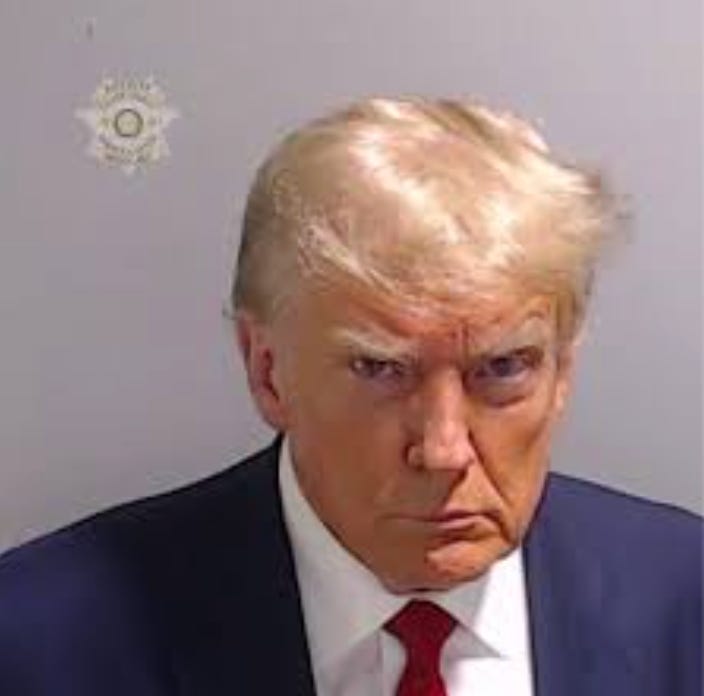
Certainly, depriving Trump of a form of respect he craves is far from the most important element of the resistance. We must deploy a range of responses (e.g., lawsuits, elections, public advocacy for the Trump’s victims, mass mobilization, congressional and media investigations, consumer boycotts, Prop. 50, etc.) to short-circuit his dictatorial ambitions. However, denying Trump an undeserved nicety can amplify the larger and more meaningful message: We are his boss, not the other way around.
"Convicted felon Donald Trump" is perfect. I have heretofore always referred to him as "occupant of the White House." To acknowledge him as President defiles the many great chief executives, no matter that poorly thinking capable Americans did vote for him.
I would list all of the names I've called him the last ten years, but there might be young readers present.