


Last week, Donald Trump sent Congress a disturbing letter announcing that under Section 1230 of the Fiscal Year 2024 National Defense Authorization Act, certain drug cartels’ actions “constitute an armed attack against the United States.” You might be wondering how smuggling drugs into the country amounts to a “non-international armed attack,” as the letter puts it. The only side engaging in any military conflict is the United States military, which on four occasions has destroyed suspected smuggling and murdered those on board. You also might be wondering how the president—rather that Congress—has the power to declare what amounts to war. You are not alone in recognizing the frightful implications of this dictatorial degree.
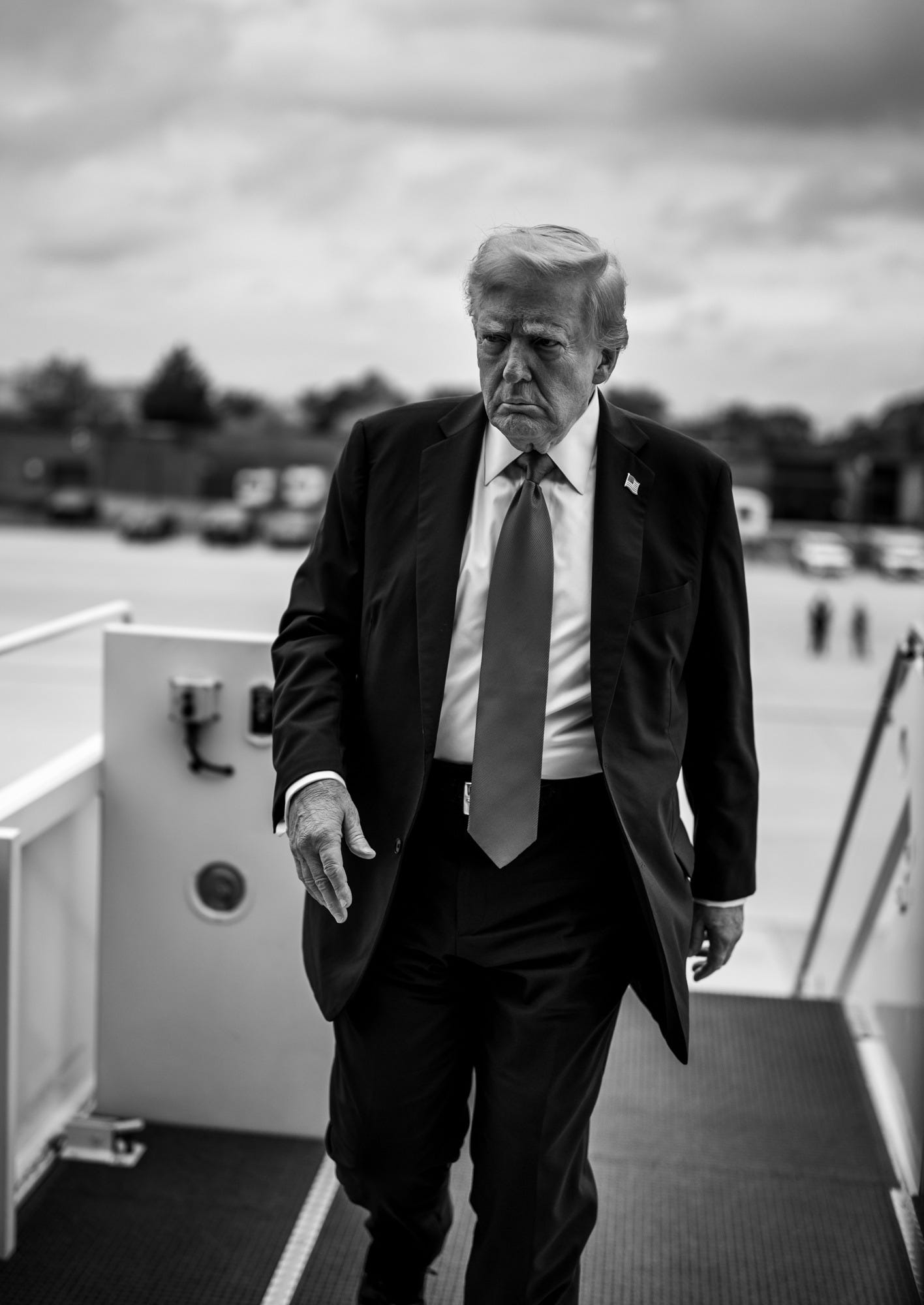
Trump now claims the right to kill someone “affiliated with a designated terrorist organization [who] at the time, engaged in trafficking illicit drugs, which could ultimately be used to kill Americans.” Under that frightfully vague, unlimited edit, he dubs people engaged in this supposed non-international armed conflict, “unlawful combatants.” As a measure of for whom such classification would be appropriate, that is how we designated ISIS and al-Qaeda members whom we captured, in some cases tortured, and held for years in prison without trial.
As many experts in the national security and international law would agree, the technical term for Trump’s notice is “garbage.” Once more, Trump (for obviously nefarious reasons) affixes labels to activities and people that bear little or no resemblance to Trump’s designation.
In particular, “armed conflict” means, under international law and common parlance, ongoing violent hostilities between a nation state and discrete enemy. That is not what is happening here, as the New York Times reminds us:
In an armed conflict, as defined by international law, a country can lawfully kill enemy fighters even when they pose no threat, detain them indefinitely without trials and prosecute them in military courts.
[Retired judge advocate general lawyer] Geoffrey S. Corn… said drug cartels were not engaged in “hostilities” — the standard for when there is an armed conflict for legal purposes — against the United States because selling a dangerous product is different from an armed attack.
Dictators love to call things “wars” as a ruse to abolish ordinary legal restraints, individual rights, transparency, and due process. In this case, Trump is “conflating the trafficking of an illicit consumer product and associated crime with an armed” without explaining how drug smuggling equates to armed conflict.
In particular, security expert Marty Lederman reminds us that a “non-international armed conflict” requires:
(i) that the non-State entity is an ‘organized armed group’ with the sort of command structure that would render members targetable on the basis of their status because they’re subject to commanders’ direction and control and
(ii) that the organized armed group has engaged in armed violence against the State that is of some intensity (think of al Qaeda’s attacks on Sept. 11, 2001) and that has been protracted.
In the words of U.S. District Court Judge Karin Immergut, who enjoined Trump’s invasion of Portland, Trump’s assertion that we are engaged in an “armed conflict” is “simply untethered to the facts.”
Trump has not even attempted to make the case the people he is blowing up are part of a single organized group. And, since “there’s nothing in international law that even suggests that such drug activity is sufficient to trigger the right of the affected State to kill persons simply because they are members of the drug cartel (which isn’t surprising, given the radical implications of such a theory),” Trump’s mumbo-jumbo is legally invalid. If we were in an armed conflict, only Congress, not the president, would have the constitutional power to declare war, or as in Afghanistan, pass a resolution authorizing the use of military force.
As if that were not scary enough, Trump’s warped language may be aimed at domestic, not foreign, use of force. If, say, Chicago drug dealers getting shipments from overseas were part of an “armed conflict” with the United States, does that mean Trump can summarily execute a suspected drug dealer plus all the people providing material support (e.g., his landlord, his bank, the Uber driver who took him to the airport)? What about liberal protesters he claims have ties to the bogeyman ANTIFA?
We should be exceptionally alarmed about the very, very dangerous road he is taking us down. Trump’s actions after sending the notice to Congress certainly indicate he plans to throw off legal restraints and deploy the military to wage war against Americans. He quickly turned up the violence in Chicago, and government lawyers attempted to defy (albeit unsuccessfully) Judge Immergut’s ruling barring deployment of Oregon national guardsmen to Portland by trying instead to send California and Texas guardsmen(!). He also delivered a disgustingly partisan speech to sailors in Norfolk, Va., suggesting the need to rid the United States of Democrats:
In short, Trump may envision a phony overseas war as a predicate for a despotic war against Americans. We should disregard words that Trump regularly distorts beyond recognition (e.g., armed conflict, non-international armed conflict, unlawful combatant). In Trump’s mind such terms are infinitely elastic, allowing him free rein to go after his enemies. If his rhetorical chicanery prevails, nothing will prevent him from targeting Americans, executing or rounding them up, and doing away with constitutional protections altogether. Which would be, by any definition, a dictatorship.
We therefore find ourselves less than ten months after Trump took office with the open question as to whether the president, anywhere, anytime he pleases, can execute or round up people he says are terrorists—without due process. That we are even entertaining such a discussion tells you how far Trump has damaged democratic guardrails and how derelict the MAGA majorities in Congress and on the Supreme Court have been in checking his power grabs.
The courts, Congress, the voters, and/or the military itself (which is obligated to refuse illegal orders) must be adamant that his dangerous charade will not work.
OK, I agree with everything you say in here but, how much more “alarmed” are we supposed to be than we already are? My alarm level is already astronomical. But I still tried forward hoping that whatever small things I can do will help and I hope there are millions more people who are doing the same thing!
Even if smuggling drugs met the standard for the international definition of armed conflict, the administration has offered no evidence that the boats in question were actually smuggling drugs.