


In the aftermath of the Supreme Court’s Louisiana v. Callais ruling — another decision vividly exposing the growing distance between what is just and what is legal — major political outlets were running familiar stories about an opening with Black voters for Republicans and potential support for MAGA-aligned politics amid years of erosion with Democrats.
A week later, the country was watching the aggressive public spectacle surrounding the federal government executing a search warrant against businesses owned by Virginia state Sen. Louise Lucas — who spearheaded Virginia’s response to Texas Republicans’ gerrymandering tactics. Fox News got the scoop about the warrant before Lucas was informed, raising questions about whether this was retribution from the federal government for Lucas’s leadership.
Meanwhile, Nick Fuentes, a white supremacist extremist who has dined with the president and who openly traffics in explicit anti-Black rhetoric, stated how living in America right now is “N*gger Hell.” His statements remained largely insulated from the sustained institutional outrage and collective condemnation that routinely follows even marginal left-wing voices online if they state something controversial. Around the same time, ABC News correspondent Rachel Scott was publicly called “a bitch” by President Donald Trump after she pressed him with difficult questions — another example of behavior that likely would have dominated national outrage cycles had the political roles been reversed.
In the same week, Virginia’s Supreme Court overturned the state’s redistricting referendum, another blow to communities already watching voting rights and representational fairness steadily weaken in real time. In Tennessee, courts allowed the dismantling of the state’s only majority-Black congressional district in Memphis to stand moving forward, reinforcing for many younger Americans the growing sense that pathways to fair representation are becoming increasingly fragile no matter how loudly democracy continues to be celebrated rhetorically.
A random social media post often becomes representative of Democrats as a whole, while openly racist rhetoric adjacent to the political right is compartmentalized as fringe, individualized, or unserious. That asymmetry matters because anti-Blackness does not function only through policy. It functions through narrative framing. Black political behavior becomes uniquely scrutinized for signs of disloyalty, extremism, or excess.
Separately, these moments might seem disconnected. Together, they reveal something much deeper about the collapsing credibility of American institutions and the narratives they manufacture.
Because at a certain point, younger generations — like my own — stop experiencing these contradictions as isolated hypocrisies and start seeing them as the system functioning exactly as designed.
Institutional legitimacy can’t be taken seriously when the public is being spun, managed, and played.
Since our nation’s founding, institutions like the Supreme Court were said to be imperfect but ultimately expanding freedom and democratic inclusion. Generations can point to tangible moments when the courts widened the boundaries of who counts in American life: desegregation, civil rights protections, voting rights enforcement, and decisions that — however incomplete — visibly expanded access, opportunity, and participation.
Many younger Americans, especially young Black people, women, and other marginalized communities, inherited a very different institutional reality. We came of age watching the rollback of protections we were told were settled. We watched voting rights get weakened while democracy was spoken about as sacred. We watched reproductive rights disappear while politicians insisted freedom was intact. We watched affirmative action get dismantled while being told the playing field was finally equal. We watched environmental protections, regulatory safeguards, labor protections, and public trust in science steadily erode while institutions demanded confidence in their neutrality and legitimacy. We came of age watching injustice unfold vividly and publicly through the killings of Trayvon Martin, Michael Brown, and many others whose deaths became defining markers of how differently justice, innocence, and humanity can be applied depending on who you are.
That experiential divide matters because it fundamentally shapes how political messaging lands.
We are living through the slow destabilization of institutions like government and traditional media. When every loss is accompanied by media narratives insisting everything is normal — or worse, obsessing over symbolic partisan movement instead of material consequences — traditional horse-race politics feels emptier than ever.
My high school debate team ran an argument that focused less on abstract hypotheticals and more on interrogating the underlying systems, assumptions, and real-world impacts that shape people’s lives. The idea was “truth over tech”: no amount of speed reading, procedural gamesmanship, or stacking endless arguments mattered if it ignored the fundamental realities people experienced. That is what much of American political discourse feels like today. Endless tactical analysis, polling movement, messaging strategy, and partisan spectacle — without acknowledging that the democracy, freedom, and institutional trust are deteriorating in real time.
Courts are narrowing pathways to representation and participation, and media remains obsessed with proving that backlash politics cannot be backlash politics because Black support exists somewhere in the GOP coalition.
Black conservatives have always existed. The issue is why political and media institutions amplify the symbolism of Black conservatism while minimizing or normalizing the anti-Black structures, democratic erosion, and racialized power operating alongside it.
Black people’s demands for voting access, representation, educational opportunity, environmental protection, and equal participation are framed as divisive “identity politics,” while political movements centered around protecting traditional hierarchies, white demographic anxiety, and exclusion are treated as neutral electoral concerns.
Even many institutional Democrats fall into this trap. Black political demands are often treated as strategically dangerous liabilities that must be softened, translated, delayed, or moderated for broader white comfort. Yet white backlash politics are routinely treated as inevitable, culturally authentic, and economically understandable — and accommodated.
Younger generations notice the inconsistency.
The selective distribution of legitimacy is part of why so many younger people increasingly experience institutional politics less as democratic participation and more as narrative management. Too often, modern political media don’t help the public understand power but instead reinforce the perception that existing systems remain fundamentally credible, fair, and functional — even as public trust erodes.
The danger is not simply that younger generations are becoming cynical. It is that more and more people are beginning to see institutional inconsistency not as failure but as the governing logic itself. And when a generation stops believing institutions are operating sincerely, restoring trust becomes far harder than winning a political argument, a news cycle, or an election.
In the aftermath of Callais, people said we need to vote harder, organize harder, and prove our political power again. That isn’t compelling for many younger people because it refuses to grapple with the depths of institutional illegitimacy. Telling people to have faith in systems that are inconsistent, selectively accountable, and structurally unequal without acknowledging that sounds like denial, not inspiration.
The conversation has to start with honesty: honesty about how fragile institutional trust has become, honesty about how the rules are no longer applied consistently, and honesty about how power is often protected even as democracy is rhetorically celebrated. Voting still matters. Organizing still matters. Civic participation still matters.
But rebuilding belief in collective action will require more than simply telling people to show up every election cycle and hope institutions eventually correct themselves. Younger generations are starving for tangible ways to feel connected, useful, and powerful again outside of endless partisan performance. That means building low-barrier structures that create immediate participation, visible impact, and genuine community without requiring massive institutional infrastructure or waiting for permission from political systems that many people increasingly distrust. Small community action circles. Digital rapid-response networks. Skill-sharing spaces. Local storytelling projects. Protect-each-other campaigns. Not because any single initiative instantly solves democratic erosion, but because they restore something many people feel is disappearing: the belief that collective action, belonging, and local power are still possible.
Younger generations increasingly want those conversations grounded in truth rather than performance — recognizing that participation is part of building something more honest, more accountable, and more genuinely democratic than what we feel we inherited.
What makes this moment so disorienting for many younger Americans is not any single headline on its own. It is the accumulation of contradictions happening all at once. A Supreme Court decision further weakening faith in equal representation. Media narratives insisting Black voters are embracing the very political movement advancing democratic rollback. A Black elected official fighting for voting rights being targeted by federal law enforcement. An openly racist extremist adjacent to political power facing nowhere near the same level of institutional urgency or accountability routinely demanded elsewhere.
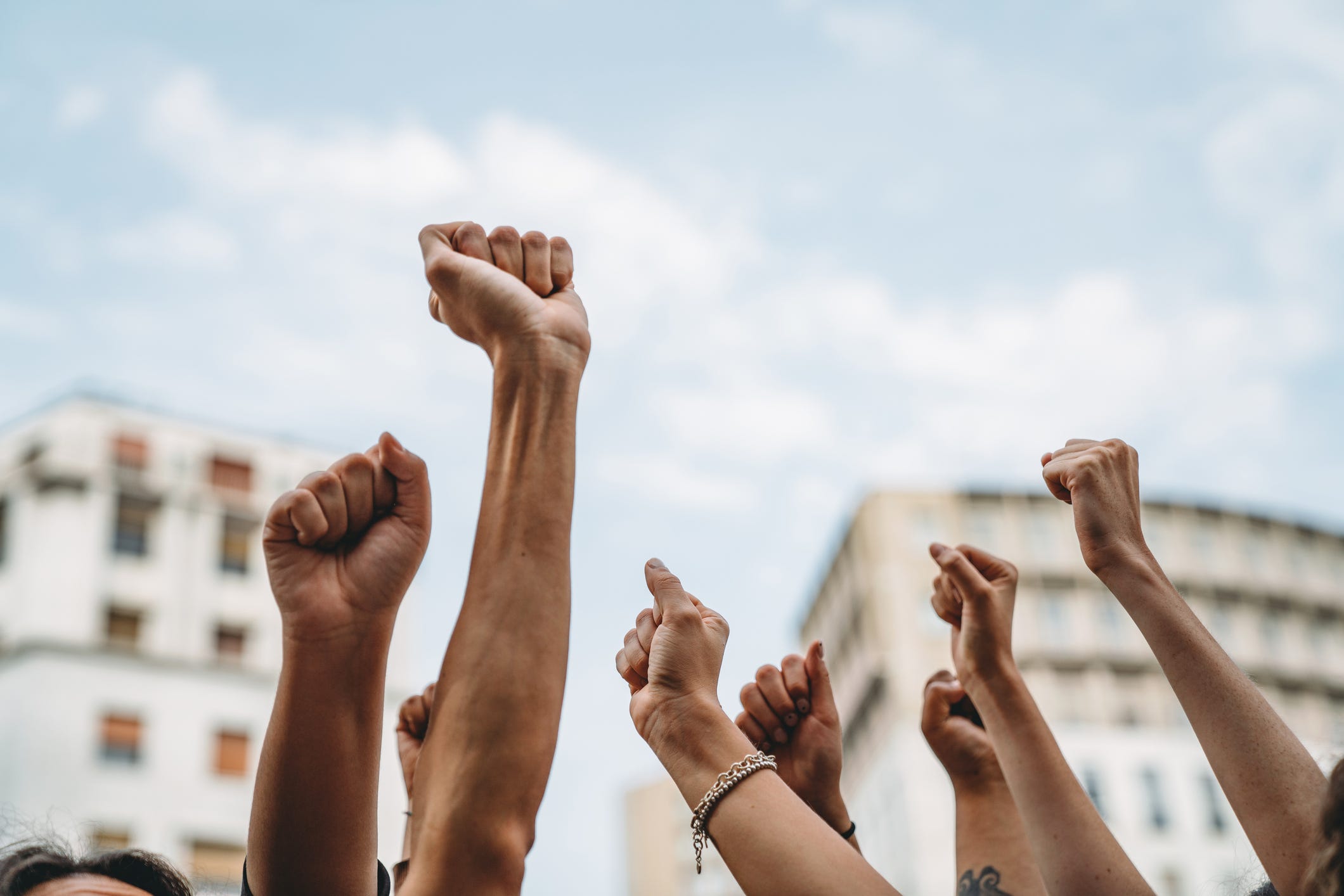
Each story sends its own message. Together, they teach a generation something far more dangerous: that legitimacy, outrage, accountability, and even democracy itself are often applied selectively.
Younger generations are not asking for perfection from institutions. We are asking for honesty about what people see and experience. Because the more institutions insist on maintaining narratives that contradict lived reality, the more alienated people become from the systems supposedly designed to represent them.
At a certain point, the problem is no longer whether institutions can survive criticism. The problem is whether they can survive being more committed to managing legitimacy than earning it.
Michael Franklin is the founder and chief thought leadership officer of Words Normalize Behavior, a speechwriting, executive communications, and coalition-building agency.

A refreshing and brilliant article that makes me rethink. Thank you. I notice that we Democrats are incapable of absorbing the reality that Republicans literally view us as the greatest threat to our country—a complete 180 projection, for sure. Yet their piece-meal attack and isolation on every one of our coalitions is remarkably effective. Disenfranchising Democratic voters, stealing our tax contributions while cutting our programs, cutting support for science, medicine ,and the arts, creating concentration camps for immigrants and ultimately political enemies, working towards essentially repealing the Emancipation Proclamation...these are all of one piece. We react separately to each one. That's our problem. Divide and conquer is working.
Michael, I agree with most everything you say, but what you don't say speaks volumes. How about all those non-voters, regardless of age or color? What does it take to effectively get people to realize that their non-voting is a major problem in that it enables organizations like the current so-called congress, so-called "supreme" court, red state governors and super majorities in their senates and houses, the billionaire press, etc. to erode all rights for me (us), but not for thee (them)?