


There’s something so seductive about the allure of a sheet-pan dinner. It promises convenience and nourishment, whole foods on a fast-food schedule. Of course, the sad reality is that most sheet-pan dinners I’ve made have ended up half steamed with a melange of ingredients whose ill-matched cooking times meant some were overdone and some raw—but it’s a beautiful concept, and when done well can truly make weeknight dinnertime a breeze.
With a calendar full of writing work, novel revisions, a baby due in November, and a very active 2-year-old, I’ve been in my convenience-cooking era big time lately. I’ve also been thinking about the things convenience cooking allows me to make time for—writing, supporting my friends and neighbors in truly terrifying times, all the ways I’m able to show up for myself and others when I’m not as bogged down by domesticity as I might be. Which made me wonder: Could sheet-pan dinners have a secret feminist history?
Well as it turns out, no—they mostly got popular because they looked good on Pinterest—but my search did lead me down a fascinating rabbit hole. Politics and food go hand in hand, and, as it turns out, convenience cooking might just have closer links to activism than I suspected.
Convenience foods and working women
During World War II, millions of American women entered the workforce. When the war ended, many of them wanted to stay there. Whether they kept their jobs because of a genuine interest in the challenges and rewards of the workplace or simply because of shifting economic realities like suburbanization and increasing consumer expectations, a growing percentage of American housewives were no longer quite as homebound as they once were.
Fortunately, a new wave of convenience foods was there to help usher in this new mode of feminine performance, also thanks to World War II. The production capacities of the industries that made frozen dinners, instant coffee, powdered mixes, and canned and dehydrated foods were dramatically expanded during the war to feed the troops, while convenience cooking technologies such as plastic wrap, Teflon pans, and microwave ovens were either innovated or perfected.
All these technologies cut down on the time women had to spend in the kitchen, but they didn’t change the fact that women were still considered responsible for feeding their families and maintaining their homes. A new pernicious expectation arose that women could (and should!) have it all—raising children, bringing home money by working, at least part time, and getting a hot (if microwaved) meal on the table every night. All of this would be challenged in just a few years by the rise of the feminist movement, which had different ideas about cooking.
Cooking and Connection: Feminism in the Kitchen
As early as the 1800s, suffragists were fundraising through a uniquely feminine form of self-publication: the cookbook. Titles such as “The Woman Suffrage Cookbook” claimed to combine “thoroughly tested and reliable recipes for cooking, directions for the care [of] the sick, and practical suggestions, contributed especially for this work.” Once more, political progress and domestic performance were closely linked. Let your wife vote, these books seem to suggest, she’ll still make sure to have dinner on the table.
In the ’60s and ’70s, female cookbook authors, including Anna Thomas and Laurel Robertson, positioned a healthy, vegetarian, whole-foods diet as central to the project of revolution and removing oneself from the worst excesses of the American processed-food system. A wave of women-run collectively owned cafes followed, and, by the 1980s, books like the Bloodroot Collective’s “Political Palate: A Feminist Vegetarian Cookbook” explicitly linked radical politics and wholesome cooking.
Of course, the only problem with this kind of politically driven back-to-the-land eating is that it takes time, and a lot of it. My mother cooked frequently from Thomas’ “The Vegetarian Epicure” when I was growing up, and her delicious honey-sweetened brown bread that filled the air with the coziest smells on rainy days really put the labor in labor of love. For me, to cook simply in trying times is about combining the lessons of these eras with recipes that are simple and quick to execute but still nourishing, healthy, and not quite as explicitly linked to the old-fashioned military-industrial system.
Bringing it All Back Home
So what does political cooking look like in this particular season of American life? For me, the sheet-pan supper just might be a top contender. Requiring minimal effort beyond turning on the oven and a little chopping, it takes longer to assemble than a Hungry Man dinner but still leaves you plenty of time to get other things done.
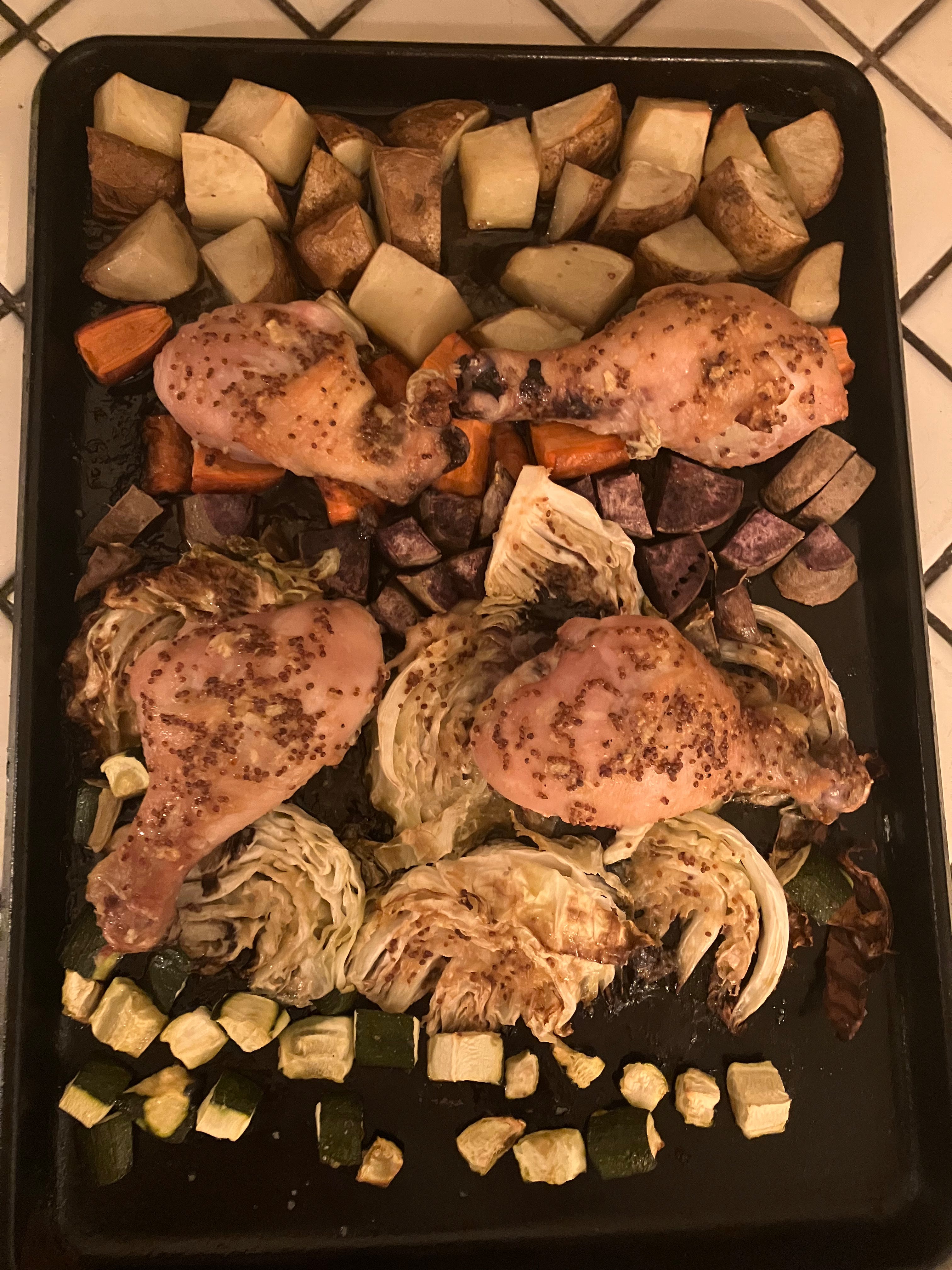
For this recipe, I wanted a sheet-pan dinner that transcended the form and felt a little bit special, so I incorporated two sauces. The first is a honey mustard glaze that goes on for the second half of the cooking time, caramelizing into a sweet yet spicy coating on all those virtuous vegetables. The second is a quick salsa verde made with roasted garlic from the pan, brightening and enlivening and bringing a welcome burst of energy to this comforting plate.
Life has felt particularly exhausting for many of us lately. If you’re among that group, I hope this recipe helps you keep your chin up and your belly full as you fight the good fight.
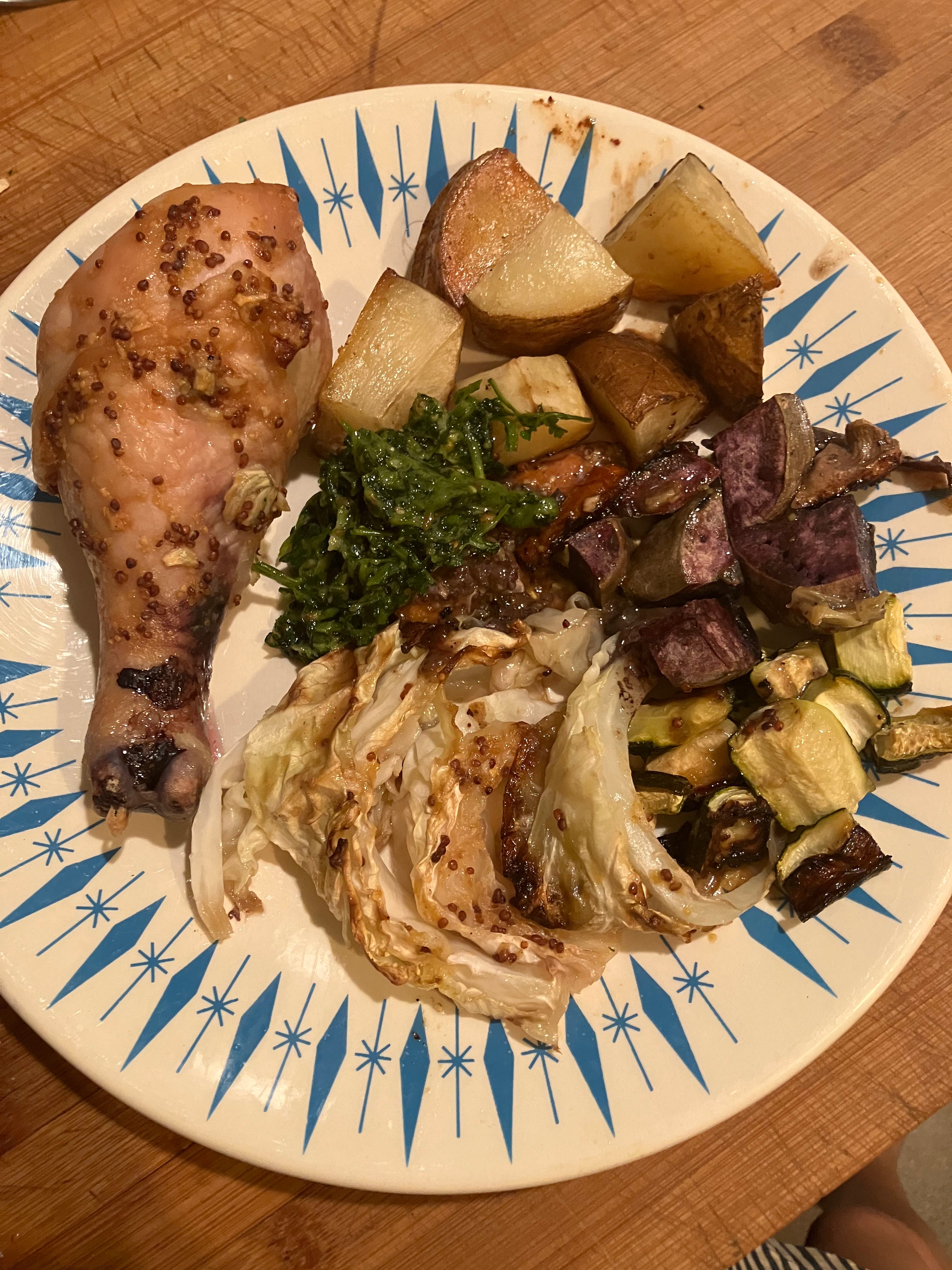
Fight The Man Sheet-Pan Supper
Note: for convenience, you can also prep your sheet-pan contents in the morning and store in the fridge until you’re ready for dinner. That’s what I did, and it was delicious.
Base:
Root vegetables of choice, cut into 1- 2-inch cubes. I used one russet potato, one purple sweet potato, one zucchini, and a big carrot.
Greens of choice. I used half a small cabbage cut into 1-inch wedges.
Chicken legs, one per person
One head of garlic
Neutral oil of choice
Sprinkle kosher salt
Honey Mustard Glaze:
1 tbs each dijon and seedy mustard
1 tbs honey
1 tsp olive oil
Pinch kosher salt
Salsa Verde:
Reserved roasted garlic from pan
½ cup tender green herbs—cilantro, parsley, chives, mint, whatever
Splash red wine vinegar
Splash olive oil
Pinch kosher salt
Method:
Preheat your oven to 425. Chop all your root vegetables and wedge your cabbage, if using, and add to the pan with unpeeled garlic cloves before drizzling everything with oil and sprinkling with salt. Top with seasoned chicken legs and bake for 20 minutes.
While your pan is in the oven, prep your honey mustard glaze by stirring together the mustards, honey, and oil with a pinch of salt. Remove pan from oven after 20 minutes and brush vegetables and chicken with the glaze before returning to the oven for 15 more minutes.
Take your garlic cloves off the tray and allow to cool, mixing the softened garlic with your finely chopped herbs and olive oil and vinegar and salt to taste. Serve alongside your veggies and chicken for dipping.
Emily Beyda’s writing has appeared in the Los Angeles Times, Built, Refinery29, Smartmouth, Fodors, the Thrillist, the Austin Chronicle, and more. Her novel, “The Body Double,” was published in 2021.

Looks delicious! Beautiful presentation!
Totally dating myself (perhaps your mother’s age), but I own and still cook from The Vegetarian Epicure (favorite Cheese & Scallion Quiche) and The Political Palate! Definitely love sheet pan dinners; thx for posting a recipe! Yum :)