


Defense Secretary Pete Hegseth went to Capitol Hill on Tuesday seeking nearly $70 billion more to sustain the war with Iran and replenish depleted weapons stocks. He could explain what the Pentagon needed to buy — rocket motors, precision-guided bombs, hypersonic missiles, counter-drone systems. He was less successful at explaining what those weapons would accomplish.
Senators from both parties pressed him on whether the administration intended to escalate further and whether the requested money would be enough to finish the job. Sen. John Kennedy, the Louisiana Republican, finally demanded, “Guys, we need straight answers.”
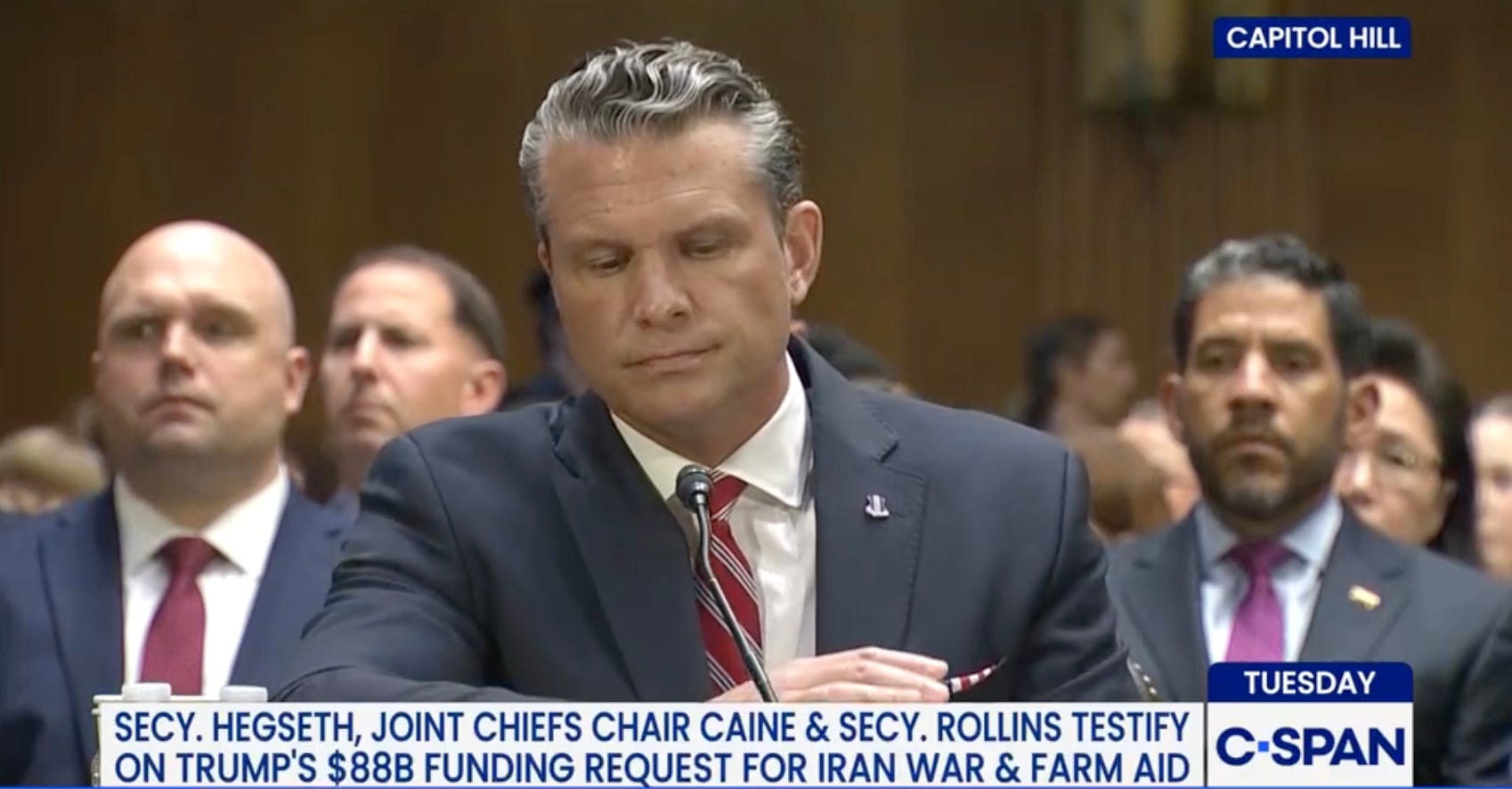
Hegseth repeatedly returned to familiar themes: peace through strength, the failures of the Biden administration, and the need for “the right bombs at the right time.” Gen. Dan Caine, the chairman of the Joint Chiefs of Staff, supplied the hearing’s most candid assessment. Asked whether bombing alone could achieve the administration’s objectives, he acknowledged that “air power’s got limits.”
The exchanges captured the problem confronting the Pentagon. Hegseth can describe the weapons he wants, the officers he distrusts, and the image of military strength he intends to project. He remains far less clear about how force will produce whatever results President Donald Trump is promising on any given day.
Trump is not a passive observer of that failure. He chose the war, defined its objectives, and repeatedly escalated it when Iran refused to yield. When American troops are killed, he promises that Iran will pay “many times over.” When Tehran absorbs another round of bombing and retaliates, he orders another day of attacks.
The United States is therefore spending tens of billions of dollars on a campaign driven by Trump’s conviction that greater destruction will eventually produce surrender. Iran has not surrendered.
Ukraine presents a different picture of wartime leadership — hardly flawless, but still centered on how to fight more effectively.
Mykhailo Fedorov, the 35-year-old technology reformer who served briefly as Ukraine’s defense minister, pushed drones, battlefield data, procurement reform, and the flexibility required to turn limited resources into battlefield results. As a result, Russian forces have failed to achieve a decisive breakthrough, while Ukraine’s sophisticated drones have struck troops and supply lines near the front and military targets inside Russia. CIA Director John Ratcliffe estimated last week that a Russian recruit arriving at the front is expected to survive only 20 to 30 minutes before being killed or wounded.
Ukraine has not won the war. Russia continues to bombard cities and deliberately target civilians, while Kyiv still faces severe shortages of manpower and air defenses. But Ukraine has shown that a smaller military can hold off a larger one by adapting faster.
That was what made President Volodymyr Zelenskyy’s decision last week to fire Fedorov difficult to understand. The dismissal followed an increasingly bitter feud between Fedorov and Gen. Oleksandr Syrskyi, Ukraine’s top commander. Forced to choose between them, Zelenskyy initially protected Syrskyi and removed the official most closely associated with Ukraine’s battlefield transformation.
The decision triggered days of rare wartime protests, joined by soldiers, parliamentarians, and veterans — even active senior commanders. Critics accused Syrskyi’s hierarchy of relying on outdated methods, discouraging initiative and rewarding loyalty over battlefield performance. Fedorov publicly charged that the high command had obstructed military reform.
Zelensky badly mishandled the dispute. But he did something Trump has shown little capacity to do: He listened to evidence that his judgment had been wrong and changed course.
After days of meetings with commanders and advisers, Zelenskyy on Tuesday night chose Mykhailo Drapatyi to replace Syrskyi as commander-in-chief. Drapatyi, 43, belongs to a generation shaped by Ukraine’s wars rather than Soviet military doctrine. He has promoted reform in recruitment and training, expanded the use of wartime innovation, and emphasized accountability.
Zelenskyy has not reinstated Fedorov, who reportedly rejected an alternative role overseeing military innovation outside the Defense Ministry. But selecting Drapatyi means Zelenskyy has accepted much of the argument Fedorov, who welcomed the appointment as “a breath of fresh air and new hope,” and the protesters had made.
The contrast with Washington these many months is hard to miss. Zelenskyy made a consequential mistake while managing a war he did not choose, but he acknowledged the misstep by replacing a trusted commander with one associated with reform and accountability.
Trump chose the Iran war. Presented with mounting costs, casualties, depleted weapons stocks, and evidence that bombing has not achieved his objectives, he escalates. Presented with warnings about Hegseth’s leadership, personnel removals, and politicization of the officer corps, he leaves his defense secretary in place.
Hegseth’s conduct in the days before Tuesday’s testimony offered fresh evidence of what Trump is tolerating. He returned to his campaign against facial hair, scrutinizing military promotions, and announcing mandatory annual testosterone screening for troops over the age of 30. He promoted the initiative as part of a “High-T Department of War” to keep American forces on the “leading edge of lethality.”
A president — and a Republican-led Congress — serious about strategy would be demanding explanations for the gap between tons of expended ordnance and Iranian resilience. Trump instead returns to threats of more airstrikes without defining what they are meant to achieve while Hegseth increasingly defines military effectiveness through masculinity, grooming, ideological pedigree, and displays of destructive force. Hegseth’s rhetoric fits the president’s view of military power: the larger the explosion and harsher the language, the stronger the policy appears.
Zelenskyy’s reversal does not erase his original mistake — or those of the past. It shows that he understood the purpose of wartime leadership: not to appear infallible, but to recognize when a decision is jeopardizing the ability to fight.
Trump has reached no similar reckoning. He is not merely tolerating Hegseth while the Iran war drifts. Trump is driving the war, supplying the threats, and embracing the same assumption that destructive power is proof of strategic success.
Military superiority cannot compensate for civilian leaders who mistake theater for strategy, belligerence for competence, or money spent with objectives achieved. Ukraine’s survival has depended on its capacity to learn faster than its enemy — and, when necessary, to correct mistakes at the top. In Trump’s and Hegseth’s Pentagon, resilience and victory increasingly seem linked to looking and sounding like John Wayne.
Brian O’Neill, a retired senior executive from the CIA and National Counterterrorism Center, is an instructor on strategic intelligence at Georgia Tech. His Safehouse Briefing Substack looks at what’s ahead in global security, geopolitics, and national strategy.

Of course, when you have a reality TV star as Commander in Chief, and a Defense Department headed by a Fox talking head, you should expect an emphasis on theater over strategy, of content over competence. I feel sorry for our military personnel, having to try to operate in a Middle Eastern war while navigating past these two boobs. The only place these two are leading us is into disaster. Sadly, we deserve it, for having elected a dumpster fire president.
If the war has cost $37.5 billion so far, why does he need $70 billion to replace what they lost?
My best guess is that it's cost a hell of a lot more than 37.5