


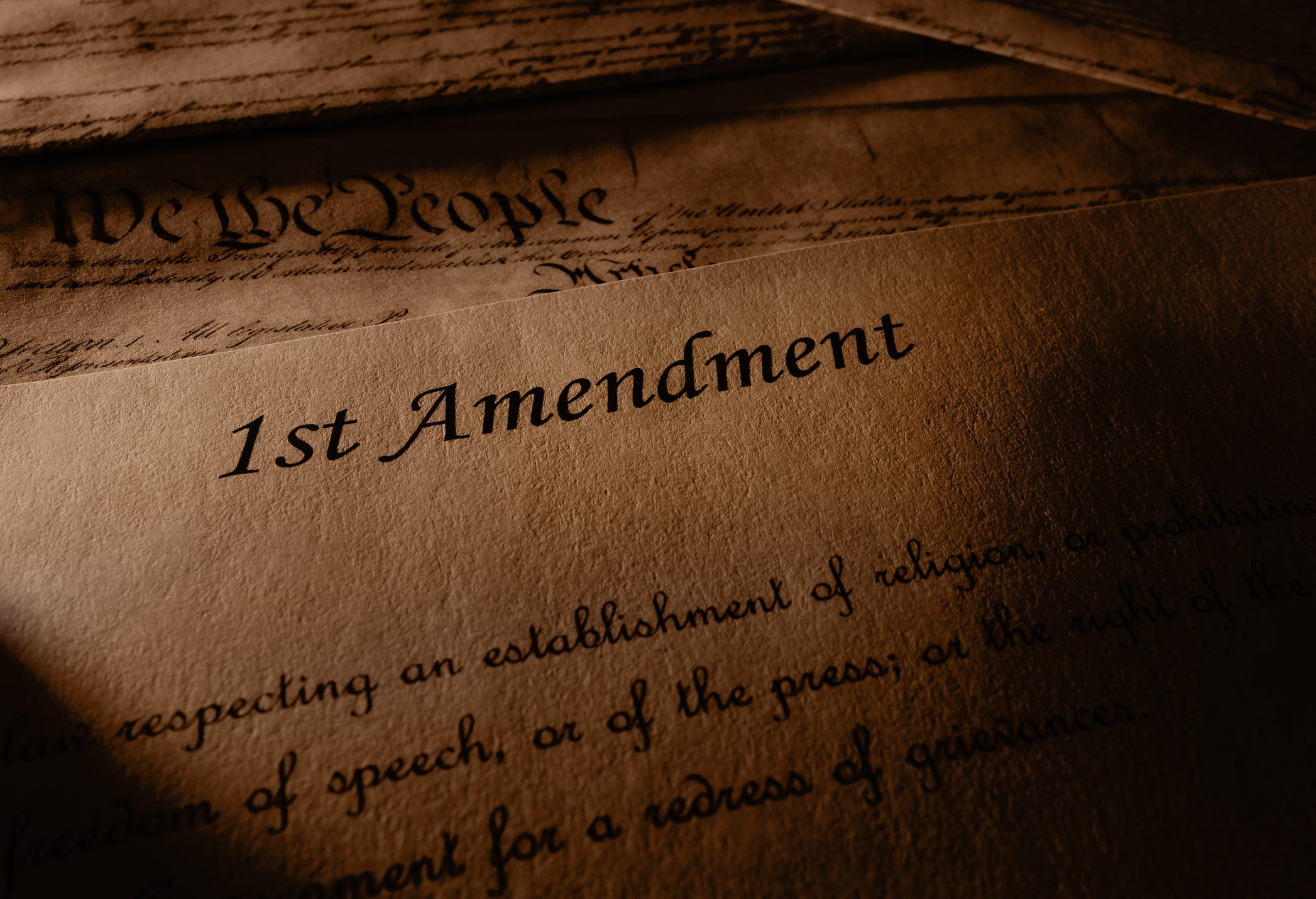
The United States may be turning 250, but some things many people think of as fundamental to the country’s founding aren’t quite there yet. Take the first 10 constitutional amendments, which were ratified in 1791.
The First Amendment contains five protections:
Congress shall make no law respecting an establishment of religion, or prohibiting the free exercise thereof; or abridging the freedom of speech, or of the press; or the right of the people peaceably to assemble, and to petition the Government for a redress of grievances.
Multiple parts of this amendment are often grouped together colloquially as “freedom of expression.” Many of us think of the Constitution as the reason we have this freedom. The reality is different.
Amazingly, just about every country has something similar in its constitution — even the most draconian, non-democratic nations.
North Korea’s constitution promises these things, but in reality the “hermit kingdom” exerts absolute control over its population and provides no such protections. China makes a similar guarantee, though in practice Beijing has some of the world’s most extensive operations cracking down on people and the media.
Qatar’s constitution vows freedoms of expression and the press “in accordance” with laws, but there are no such freedoms, and criticism of its leaders is banned. Iran, meanwhile, barely even bothers to pretend. Its constitution includes “freedom of expression and dissemination of thoughts” and says, “Publications and the press have freedom of expression,” but both come with the giant caveat that the government gets to make exceptions based on Islamic criteria. The nation’s nightmarish prisons are filled with people arrested and often executed for speaking out against the Islamic regime.
What makes democracies different are the legal structures enforcing constitutional freedoms. When the power lies with the people through voting, the people can demand that those structures remain robust and active.
There’s nothing “left” or “right” about this. Throughout America’s history, people of different political persuasions have fought against government encroachment into freedom of expression.
James Madison drafted the First Amendment in 1789. He and others believed it was not enough to just establish freedom to speak; the government also had to guarantee the rights to publish and disseminate information. He wrote, “freedom of the press, as one of the great bulwarks of liberty, shall be inviolable.” Though the language shifted before passage, there was little debate over this issue among lawmakers, according to congressional records.
But challenges to that freedom began soon after. In 1798, Congress passed the Sedition Act. “The Federalists sought to suppress dissent and criticism of the government,” the National Constitution Center explains.
Since then, there have been legal battles in every generation. It took until 1925 for the Supreme Court to establish that states are constitutionally barred from infringing on freedoms of speech and the press. Just about every (probably every) presidential administration has been accused of infringing on those rights.
President Barack Obama used an array of tactics, including the 1917 Espionage Act, to go after journalists and their sources. Numerous news agencies called out his administration. President Donald Trump regularly calls the media “the enemy of the people.” He has used access restrictions and personal lawsuits against news agencies, moves widely seen as attacks on press freedom.
Battles happen at the state level as well. FIRE, the Foundation for Individual Rights and Expression, is fighting California over a state law penalizing anyone “who disseminates information relating to a sealed arrest,” including a journalist who obtains the information legally.
Fortunately, in the big picture, our freedoms of speech and the press remain firmly in place. They’re the reason I can write this and you can both read and share it. They’re the reason I’ve been able to create my podcast, They Stand Corrected, fact-checking the news.

There’s never a guarantee that freedom will last. It’s up to citizens to demand that our leaders uphold and respect these rights. This is where the strength of democracy lies. Through political engagement, we can vote for leaders who value what we value. And we must value these freedoms.
In fact, we must ensure that we have a government that actively protects press freedom, not only from internal threats but from external ones as well. This year, two American men pleaded guilty and were sentenced in a plot by the government of Iran to assassinate an Iranian-American journalist who dared to speak out.

Democracy is the exception, not the rule. Three-quarters of humanity currently lives in autocracies, according to the latest annual report from V-Dem. In parts of the world, the figures are even worse. “The Middle East and North Africa is the most autocratic region in the world. Only 2% of the population reside in an electoral democracy — Israel,” the report says.
Upholding democracy isn’t easy. We have to demand it. And free expression is one of its most essential cornerstones. As the Supreme Court Justice Louis Brandeis wrote in 1927, the founders “believed that freedom to think as you will and to speak as you think are means indispensable to the discovery and spread of political truth” and that “public discussion is a political duty.”
To fulfill this duty, citizens need the facts. That’s why I can’t stand the constant onslaught of inaccuracies and lies from the media. News giants have precious freedom to deliver the truth; there’s no excuse for failing to.
As we kick off the next century of America’s existence, we have the chance to strengthen it. To demand truth from the media while protecting its freedom from government interference. The more we do that, the more we’ll turn the promises of the Constitution into reality.
Josh Levs is host of They Stand Corrected, the podcast and newsletter fact-checking the media. Find him at joshlevs.com.