


The Supreme Court’s ruling to allow Alabama to use a congressional map found to be racially discriminatory indicates that the conservative justices are following a single principle: Do whatever it takes to help the Republican Party. Even for a court that has already undermined voting rights, Tuesday’s decision was stunning in its disregard of basic constitutional and judicial principles.
The litigation over the Alabama election districts has stretched over many years. In 2023, in Allen v. Milligan, the Supreme Court upheld a lower court’s determination that Alabama’s election districts disadvantaged Black voters in violation of Section 2 of the Voting Rights Act. That provision forbids state and local governments from having election systems that have the effect of disadvantaging voters of color.
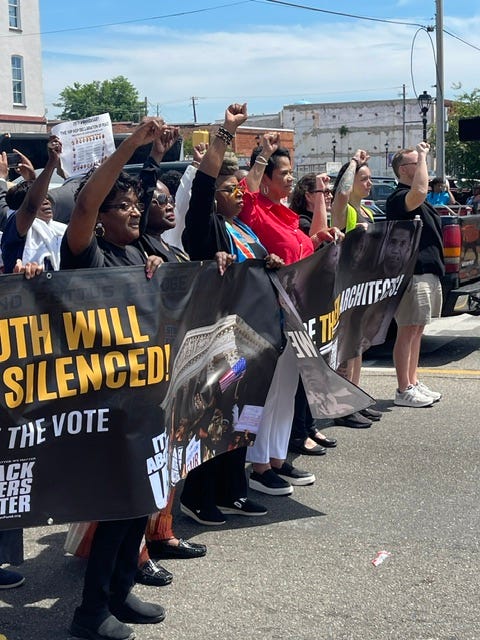
Alabama then drew a new map for congressional districts. A federal court held an 11-day hearing, with 51 witnesses, and volumes of submitted written testimony. That court concluded that the new map also discriminated against Black voters, again violating Section 2.
On April 29, in Louisiana v. Callais, the court effectively gutted Section 2, saying that proof of a racially discriminatory impact was not sufficient to establish a violation of the law; there must be proof of a racially discriminatory intent. After this, the Supreme Court sent the Alabama case back to the federal district court for reconsideration.
Challenges to election districts are heard in a three-judge federal court. On May 26, a federal court ruled that Alabama’s 2023 congressional district maps intentionally discriminated against Black voters. The court declared, “Ultimately, we cannot see our way clear to requiring Alabamians to cast their votes in the 2026 elections under a districting plan tainted by intentional race-based discrimination.” The court said “We do not lightly intrude in state affairs, but our previous review of the undisputed evidence left us in no doubt that Alabama’s legislatively enacted plan (the ‘2023 Plan’) intentionally discriminated based on race in violation of the Constitution.... We again cannot understand the 2023 Plan as anything other than intentionally discriminatory.”
Although the Supreme Court has been hostile to voting rights, it still is astounding that it reversed the district court’s conclusions. Most important, in Callais the court was explicit that proof of a racially discriminatory intent would be sufficient to prove a violation of the Voting Rights Act. And, apart from that statute, the Supreme Court long held that it violates the Fourteenth Amendment’s guarantee of equal protection for the government to draw election districts based on race. That is exactly what the federal court found Alabama did. Ironically, the first paragraph of the Supreme Court’s decision on Tuesday in Allen v. Milligan spoke of “our colorblind Constitution,” yet the conservative justices ignored the overwhelming evidence that the Alabama legislature acted based on race to harm voters of color.
The court’s explanation for doing so makes little sense. It said that the federal district court did not “heed the presumption of legislative good faith,” the requirement that courts assume that legislatures act in good faith in drawing election districts. But this ignores the district court’s lengthy hearing with voluminous evidence, leading to a 78-page opinion detailing the basis for its conclusion that the Alabama legislature intentionally discriminated based on race. As Justice Sonia Sotomayor observed in dissent, the district “more than adequately accounted for the presumption of legislative good faith.... The record is crystal clear.”
The fact-finding of a federal district court can be overturned only if the appellate court concludes that it was “clearly erroneous,” a difficult legal standard to meet. But the Supreme Court’s short opinion does not even attempt to argue that the district court erred in its conclusions of intentional race discrimination.
Instead, the court said that “the District Court was required to deny relief unless the plaintiffs’ alternative map ‘performed ‘just as well’ with respect to all of the State’s constitutionally permissible districting criteria.” In other words, this says that the only way the court could have declared race-based districting unconstitutional would be if there were a race-neutral map that would achieve all of the Republican-led Alabama legislature’s goals. What if there was no way to draw a map that did this except by impermissibly using race? That surely should not be a basis for accepting an unconstitutional government action. If a districting map violates equal protection, it should be deemed unconstitutional. Period.
Finally, in an argument of remarkable hypocrisy, the Supreme Court said that the federal court should not have granted relief because “[w]e have repeatedly cautioned that lower federal courts should not ‘alter the election rules on the eve of the election.’” The constitutional basis for this has never been explained by the Supreme Court. Why should unconstitutional or illegal restrictions on voting be allowed just because the challenge is being heard soon before the election?
But the court totally ignored this concern in its Callais decision. Mail-in ballots in Louisiana already had been sent and early voting was to begin within a few days. Nonetheless, the Supreme Court paid no attention to this principle, and Justice Samuel Alito’s majority opinion did not even mention it. The day after the Supreme Court’s decision, Louisiana Gov. Jeff Landry suspended the congressional primary but allowed primaries for other offices to occur as scheduled on May 16. Contrary to the Purcell principle, the Supreme Court dramatically changed congressional elections in Louisiana very near an election.
The Supreme Court’s ruling has triggered changes in other states that are in the midst of their primaries. Florida, for example, passed a new map for congressional districts while its primary process was underway. Tennessee’s legislature passed a new map on May 7, even though candidates had to qualify in March to run.
It thus is impossible to read the Supreme Court’s ruling in the Alabama case without seeing it as conservative justices abandoning the Constitution and basic legal principles to allow Alabama to create one less majority Black district and an additional district that is likely to be controlled by Republicans. Justice Sotomayor was right in her dissent that the court’s majority “disregard[ed] both democratic values and the rule of law.”
We should expect much better from the Supreme Court.
Erwin Chemerinsky is dean and Jesse H. Choper Distinguished Professor of Law at the University of California Berkeley School of Law.

This court is an activist court. They gutted the VRA without any oversight whatsoever. I like Doug Jones’s idea to elect these justices so they have term limits like every other federally elected office. Congress should be a balance on the Supreme Court.
I no longer live in Alabama, but I am determined to make SCOTUS reform my main demand of every elected official who has sway. State boundaries don't exist anymore when it comes to the voting rights of every American.